
Identification is the very first step in our "3 Steps to Discovering Nature" concept. However, identifying insects can be a challenge. That's because so many kinds of insects exist that no convenient, easy-to-carry and easy-to-use field guide is possible. There are indeed guides to insect identification, but either they consider only a small fraction of the insect species conceivably to be encountered, or else are so technical that it's hard to use them.
USING BUGGUIDE.NET FOR IDENTIFICATION
If you own a digital camera you can have your digital pictures of insects identified online at BugGuide.Net.
At the above page register for free, then log in and click on "ID Request." On the resulting page click on "add image," and fill in the information boxes. When you come to the box called "Image" you need to tell BugGuide.Net where your picture is found in your own computer. Click on "Choose" at the right of that box, then navigate the subdirectories or folders of your computer until you find file holding your file. When you finish all the boxes and click on "Submit," in a few seconds your photo will appear at the head of the line of photos needing to be identified, and probably someone, someplace in the world, will let you know your bug's name.
The Peterson field guide A Field Guide to Insects does its best, illustrated with 1,300 drawings and 142 paintings, but in just the US about 91,000 insect species are known, while another 73,000 remain to be "discovered" by science. Clearly, the backyard insect-identifier needs to be ingenious and persevering. However, that's OK, since being ingenious and persevering is fun!
Here's a good general approach to identifying an insect of which you don't have the foggiest notion what its name is:
STEP 1: FIGURE OUT THE ORDER
Assign your discovery to one of the 25-35 insect orders. On our Insect Orders page we see that most insects found in our backyards belong to only ten or so orders, such as the Beetle Order, the Wasp & Bee Order, and the Fly Order Mastering those ten orders is no big deal. Remember that we provide a "Key to the Big Ten Insect Orders."
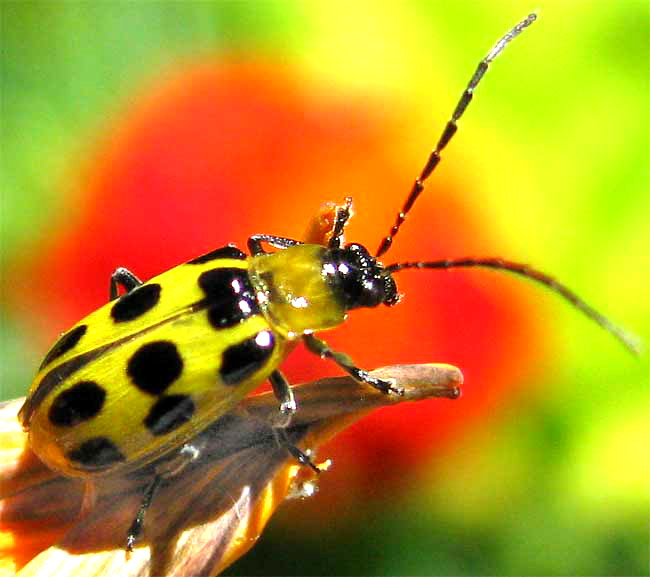
Most good field guides organize their pages so that members of the same order are grouped together. In other words, if you're trying to identify a member of the dragonfly/damselfly family, you don't have to plow through all the illustrations of butterflies, moths, wasps, bees, etc. It's easy to recognize the most common orders. For example, the biggest order, that of the beetles, has species with forewings, or elytra, hardened into a kind of shell, and meeting in a straight line over the back, just as seen on the Spotted Cucumber Beetle shown here.
STEP 2: FIGURE OUT THE FAMILY
Once you know that your unknown insect is a member of, say, the big, easy-to-recognize Beetle order, the Coleoptera, now try to figure out which of the world's 176 beetle families family of beetle you have. That's not as hard as it seems like.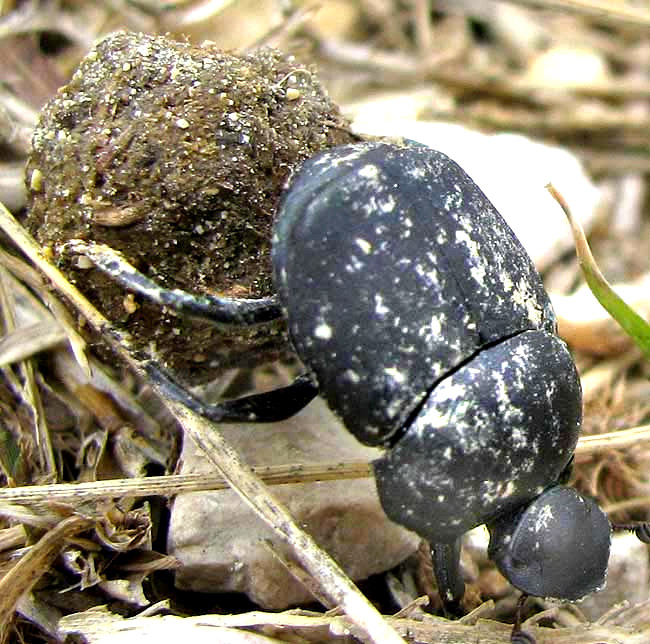 First, many of those 176 families won't appear in your area. North America has about 130 beetle families. However, as with the orders, only a few of those families commonly are encountered, and before long you'll learn those. For example, there's the Rove, Scarab, Blister and Stag Beetle Families. The dung beetle at the left, rolling a ball of cow poop, belongs to the Scarab Family. Lots of dung-rolling dung beetle species exist, and they're all in the Scarab Family.
STEP 3: USE YOUR FIELD GUIDE
Look for your insect's illustration in your field guide. Though only a small percentage of the species we might conceivably encounter can be illustrated in a handy field guid, the most common and conspicuous species are, and your unknown insect may well be one of those. For example, Monarch Butterflies are pretty common in much of North America, so nearly all North American butterfly field guides have a picture of the Monarch, and tell you that Monarchs are Danaus plexippus, members of the Danaidae, or Milkweed Butterfly Family.
STEP 4: USE AN INTERNET SEARCH ENGINE
Let's say that you've figured out that you have a member of the Narrow-winged Damselfly Family, the Coenagrionidae. Go to a search engine with an Image-Search function, such as Google or Yahoo!, and do a search on the word Coenagrionidae. Then you'll be presented with thumbnail pictures from sites all over the world posting images of species belonging to the Coenagrionidae. If you see a thumbnail looking like your critter, check it out. If you go to the web page holding the photograph, maybe there will be more information about it. After searching on Coenagrionidae, search on "Narrow-winged Damselfly," being sure to place the words within parentheses, or you'll end up with pictures showing everything narrow, everything winged, and everything about damselflies in general!
FINALLY, DON'T FORGET: There are special insect-identification web sites. A number of websites focus on special insect groups or provide online insect collections. Among them are: