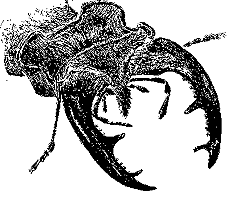
 The concept of "insect orders" is important for us backyard naturalists because all the world's millions of insect species can be pigeon-holed in them, and there is such a small number of orders -- maybe 25 to 35, depending on your expert -- that our brains can deal with that number. In other words, a good first step toward mastering insect diversity is learning to assign any insect we find anyplace in the world to its appropriate order.
For us backyard naturalists, this challenge is even easier than it seems. That's because about half of the orders are very small ones seldom encountered, or else species included in them appear only in habitats unlikely to occur in backyards. The vast majority of conspicuous insects backyard naturalists are likely to encounter belong to one of just ten orders -- the "Big Ten." The Big Ten is just a made-up grouping to help us learn the orders. It has no scientific status at all.
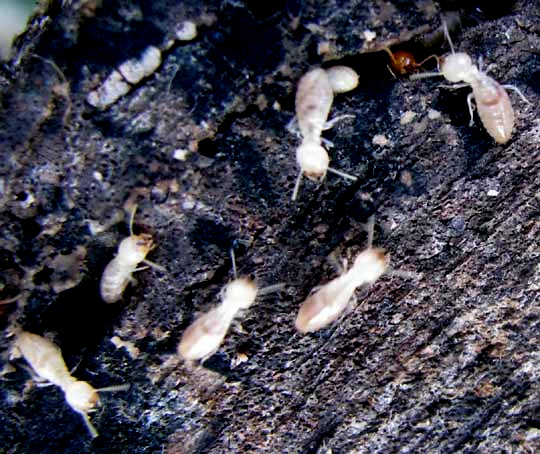 Termites, in older field guides are placed in their own order, but now are lumped into the cockroach order
In the following list of 28 insect orders listed on Wikipedia's Insect Orders page in June, 2021, the "Big Ten" orders are highlighted in red. However, if you count them, only eight orders in the list are red. That's because Wikipedia's list is more up-to-date than many insect field guides in circulation today. In Wikipedia's list, which volunteers try to keep updated, cockroaches and termites are lumped into a single order, while many books in circulation still place the termites in their own order, the
- Archaeognatha, jumping bristletails
- Blattodea, cockroaches & termites
Coleoptera, beetles Dermaptera, earwigs Diptera, flies - Embioptera, webspinners
- Ephemeroptera, mayflies
Hemiptera, true bugs Hymenoptera, wasps, bees, ants & sawflies Lepidoptera, butterflies & moths - Mantodea, mantises
- Mecoptera, scorpionflies
- Megaloptera, dobsonflies, alderflies & fishflies
- Neuroptera, lacewings, antlions & mantidflies
- Notoptera, "notopterids"
Odonata, dragonflies & damselflies Orthoptera, grasshoppers & crickets - Phasmatodea, stick insects
- Phthiraptera, lice
- Plecoptera, stoneflies
- Psocodea, barklice, booklice & true lice
- Raphidioptera, snakeflies
- Siphonaptera, fleas
- Strepsiptera, endoparasites in other insects
- Thysanoptera, thrips
- Trichoptera, caddisflies
- Zoraptera, angel insects
- Zygentoma, silverfish
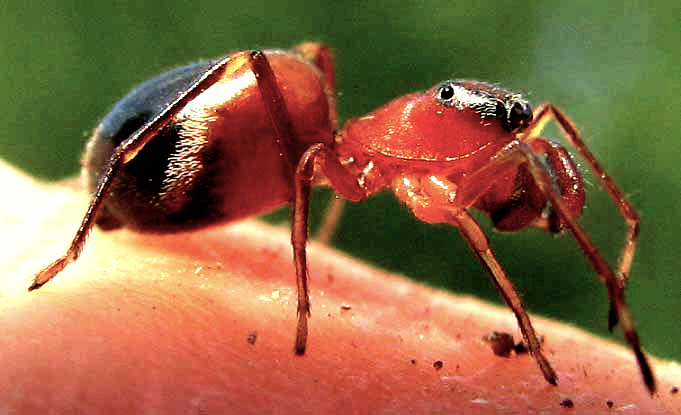 In Texas, a jumping spider mimics an ant, which helps it sneak up on its prey
Looking over the above list, it's easy to see why so many people "get hooked" on insects. It's because insects have so many strange manners of being. When you begin paying attention to insects, it's like going to another world where you find beings totally different from anything you've ever known, or even thought of. Even more mind-expanding is the fact that always, once you've studied what seems to be the insects' weirdness, their cruelty, or even their profound stupidity, you come to see that their manner of being is actually an exquisite adaptation for the ecological niche they occupy.
A good way to begin the insect-learning process is to print up our "Key to the Big Ten Insect Orders," go outside with your hand lens, and see if you can assign some insects to their orders.