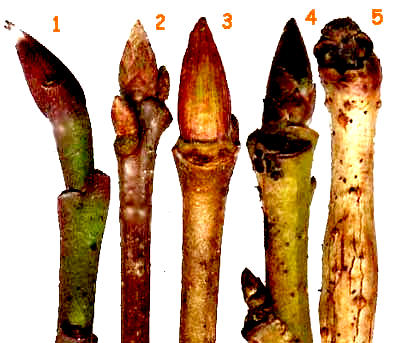
A glimpse at the five twigs shown at the right, randomly collected during a brief walk, is enough to convince us that each species has a certain kind of twig, and that with practice we can identify woody plants by their twigs.
Twig features have been described on our Woody Twig Exteriors page and our Leafscars page. Here, let's simply practice paying attention to twigs, using the above five twigs.
- #1 is Flowering Dogwood, Cornus florida, easy to know because of its greenish stem, opposite leaf scars (two leaves arising opposite one another), and a large terminal bud with no scales
- #2 is an oak twig (Water Oak in this case, Quercus nigra), with buds clustered toward the twig tip and covered with several scales
- #3 is a Sycamore twig, Platanus occidentalis, with a single big scale covering the bud
- #4 is a Sweetgum twig, Liquidambar styraciflua, featuring scaled buds as in the oak, but the buds don't cluster toward the twig tip the way oak buds do
- #5 is Honeylocust, Gleditsia triacanthos with buds very small, hardly distinguishable
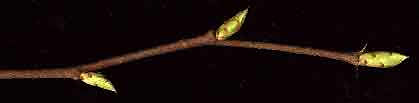
The above twig is from a Hophornbeam tree, Ostrya virginiana, as it appears in early spring when buds are expanding. All winter the buds had been tiny and brown but now the bud contents and the bud scales around them are enlarging and turning green. The bud scale tips are still brown.
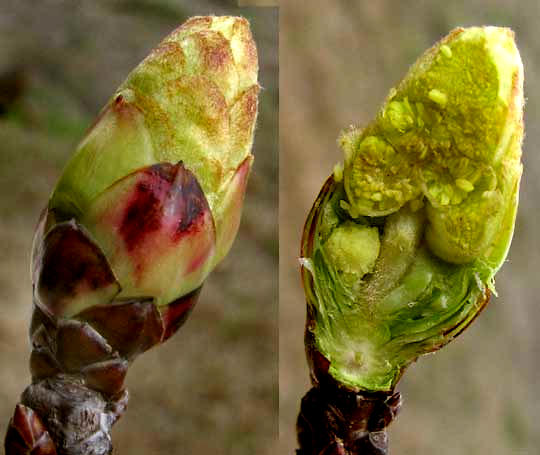
At the right are two views of a terminal bud a Sweetgum tree, Liquidambar styraciflua. In the picture's left side we see the entire expanding bud. On the right, the bud has been cut open to reveal a green, granular mass of material consisting of immature, fast-developing flower parts, mostly male stamens. The flower parts arise atop a thick, hairy stem, or peduncle. The spherical item on the peduncle's left side is a future head of female flowers, which eventually will develop into a spiny fruit. Around the peduncle's base, future leaves are layered over one another, and at the bud's bottom are brown-surfaced bud scales.
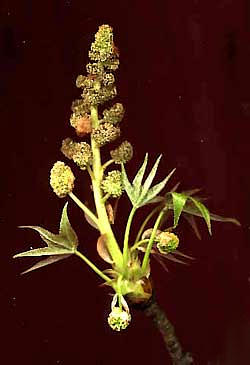
At the left, you can see how it all appeared a few days later.
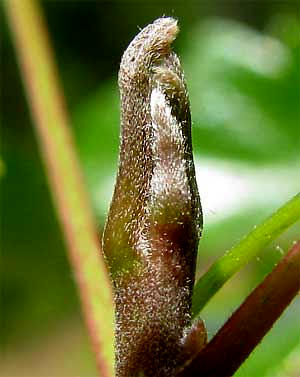
Many buds lack scales entirely, as seen at the right at the branch tip of a Poison Oak bush, Toxicodendron diversilobum. Instead of being protected by scales, it's hairy. In the hot tropics, most buds lack scales, and many of those aren't hairy either -- just naked leaves emerging in bunches at twig nodes.
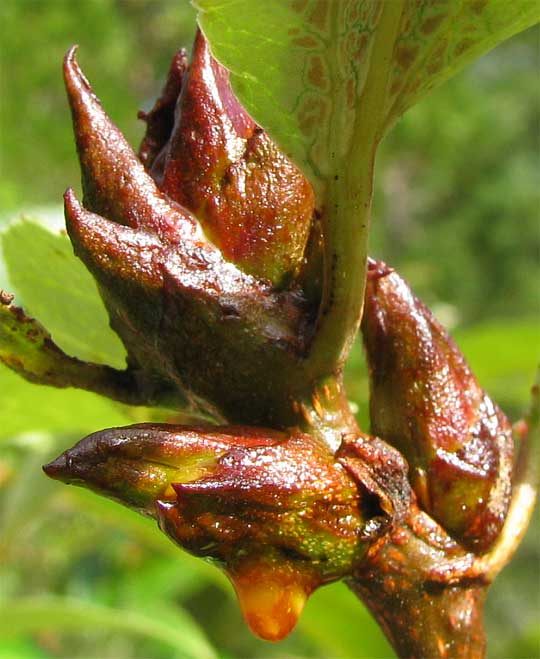
At the left, buds on a Black Cottonwood tree, Populus trichocarpa, are covered with very sticky resin. Such resin would keep bugs from eating the buds, because of the tar-baby effect, and maybe it protects against temperature extremes. A 2013 study by MB Wilson and others tells us that "Resins are complex mixtures of phenolic and isoprenoid compounds secreted by plants to provide protection against predators and pathogenic microorganisms." They point out that many organisms, including insects, birds, humans and, in their study, honeybees, collect and use resins as protection against pathogens and parasites.