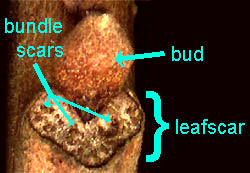
When leaves fall off before winter they leave leafscars on the twigs. At the right we see a leafscar on a twig of the Pecan tree, Carya illinoinensis. Note the dark bundle scars, resulting from the breaking of pipe-like vascular bundles that earlier passed between the twig and the former leaf's petiole. Vascular bundles consist of the plant's xylem and phloem, described on our Inside Woody Twigs page.
Now just look at the variety of leafscars and buds in the picture appearing below:
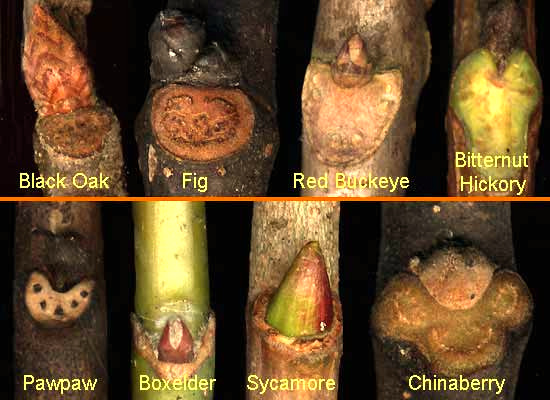
As you can see, leafscars and buds vary tremendously from species to species. Therefore, during winter they are great help to backyard naturalists identifying tree species using twig characteristics. In the above image, be sure to notice these features:
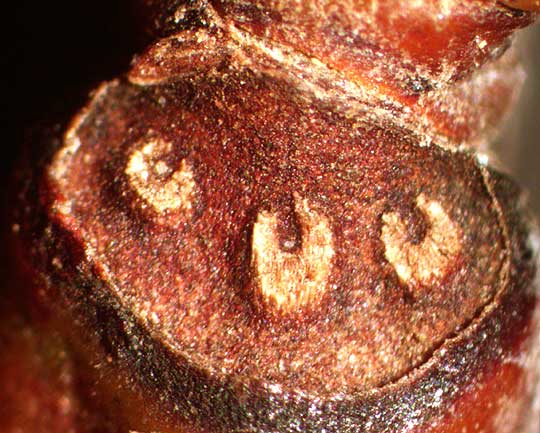 Leafscar of Sweetgum, Liquidambar styraciflua
- the Black Oak's bud bears many overlapping scales but the Sycamore just has one big scale
- the Fig's leafscar is oval, the Boxelder's V-shaped, and the Sycamore's almost circular
- vascular bundles are arranged differently from leafscar to leafscar. Notice how they are...
- neatly collected into five little dots in the Pawpaw
- but in three broad C-shaped regions in the Chinaberry
- some twigs like the Fig's and the Chinaberry's are thick, while others like the Boxelder's are slender
- twigs come in different colors -- such as the green Boxelder
You see? You really can identify woody species even after their leaves have fallen!