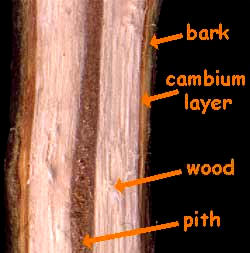
At the right you see a Pecan-tree stem cut down the middle lengthwise -- a "longitudinal section." The stem was a little thicker than a pencil. The terms "bark," "wood" and "pith" are general words we know from everyday life. However, the "cambium layer" is so special that it needs to be considered and admired, even though in the picture it's the least apparent -- almost undetectable -- feature. For, the cambium layer is the only living part of a woody twig.
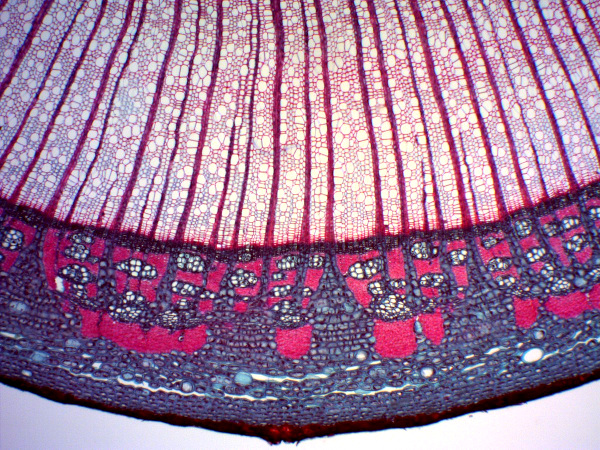 Cross section of stem of Tulip Tree, Liriodendron tulipifera; image courtesy of Plant Image Library, Boston, Massachusetts, USA
In the micrograph at the left, the cambium layer is the narrow, shallowly U-shaped, dark band of cells stretching across the middle of the photo. That's the part that's alive and you can see that it's only one or two cells thick. If somehow you could make all parts of a tree and its branches disappear, except for the living part, you'd end up with a tree-size, tree-shaped, pale greenish but almost transparent -- ghostly, maybe shimmering in sunshine -- much branching cylinder of cambium cells. Looking at a real tree, it's something beautiful to think about.
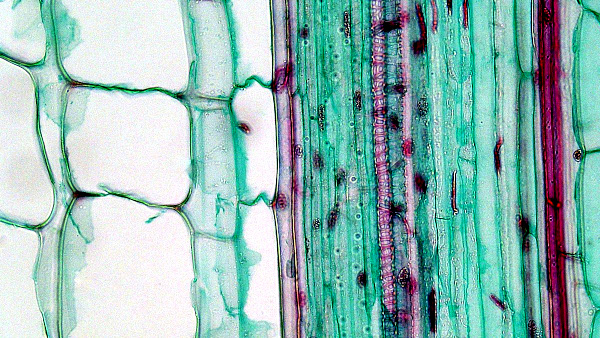 longitudinal section of stem of corn stem, Zea mays; image courtesy of Berkshire Community College Bioscience Image Library, Massachusetts, USA
In the above micrograph, cells below the cambium layer (toward the stem's exterior) are largely phloem cells, which conduct photosynthesized sugars and other products downward from the leaves. Above the cambium layer, (toward the stem's interior) are found xylem cells, which conduct water and dissolved salts upward from the roots. At the right, a micrograph shows a side or "longitudinal" view of xylem and phloem cells, enabling us to see how they connect together lengthwise to form tube-like "vessels" or veins.
Other kinds of cells than xylem and phloem appear in the above micrographs, because there's a lot going on in stems and twigs other than the transport work of xylem and phloem cells, such as food storage and physical strengthening. Also, there are different kinds of xylem and phloem cells. That's for Biology Class, though. Here we just tip our hats to twigs in general, and remind ourselves that much interesting stuff goes on inside every stem and twig everywhere all the time.
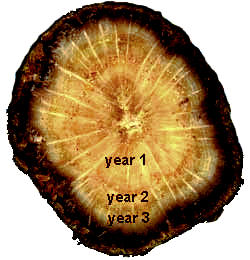
At the right, in a cross-section of a three-year-old stem of a Black Oak tree, Quercus velutina, you can see three growth rings, also called annual rings. On this twig the inner part of each ring is pale, consisting of wood deposited in the spring when the tree was growing fast, and the outer part is darker, consisting of wood deposited later in the year and winter, when the tree was growing slower. You can also see the pale pith in the stem's center. Piths in oak tree twigs often are vaguely star-shaped, as in the image. The light-colored streaks spreading outward from the pith are vascular rays involved with the lateral, or sideways, conduction of food and water. Vascular rays occur in other tree species, but they're seldom as conspicuous as among the oaks.
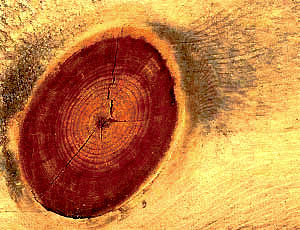
At the left you see a knot in a rough sheet of plywood. Here's how knots form:
When a twig develops on a main stem, its center vascular system stays connected with the main stem's vascular system as both the main stem and twig continue growing year after year. During this growth, the main stem's exterior must envelop the twig's base. A knot, then, is where the main stem's wood has grown around, merging with and enclosing the the branch's base within its own body. Annual rings inside the knot at the left show that the cut was made through a part of the tree's trunk that had been growing around, fusing with and burying the base of the elongating branch/twig in its own body for maybe 18-20 years.
In the above picture, around the knot, notice the ray-like lines. These lines also are growth rings, except that the main stem, the tree trunk, instead of being cut in cross-section as the knot/branch was, was cut length-wise.