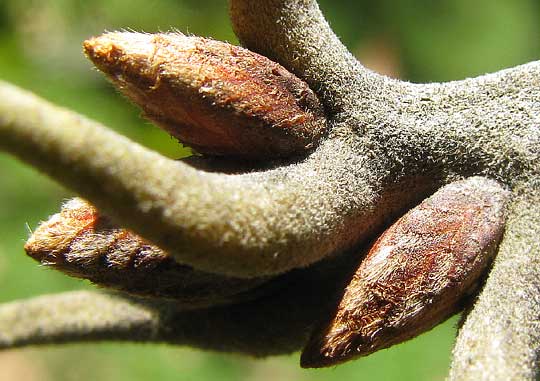
At the right, the tip of a late-fall twig of Black Oak, Quercus velutina shows plenty of interesting and distinctive features.
For example, the twig tip bears three brownish buds from which new stems and leaves will emerge in the spring. The buds are protected by numerous overlapping bud scales, though in most tree species with buds bearing scales (and all don't), the scales are less numerous, but maybe thicker and tougher. 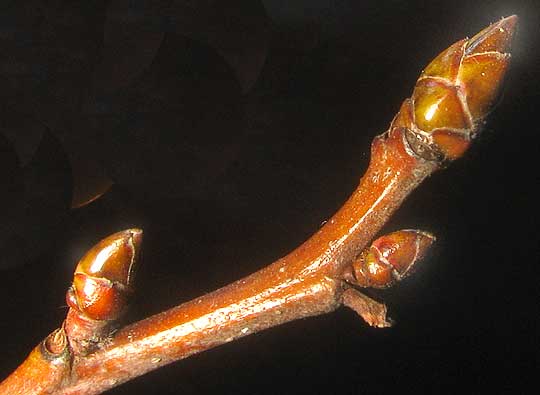 At the base of each bud arises a leaf petiole, soon to snap off when the leaf falls, leaving a leaf scar, which itself will be interesting and distinctive. The twig and petioles are heavily coated with silvery hairs which protect the stem from temperature extremes. At the left, look how different is the twig of a Sweetgum tree, Liquidambar styraciflua.
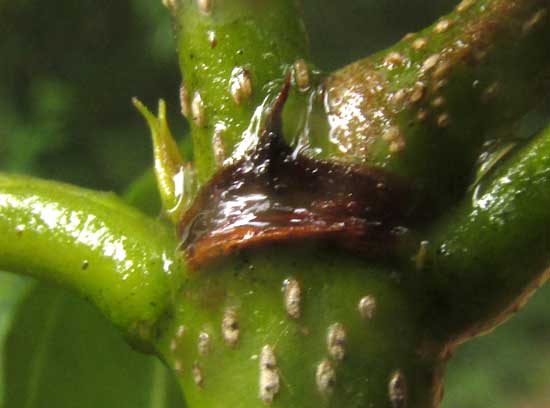
At the right, this mature stem of the tropical tree known as Chak Sab Che' in Yucatec Maya, Exostema mexicanum, stays green year round. At each stem node two leaves arise instead of the one leaf at each node of the above two species. The brown, ±triangular item is a stipule about to fall off, leaving a stipular scar connecting the two petioles. 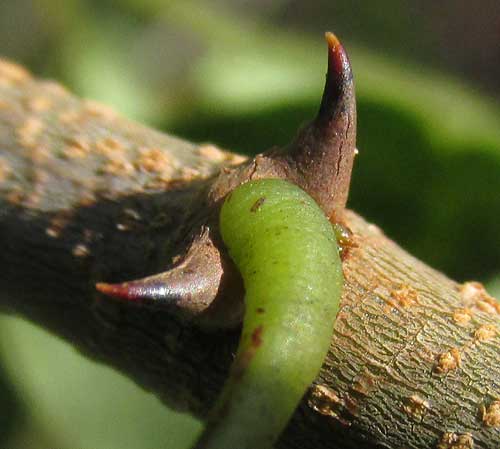 At the left, in the tropical Sphinga tree, Sphinga platyloba, stipules have been modified into hardened, very effectively defensive stipular spines.
On the above Chak Sab Che' stem, note that in the axil between the stem and the leaf petiole on the picture's left side, new leaves are sprouting where we might expect scaly buds. Chak Sab Che' is a tropical tree whose developing leaves don't need special protection from extreme temperature changes, so of what use are bud scales? Also, on both the Chak Sab Che' and the Sphinga, note the white bumps on the stems' surfaces. Those bumps are lenticels through which air can pass. They help the twig "breathe."
![Bull-Horn Acacia, VACHELLIA [ACACIA] COLLINSII, thorns with ant holes](n/10/100328ad.jpg)
Sometimes, as with the Bull-horn Acacia, Vachellia collinsii, shown at the right, a twig's stipular spines develop into spectacular thorns. The thorns on this tree are hollow and have holes in them, enabling ants to live inside the thorns. If the thorns aren't enough to keep a herbivore from nibbling on the tree, maybe ants rushing from the thorns and biting the animal's lips and tongue will be!
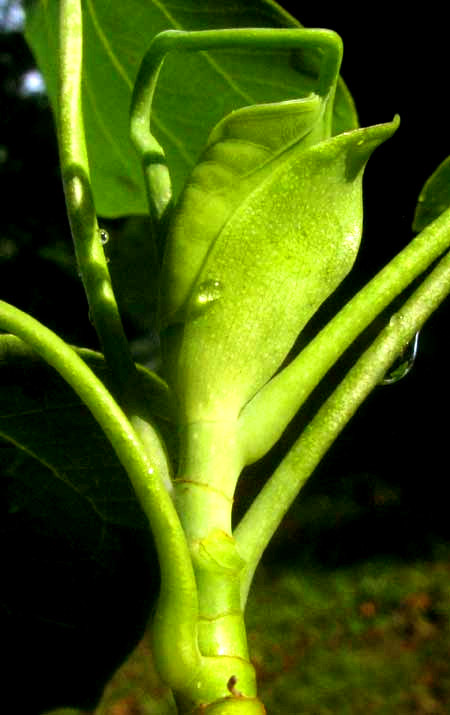
But, why do many kinds of twigs have stipules? At the left, a twig of the Tulip Tree, Liriodendron tulipifera, is providing an answer. Tulip Trees offer a special insight into the origin of stipules because Tulip Trees are members of the Magnolia Family, a "primitive" family which appeared so early during the evolution of flowering plants that today species in the family are neither considered monocots nor dicots.
The picture shows a Tulip Tree leaf as it unfurls in early spring. The bent, green stem at the picture's top is the leaf's petiole. The new leaf, with its blade folded like a sheet of paper, is being withdrawn upward by the elongating petiole. The folded blade is being withdrawn from within a green, leafy, sheath-like thing, which is the stipule. The stipule protects the leaf at this early stage of its development. The stipule itself is a modified leaf that will fall off as soon as the leaf is fully emerged. This is an example of the simple beginning of all those fancy stipules, stipular spines and more which eventually arose in more recently evolved species.
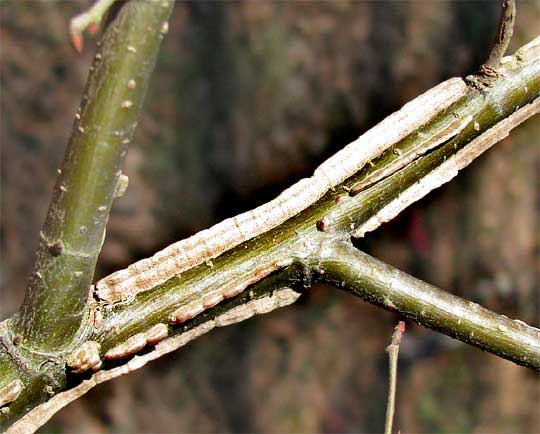
At the right, a twig of Winged Elm, Ulmus alata, bears tough, corky wings. It's not known why certain species develop such appendages. Maybe they provide structural strength, keeping the twigs from so easily snapping off. Or maybe they're thermal regulators, increasing twig surface area so intense sunlight doesn't cause heat to build up inside the twig, or maybe when it's cold they gather sunlight's warmth. Maybe they dissuade herbivores from grazing on the twigs, or maybe they accomplish all the above and more. Sometimes Sweetgum trees have them, sometimes not.
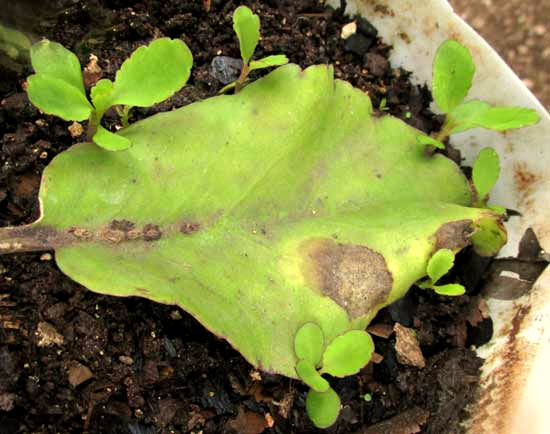
We end with what's shown at the left, which at first glance seems totally out of place on a page about the outside appearance of twigs. However, what's shown at the left is not a leaf producing sprouting new plants along its margins, but rather a phylloclade. Phylloclades are stem segments (read "twigs") which function as leaves. The phylloclade in the picture is from Bryophyllum pinnatum, which goes by a huge confusion of unstandardized English names.
Therefore, since phylloclade are stem segments, there's nothing strange about spouts forming along their margins, where each indentation represents a node, which is exactly where buds and sprouts form on typical twigs.
All this reminds us that Nature makes no effort at all to fit Her creations into the neat, narrow definitions and concepts we humans come up with.