PLANTS | ANIMALS | ECOLOGY | FUNGI | GEOLOGY | GARDENING | TOOLS
MEXICAN PLANTS & ANIMALS HOME

Excerpts from Jim Conrad's
Naturalist Newsletter
from the November 29, 2009 Newsletter issued from Hacienda Chichen Resort beside Chichén Itzá Ruins, central Yucatán, MÉXICOfrom the
TURK'S TURBANS/ TULIPANES
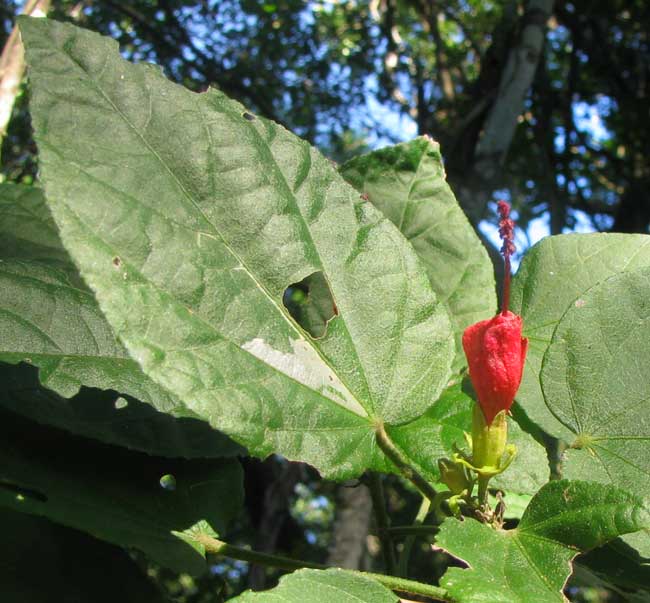
At the end of the rainy season the forest is lush, green and shadowy. It smells of mold. I assume that lack of sunlight on the forest floor is responsible for the paucity of flowering plants there, as well as this being the beginning of the dry season. Orchids and bromeliads are easy to find, but very rarely are they flowering. One head-high bush, however, is flowering, however, as shown above.
 Though this is a native Mexican plant very much at home in our reserve here, the English speaking world has long admired and propagated the species, bestowing it with several English names: Turk's Turban, Ladies' Eardrops, Scotchman's Purse, and Wild Fuchsia among them. People here use the name Tulipán. It's MALVAVISCUS ARBOREUS, a member of the Hibiscus Family, the Malvaceae.
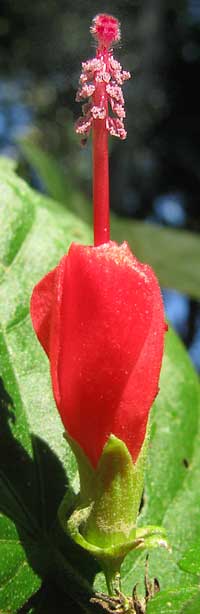
You can see how similar the blossom is to hibiscus flowers, the main differences being that the Tulipán's corolla doesn't open much more than is shown in the picture, plus there's that tall, slender item projecting upward from the flower's center. You can see better what's going on there at the right:
That slender thing is composed of numerous male stamens arising from a cylinder surrounding the threadlike style of the female pistil. The fuzzy, spherical thing at the top is the stigma where pollen grains land and germinate. The pale purple, granular items are anthers shedding pollen. I dissect a blossom and show how all this hangs together in hibiscus flowers at www.backyardnature.net/fl_hibsc.htm.
In the US this species is planted outdoors in the Deep South, in USDA Hardiness Zones 8-10. One website says of it, "It is an old fashioned, 'pass-along' southern plant, attracting butterflies and hummingbirds."
from the February 28, 2016 Newsletter issued from Hacienda Chichen Resort beside Chichén Itzá Ruins, central Yucatán, MÉXICO
THE TULIPÁN'S LITTLE PUMPKIN-FRUIT
A slender, shoulder-high, woody-stemmed bush leaned across the trail with late-season, bug-eaten leaves and a grape-sized, orangish fruit looking like a little a pumpkin at the tip of its stem, as shown below:
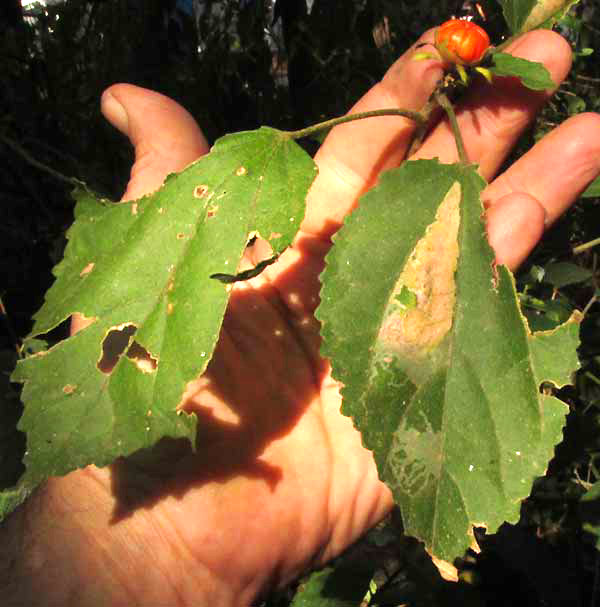
A close-up of the "pumpkin" shows that it's divided into five sections separated by shallow grooves, as seen below:
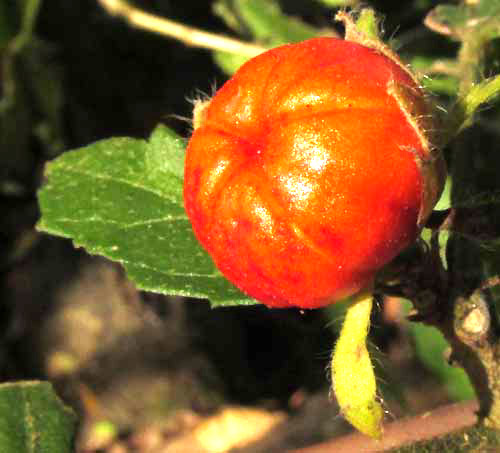
Below, a view from the side shows that the fruit is subtended by a bowl-like calyx and several slender bracts:
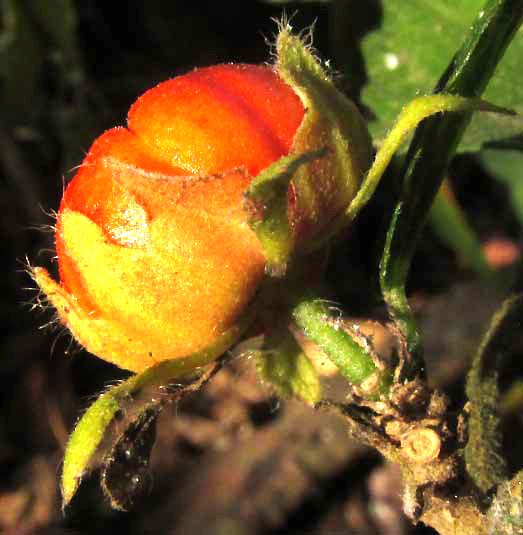
One branch bears an old, drying-up, shriveling flower displaying a red corolla and a long, slender "staminal column" curving from the corolla, with exhausted, brown anthers clustered at its tip, reminding us that we know this plant. It's common here and, when in flower, very conspicuous at forest edges and along trails. It's the Tulipán, sometimes called Turk's Turban, Malvaviscus arboreus, in the Hibiscus Family.
Everyone admires the Tulipán's bright flowers. Now we know to look for its pumpkiny fruits as well.
from the September 22, 2018 Newsletter issued from Rancho Regenesis in the woods ±4kms west of Ek Balam Ruins; elevation ~40m (~130 ft), N~20.876°, W~88.170°, central Yucatán, MÉXICO
TULIPÁN AT THE BEACH
Last week during my camping trip to the Yucatan's northern coast, amid scrubby vegetation much stunted by salt-spray, the lack of water and nutrients in sandy soil, extreme heat and glaring sunlight, next to my tent atop a dune grew a waist-high bush with obvious Tulipán flowers. However, the leaves were so small and leathery, and the flowers looked a little different from what I remembered, that I thought I might have a second Tulipán species -- a second species of the genus Malvaviscus. Below, you can see the plant's flower and leaves:
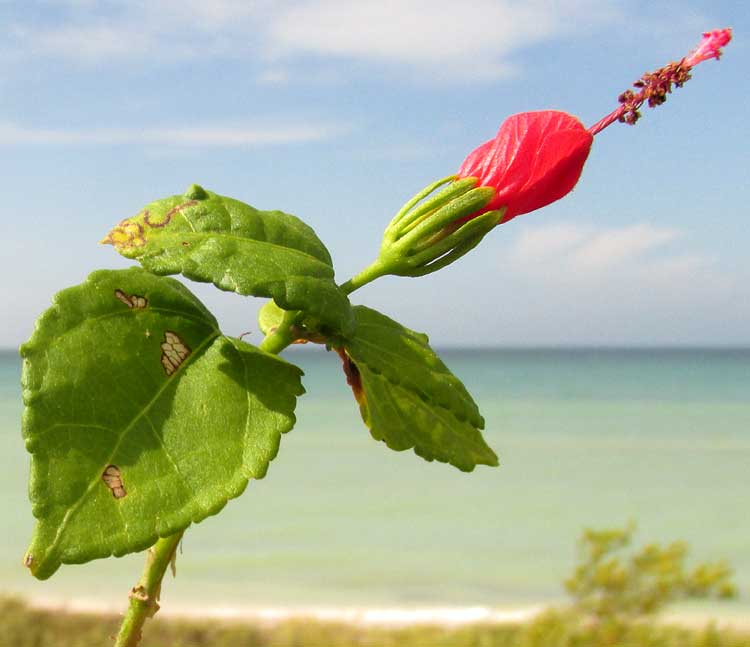
Thing is, no second Malvaviscus species is listed for the Yucatan. Apparently the coastal dunes' extreme environmental conditions caused the leaves to look so different. Also, the feature of the flower that caught my attention was that its base was enclosed within a cage-like involucre of narrow bracts. I remembered the flowers having a cuplike calyx with short, wide lobes. However, later I remembered that even flowers on inland plants are subtended by narrow bracts, just that usually they're not held so close to the calyx as in the picture.
Still, it's worth posting our picture just to show another face of this pretty plant, and to acknowledge that this is a tough, adaptable species able to thrive in habitats ranging from humid, shady woods to atop those wind-swept, salty sand dunes.