
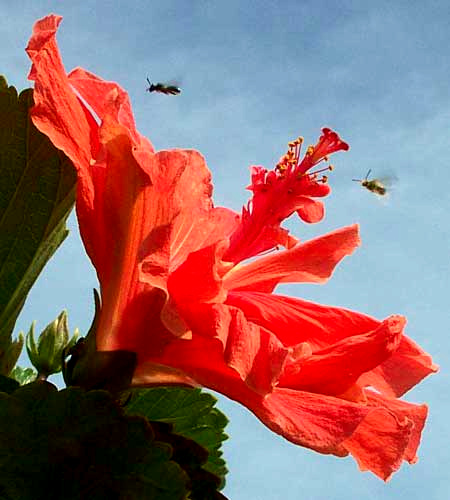
About 350 species of hibiscus are known to exist, with many cultivars developed from them, and all hibiscus flowers share certain features. The blossom at the right, an ornamental, can introduce us to hibiscus-flower basics.
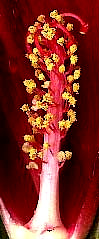
If you tear away one side of a hibiscus flower, inside the corolla you'll find something similar to what's shown at the left. On our Standard Blossom page it's seen that a flower's male sexual parts, the stamens, consist of a pollen-producing anther atop a slender, stemlike filament. In the picture at the left, the roundish, yellow things are anthers discharging yellow pollen. Notice that, as in our Standard Blossom, each anther is held aloft by a slender, pink filament. However, very unlike our Standard Blossom, in an hibiscus flower each filament is then attached to a pale, pink cylinder, known as a staminal column or "stamen tube."
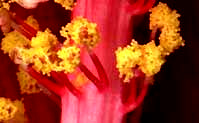
At the right you see a close-up of the staminal column better showing how each stamen is attached to it.
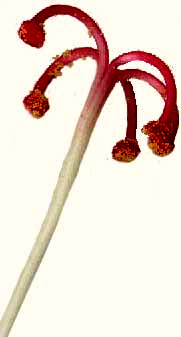
If you carefully cut away one side of the staminal column you'll find that it is a cylinder inside which is found the flower's long, slender style. The style connects the ovary at the flower's bottom with five stigmas at the top, the very thing seen at the left. If you look closely at the stigmas at the left, you'll see that they're dusted with yellow pollen grains.
All that makes sense because it's the very nature of flowers that pollen grains carrying a male sex germ make their way onto stigmas, where they germinate. Upon germination they produce a root-like "pollen tube" that penetrates and growth through the long, slender style inside the staminal column. When the pollen tube's tip enters an ovule inside the ovary, it delivers its male sex germ to the ovule's female sex germ, and fertilization takes place. At that point the ovule begins its process of eventually becoming a seed within a fruit, the ovary around the ovule maturing into a fruit.
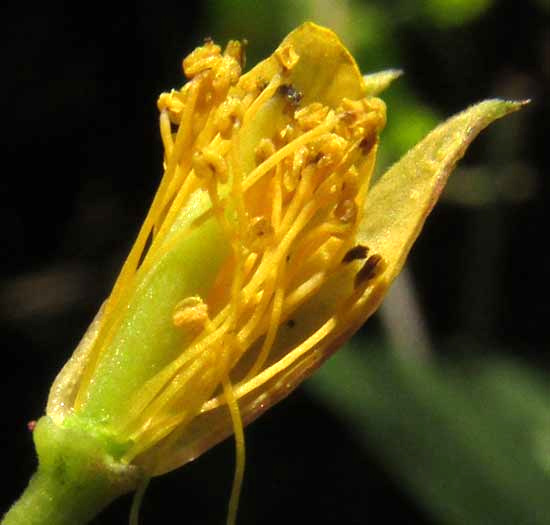
So far we're just talking about hibiscus flowers as they occur in the genus Hibiscus, of which about 350 species are recognized. However, the Hibiscus genus is just one of maybe 240 or so genera in the Hibiscus Family, the Malvaceae, as it's configured in 2021. Other Hibiscus Family genera, and the many, many cultivars based on the genus Hibiscus, may show interesting variations on the hibiscus-flower theme. However, in the end nearly all members of the Hibiscus Family have their stamens' filaments united at their bases, if not in a column or tube, at least in a low collar. But, there are a few exceptions, as evidenced by the Slippery Bur, Corchorus siliquosus, at the right. That weedy plant's stamen filaments don't fuse together at their bases. It's a real renegade.
And then, among cultivated hibiscus plants, consider the following:
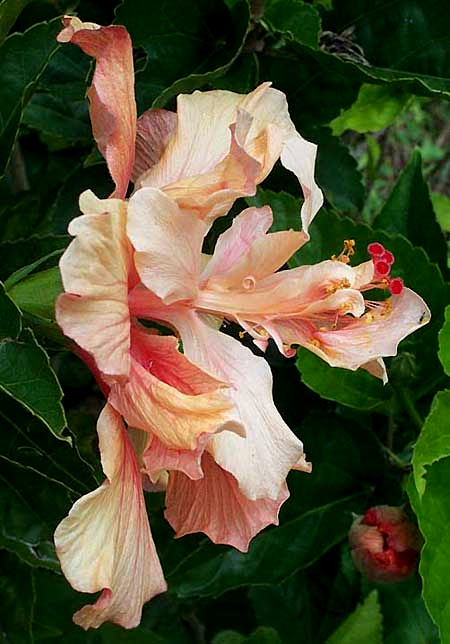
In this blossom of the Rose-of-China, Hibiscus rosa-sinensis, several stamens on the staminal column have developed into petals or "half-petal, half-stamen" appendages. Converting stamens to flashy petals is a trick plant breeders often employ to make blossoms gaudier.
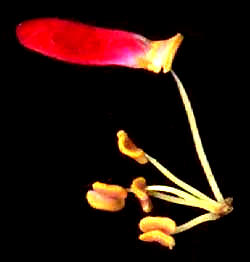
The same trick is used among roses. Wild roses have only five petals, but you know that garden roses usually have more. At the right, you see a stamen's anther which has almost decided to become a rose petal. Similar stamen-to-petal situations can be found among the buttercups, camellias and other commonly grown ornamentals.