PLANTS | ANIMALS | ECOLOGY | FUNGI | GEOLOGY | GARDENING | TOOLS
MEXICAN PLANTS & ANIMALS HOME

Excerpts from Jim Conrad's
Naturalist Newsletter
from the January 11, 2015 Newsletter issued from Río Lagartos, on the Yucatan Peninsula's northern coast (~N21.60°, ~W88.16°), Yucatán state, MÉXICO
ROYAL PALM
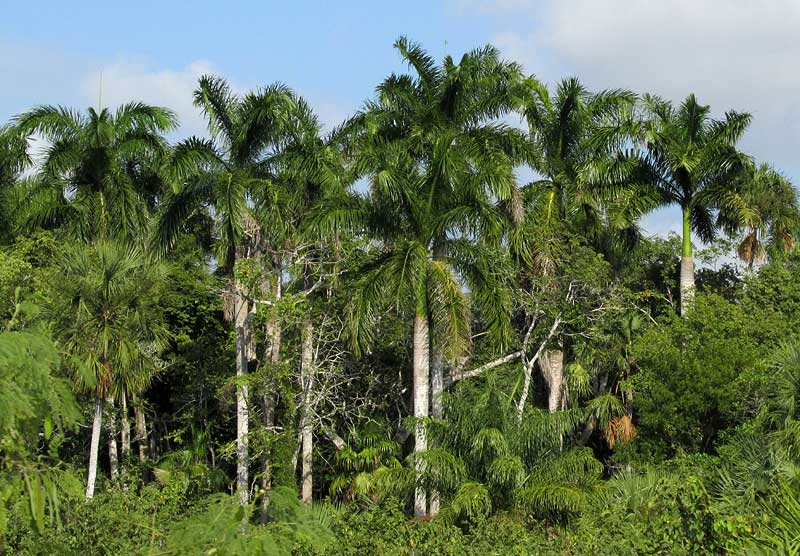
Joyously standing in summery, ear-flapping wind in the back of Diego's black pickup truck with flamingo and fish decals artfully applied to its sides, ostensibly we were looking for rare birds for a Finnish birding guest, but my eyes couldn't be taken off the vegetation that rolled by, for here just an hour or so east of Río Lagartos the seasons were rainier and the vegetation higher and lusher, with species not seen farther west. Suddenly there was a whole forest of some old-friend palms, palm compadres I've known for many years as Royal Palms, ROYSTONEA REGIA, but these Royal Palms were doing things that surprised me.
What surprised me was that I'm used to Royal Palms standing regally in straight lines along streets and plantation entry lanes, planted and cared for, as shown on our Royal Palm Page at www.backyardnature.net/yucatan/royal-pm.htm.
But these Royal Palms stood shaggily and haphazardly in wild forest, as seen from the back of Diego's famous Flamingomobile at the top of this page. A close-up showing the Royal Palm's main field marks is shown below:
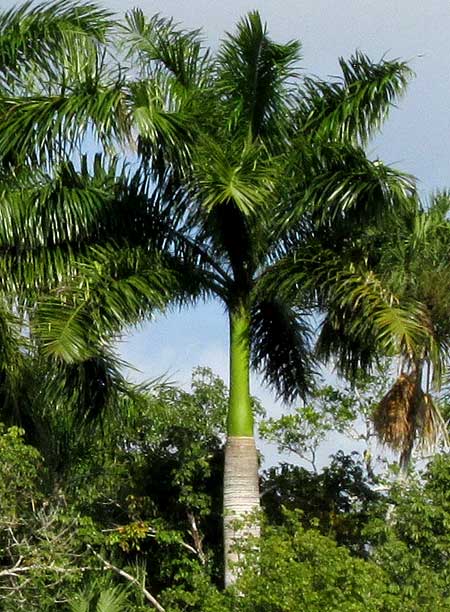
Here's what to notice:
I myself have written that "Royal Palms are native to southern Florida, southeastern Mexico, including the Yucatan, Cuba, the Bahamas and the Cayman Islands. Earlier the Florida populations were regarded as a different species, but genetic studies show that they are not distinct enough to be regarded as a separate species..." so all along I've known that wild Royal Palms should be growing here in the Yucatan. However, during all my years of Yucatan-wandering I've never seen them, so I'd begun suspecting that they were practically extinct here, except where planted.
I'm told that all the Royal Palms in our area occur in that small forest we zoomed through and that all the land there is owned by one person, who recognizes the trees' importance.
from the January 12, 2009 Newsletter issued from Hacienda San Juan near Telchec Pueblo, Yucatán state; ~10m (~33 ft), N21.21°, W89.25°, MÉXICO
ROYAL PALMS
Back during the heyday of henequen or sisal production, when Mérida boasted of being home to more millionaires per capita than any other city on Earth, entry roads to the most elegant plantation mansions often were framed with tall, stately Royal Palms, ROYSTONEA REGIA. You can see the Royal Palms where I am now below:
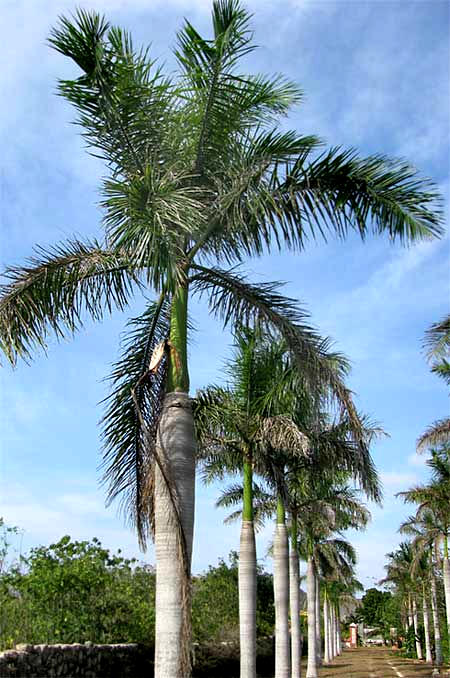
Unlike the Chit and Thatch Palms at our last two stops, which were fan palms with the fronds' pinnae radiating from the petiole top, you can see that Royal Palms are "feather palms" whose pinnae arise from a long midrib or rachis. You can compare the above Royal Palm's feathery fronds with a fan-type Chit Palm frond at our recently uploaded Chit Palm page at www.backyardnature.net/yucatan/chitpalm.htm.
As a group, the genus Roystonea is distinguished by: its tall, columnar, single trunks, or boles; its fronds' pinnae arising at several angles from the midrib so that the fronds look a little shaggy, not neatly flat like a chicken feather, and; having a prominent, green "crownshaft" between the gray bole and its tuft of shaggy fronds.
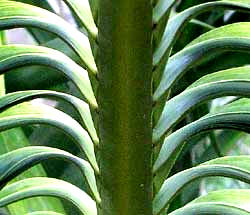
The above picture shows how the palms' crownshafts are formed by the leaves' very broad, overlapping petiole-bases, the petiole being a leaf's stem.
The bottom leaves or fronds of Royal Palms always are drying up and falling off as new, larger fronds emerge above them. The flaring petiole-base of a frond lying just outside my door, next to my foot-long sandal, is seen below:
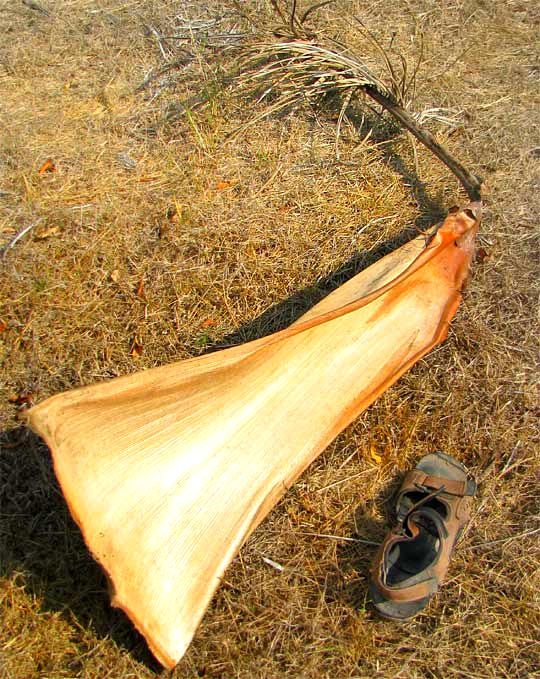
Notice how the Royal Palm's gray bole is narrowly ringed horizontally. Those rings are scars from where old petiole bases have fallen. You can see, then, that during its whole life a Royal Palm drops quite a few fronds and petiole bases like the one pictured one. Old fronds fall mainly during the dry season, which we are into now. Ridding itself of older, presumably less efficiently photosynthesizing leaves can be thought of as a water-saving adaptation.
You can see a Royal Palm frond's closely packed pinnae shaggily arising from various angles from the midrib below:
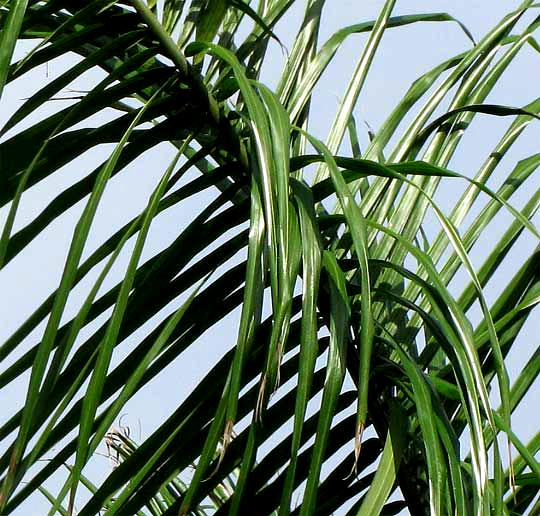
Compare that with pinnae systematically arching at just two angles from the midrib of a Manila Palm shown below.
Why would such dignified palms permit themselves such disorderly appearing fronds? I think I know the answer because each morning I build my breakfast campfire beneath a Royal Palm and all during the meal cool water droplets shower onto my bare back. The droplets fall from the palm's shaggy leaves where water has condensed. Typically at this time of year we have morning fogs; the fronds' multitudinous slender pinnae projecting into the air gather fog droplets and combine them into little streamlets of water that drain down the palm's trunk, as shown below:
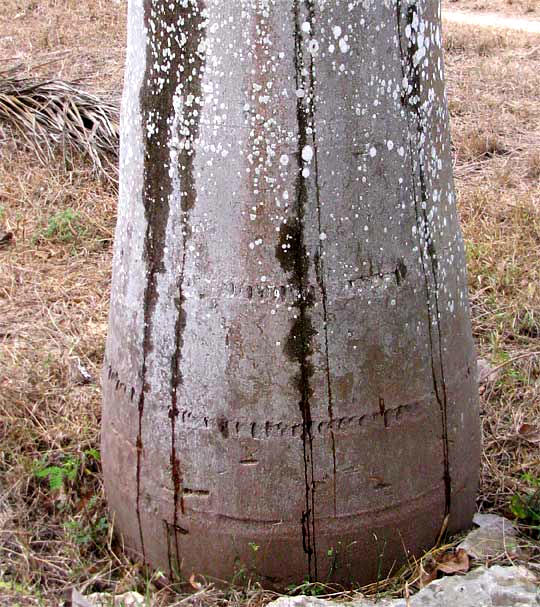
These are very modest streams but here during the dry season after a too-dry wet season, maybe such little streams make all the difference to the trees. I wouldn't be surprised to find that most of this trunk-surface water is absorbed into the trunk directly instead of entering the tree via roots.
Royal Palms are native to southern Florida, southeastern Mexico, including the Yucatan, Cuba, the Bahamas and the Cayman Islands. Earlier the Florida populations were regarded as a different species, but genetic studies show that they are not distinct enough to be regarded as a separate species
These variously positioned bole bulges provide extra water storage capacity for the species. I've always wondered why trunks in this species bulge, and now I'm suspecting that they may bulge where they most imbibe water draining down their sides.
With bulging boles, the discarding of older fronds during the dry season, and dew-collecting pinnae, the genus Roystonea is beautifully adapted for surviving severe dry seasons.
from the January 31, 2010 Newsletter issued from Hacienda Chichen Resort beside Chichén Itzá Ruins, central Yucatán, MÉXICO; limestone bedrock, elevation ~39m (~128ft), ~N20.676°, ~W88.569°
ROYAL PALMS FLOWERING
One morning this week even before sunlight illuminated the tops of my little hill's tallest trees, I heard so many bees buzzing that I was sure a swarm must have been passing, even though it was far too early for that. Tracking down the sound took me to the base of a tall Royal Palm, where it was clear that the powerful humming was from bees that weren't swarming, but rather just working among the tree's enormous flower clusters some 30 feet overhead, as seen below:
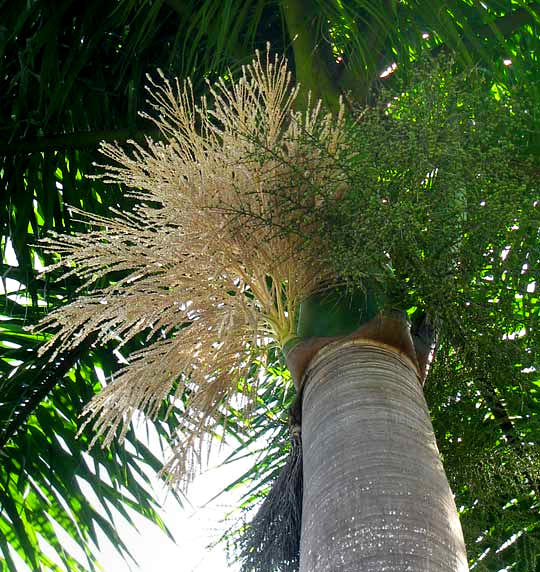
Royal Palms, ROYSTONEA REGIA, are "monoecious," which means that each tree bears separate male and female flowers. In the picture, the dark flower cluster on the right bears hundreds of developing fruits, which when mature will be only about half an inch wide (1.3 cm); the white cluster at the left bears thousands of male flowers, spent ones of which on that still morning flurried to the ground like a gentle snow. The ground was white with discarded male flowers about half an inch across. You can see one in my hand below:
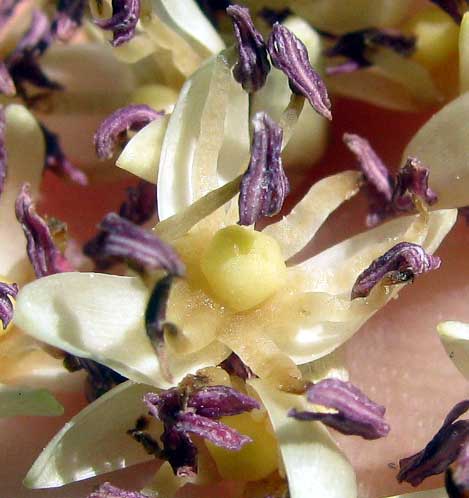
Each male flower consists of three white tepals -- tepals being the term used when sepals and petals are indistinguishable -- six to twelve stamens with purple anthers (the pollen-producing bags), and in the center there's an ovary! The ovary deserves an exclamation mark because these are male flowers and of course an ovary is female. The ovaries in these male flowers can be thought of as vestigial ovaries. Sometimes they are referred to as "pistillodes," to differentiate them from fertile pistils that will develop into seed- bearing fruits.
All week it's snowed male flowers from our many stately Royal Palms, and every morning I've returned from my jog hearing a pleasing, busy hummmmmmmmmmmmm overhead.
from the January 24, 2016 Newsletter issued from Hacienda Chichen Resort beside Chichén Itzá Ruins, central Yucatán MÉXICO
TRUNK OF THE ROYAL PALM
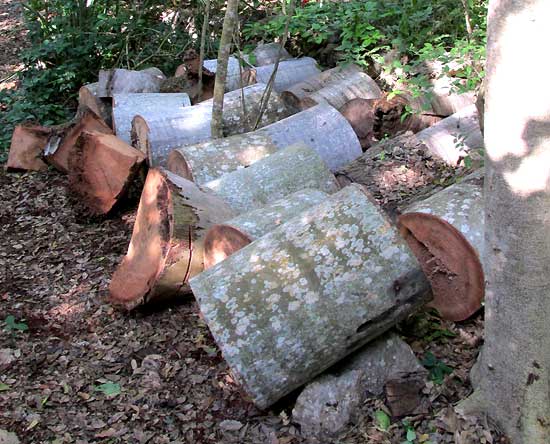
This week the Hacienda's usual tranquility was interrupted by the noise of a chainsaw, followed by the ground shaking when a tree fell. The next day I saw that the victim had been one of the Hacienda's many Royal Palms, diseased on one side and threatening to fall. Below, you can see the sections of our fallen tree's cut-up trunk:
A closer look at the cut face of one section is shown below:
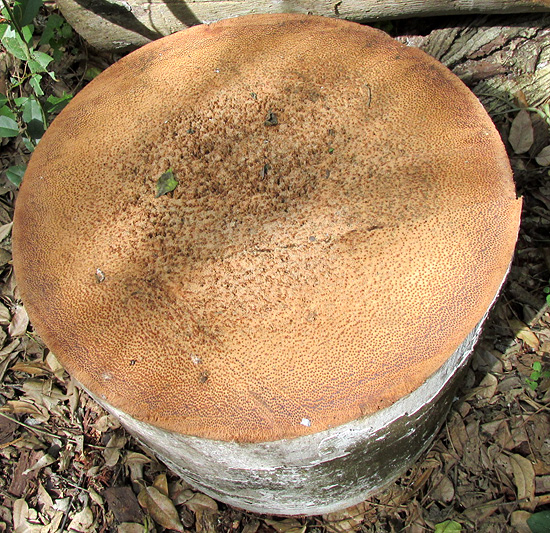
Here we see two features distinguishing palm trunks from trunks of most trees we're familiar with. First, they're not covered with thick, woody bark; second, there's no evidence of annular growth rings. To understand the reasons behind these differences, we have to resort to taxonomy.
In the old days we spoke of all flowering plants as being either dicots or monocots. Dicots generally have net-veined leaves and when their seeds sprout send up two leaves, the cotyledons, atop the stem. Oaks, rose bushes, and bean vines are typical dicots. Monocot leaves usually but not always have parallel-veined leaves, and when their seeds germinate only one cotyledon emerges from the soil. Grasses, lilies and orchids are monocots. Nowadays it's recognized that a few flowering plants don't fit into these broad classifications, such as certain waterlilies, but the dicot/monocot concept is still useful.
All of our northern, Temperate Zone trees -- unless you regard bamboo as a tree -- are dicots, or else conifers such as pine, spruce and fir, which are not flowering plants to begin with. Our Royal Palm stems are so different from tree stems up north because palms are neither conifers nor dicots. Palms are monocots, along with grasses, lilies and orchids, and those plant groups produce neither bark nor annular rings.
In the North's flowering trees, which are all dicots, the only living part of a trunk is the cambium layer, which forms a very thin, filmy zone of cells just beneath the bark of woody trunks and branches. Outside the cambium layer there's dead bark, while inside there's dead wood. When the tree is growing fast, the cambium layer produces large wood cells, and when it's growing slowly, as during the winter, the cells are small and usually darker. These differences in cell size and shade, produced by seasonal variations in rates of growth, are the tree's rings. In contrast, palm trunks don't have cambium layers. The entire interior of a palm trunk is alive and remains alive during the palm's life, which can be hundreds of years in some species.
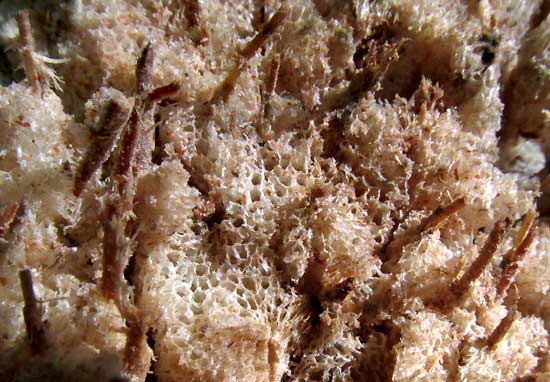
Palm trunks have been described as analogous to reinforced concrete pillars, with the conductive tissue, or "vascular bundles," being like steel rods or rebar, and spongy "filler" parenchyma cells analogous to concrete. On our trunk cross-sections, the vascular bundles composed of vesicles that conduct water and dissolved nutrients up the trunk and photosynthesized carbohydrates down the trunk can be clearly seen amid spongy parenchyma, shown below:
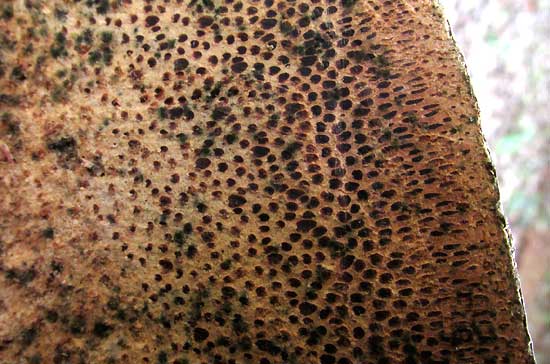
Up closer, the analogy with steel rods and concrete is more obvious, as seen below:
In palms, all new leaves and flowers develop from what's called the trunk's "heart" or "bud," or more technically the "apical meristem." This means that the apical meristem is surrounded by leaf bases -- the attachment points of frond petioles. In most palm species, where the apical meristem or "heart" remains close to the ground, this means that most stem growth of a young palm is outward, not upward. Royal Palms, however, are part of that small group of species whose apical meristems are borne upward by the lengthening trunk. On a Royal Palm, the heart, or zone of apical meristem, is clearly visible as a constriction in the trunk, at which point there's brown trunk below the constriction, and green "crownshaft" above. You can see constrictions and crownshafts atop trunks in our picture at www.backyardnature.net/yucatan/royal-pn.jpg.
The crownshaft is composed of petioles of the palm's fronds wrapping around one another, the newest petioles on the inside, the older ones on the outside. Among the trunk sections lying on the ground in our photo, the section bearing the tree's heart or apical meristem, constricted at the end holding the heart, is shown below:
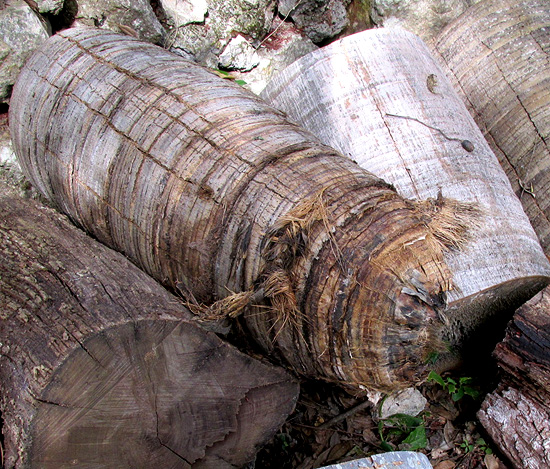
The tree section in that picture's lower, left corner belongs to another tree, a dicot bearing bark.
An important point about palms producing leaves and flowers only at the apical meristem is that if that part is killed and the palm is of the kind producing just one stem, like our Royal Palm, the palm's life is finished.
Another important difference between Northern tree trunks and palm trunks is that when a dicot or conifer tree's trunk is damaged, the wound is compartmentalized and grown over, but stem wounds among the palms are permanent.
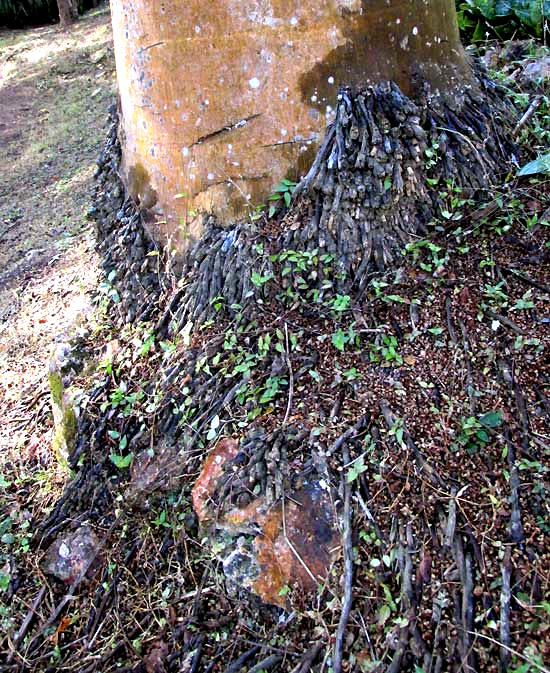
Palm roots also are radically different from the roots of dicots and conifers. Palm roots, instead of forming as "their own thing" during the seed's germination, emerge adventitiously from the lower region of the trunk. This region, known as the "root initiation zone," is seen on one of our healthy Royal Palms below:
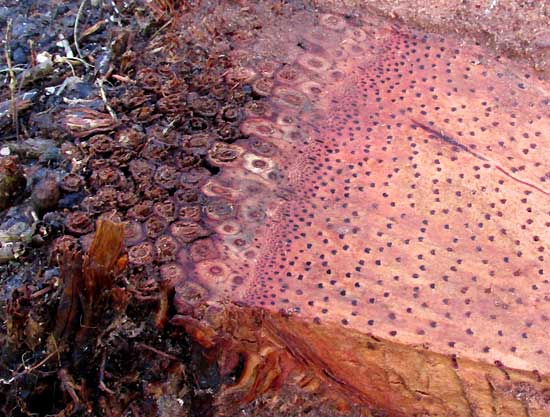
Below, one of our cut trunk sections shows how the trunk's vascular bundles connect with roots forming at the perimeter:
If a palm's new roots developing above ground come into contact with dry air, they stop growing. When palm roots emerge from the trunk, they're already thick, but that's as thick as they'll become. Most roots grow outward from the trunk, not down. If a root is cut, branching may occur behind the cut, but the secondary roots will have the same size as the cut primary. Palm roots don't have root hairs. There are also tertiary and fourth-order roots that are somewhat smaller and short-lived than primary roots, and they grow upward toward the soil surface. These are the ones who absorb water and nutrients.
Most of the above information, which enabled me to make sense of what I saw among the cut sections, was gleaned from an excellent Web page by TK Broschat entitled "Palm Morphology and Anatomy," presented by the University of Florida at https://edis.ifas.ufl.edu/ep473.
