PLANTS | ANIMALS | ECOLOGY | FUNGI | GEOLOGY | GARDENING | TOOLS
MEXICAN PLANTS & ANIMALS HOME

Excerpts from Jim Conrad's
Naturalist Newsletter
from the July 3, 2011 Newsletter issued from Mayan Beach Garden Resort 20 kms north of Mahahual; Caribbean coastal beach and mangroves, ~N18.89°, ~W87.64°, Quintana Roo state, MÉXICO
PARROT SNAKE
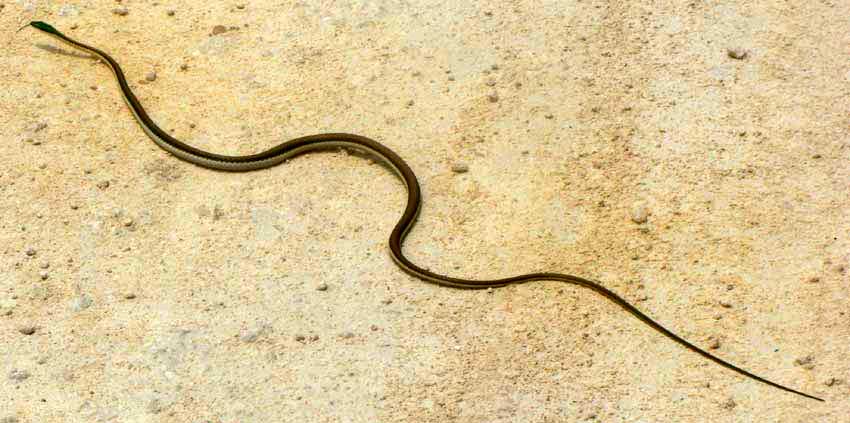
Mid-afternoon sunlight glared off the road's white sand as I approached the 2.5-ft-long (75cm) snake seen above. Because of the snake's length and extreme slenderness I thought it was either a Brown or Green Vine Snake, which are fairly common here. However, then I noticed that the head wasn't long-pointed like a vine snake's. A closer shot of the road snake's front is shown below:
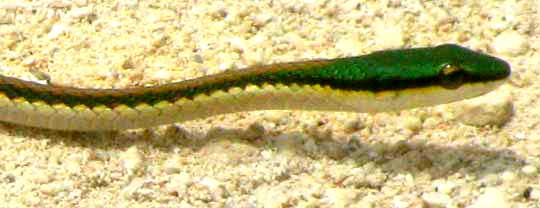
The bronzy line down the snake's back finally reminded me that we've run into this species before, back in 2008 near Telchac Pueblo in northwestern Yucatán. {see next entry}.
from the December 14, 2018 Newsletter issued from Rancho Regenesis in the woods ±4kms west of Ek Balam Ruins; elevation ~40m (~130 ft), N~20.876°, W~88.170°, central Yucatán, MÉXICO
BRONZE-BACKED PARROT SNAKE UP CLOSE
Biking from Ek Balam back to the rancho, a slender, meter-long (3.3ft) snake rested unmoving in the middle of the road. He didn't respond when I nudged him, so he was roadkill, though few indications of that were apparent. He was as pretty one, but one we've already profiled. However, this was the first one I'd been able to photograph up close, so I set to work documenting his most important field marks.
In snake identification, scale configuration, especially on the head, is of great importance, so first I got a good side view of the head, shown below:
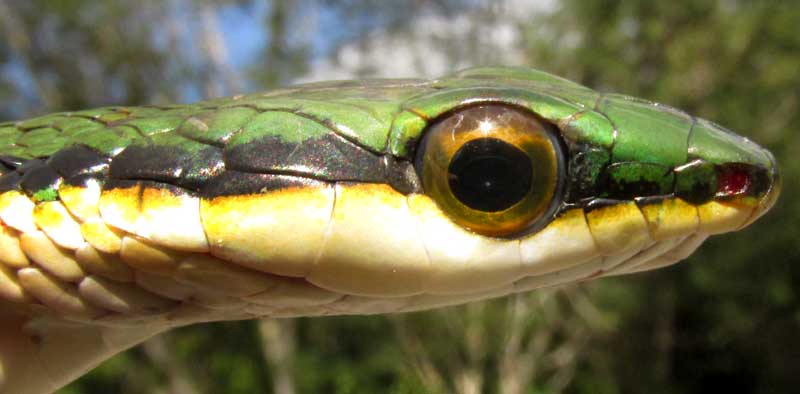
This species' eyes were large for the head size. Something else distinguishing this species from another of the same genus is that it has a "loreal scale." To find the loreal, locate the nostril at the head's front. Behind the nostril, toward the eye, there's the ±hexagonal "postnasal scale." The scale in front of the eye, toward the nose, is the "preocular scale." The loreal resides between the preocular and postnasal scales. Scales atop the head also are important and, below, you can see our snake's:
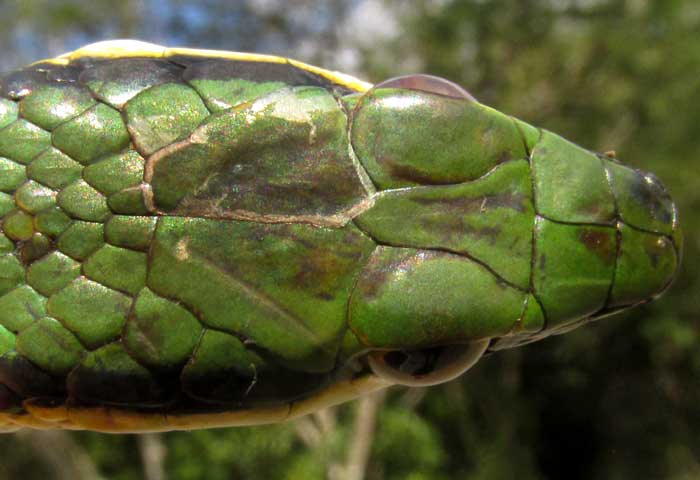
If you're fascinated by this scale business, you might enjoy our Snake Identification page, where head scales are identified, at www.backyardnature.net/snakidnt.htm
One good field mark our snake displays is that its nose is blunt, almost squared. However, more important is the number of rows of scales along the body. Bronze-backed Parrot Snakes, at the middle of their bodies, bear 15 rows of dorsal scales, or top scales. Below, you can see that the dorsal scales bear slender but prominent ridges, or "keels," on a side view of our snake:
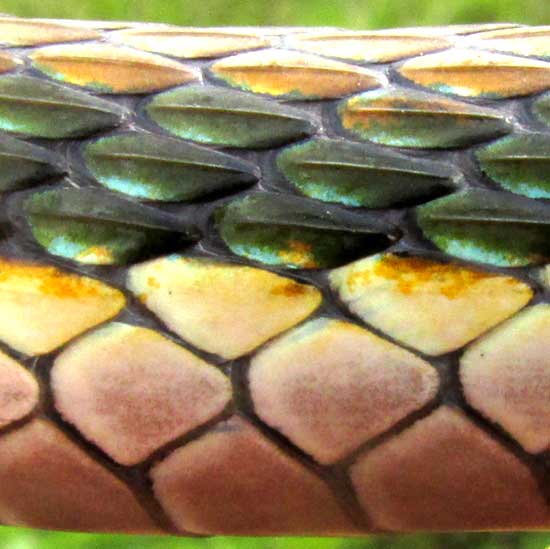
The white bottom scales, or "ventrals," lack keels. Those keels are a good field mark, and it's supposed that keels help the snake maintain hold on shrub and tree limbs they move through. Bronze-backed Parrot Snakes are arboreal, often seen climbing among bushes and other low vegetation, where its main food is frogs, though it's also been noted eating salamanders and lizards.
Bronze-backed Parrot Snakes are distributed from northern Mexico's Atlantic slope south to Costa Rica. Two subspecies are recognized. Here in the northern Yucatan we have a special Yucatan subspecies, Leptophis mexicanus ssp. yucatanensis.
from the April 1, 2006 Newsletter issued from Hacienda San Juan just east of Telchac Pueblo, northwestern Yucatán, México
BRONZE-BACKED PARROT SNAKE
Friday Roberto came to the door saying that he had another snake for me, and that it was a good one. He said that all day yesterday and all of that day a snake had been trying to eat a mother ground-dove sitting on her nest, and that the snake was going around and around the nest "mareando" the mother. That word translates to "making seasick," but Roberto meant that the snake was trying to get the bird into a dazed state, a kind of hypnotic trance, where the snake could simply attack as the bird was frozen with inactivity. When I went out I saw a slender snake about four feet long, with a brightly green head. He had lines like a garter snake, with the top line a bronzy color, edged in black, and then a white bottom. The book identified it as a Bronze-backed Parrot Snake, LEPTOPHIS MEXICANUS.
And it was true that at a distance of about three feet the snake just went around and around the little Ruddy Ground-dove as she sat on her nest wide-eyed, with a nestling peeping out from beneath one of her wings. She was very nervous. A puff of wind shook the palm frond's petiole holding the nest and the mother fluttered with shock. When the snake got too close, the mother beat her wing against a palm frond making a loud crashing sound.
Curiously, the book says that this species mainly eats frogs, and only occasionally birds. There's another snake, the Bird-eating Treesnake, which is similar in appearance, and which behaves exactly as we saw this snake behaving. Therefore, I was a little unsure which species it was when late in the afternoon my young friend Ricardo Pat came for a visit from Dzemul. I told him about the snake and that I'd like to catch it to see if the snake's anal plates were divided or undivided. One species is one way and the other is the other.
Before I could figure out what was happening, Ricardo, an old snake hand, managed to grab hold of the snake's tail and present it before me.
I was amazed. Held by its tail, the snake tried several times to rise to bite Ricardo's hand, but it was too slender and weak. Finally it did manage to rise to Ricardo's hand and slither between his wide-spread fingers, which enabled Ricardo to close two fingers around the neck. Now we could examine the snake's anal scales.
The thing is, this happened exactly as Ricardo had planned. He knew that -- unlike the vast majority of snakes -- this species should be grabbed by its tail. He knew it would eventually rise to his hand and pass between his fingers, not biting, and that then he could close his fingers around his neck. He'd learned all this as a kid, and it was all exactly as it should be. What these Maya people know... !
The snake had divided anal plates, as well as the right number of scales on the face, and a two-toned iris (yellow above and dark brown below), so it was definitely a Bronze-backed Parrot Snake, despite its behaving exactly like a Bird-eating Treesnake.