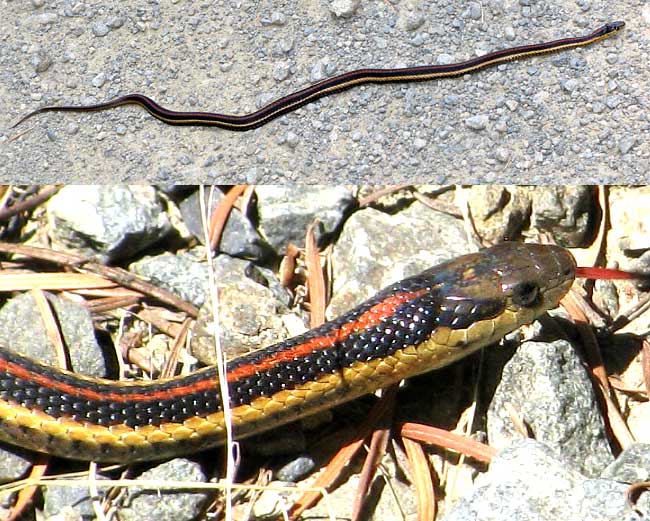
Northwestern Garter Snake, Thamnophis ordinoides
Snake identification sometimes requires close examination of obscure details. For example, above, that's a garter snake. However, in North America there are several look-alike garter snake species, plus ribbon snakes look a lot like garter snakes. Therefore, if we want to be sure about what species of snake we have, we need to pay attention to such obscure characteristics as those referred to below:
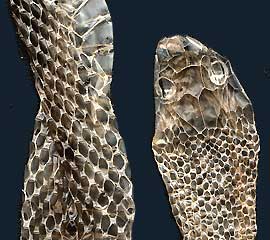
- Scales on snakes don't occur randomly, like hairs on a human body; along the body they line up in rows that are so systematically arranged that the number of scale rows usually is constant within a species. At the right you see the shed skin of a Racer, Coluber constrictor, clearly showing the position of each individual scale. Mature racers normally have 17 scale rows at midbody, 15 near the tail. In contrast, the Common Garter Snake normally has 19 rows at midbody.
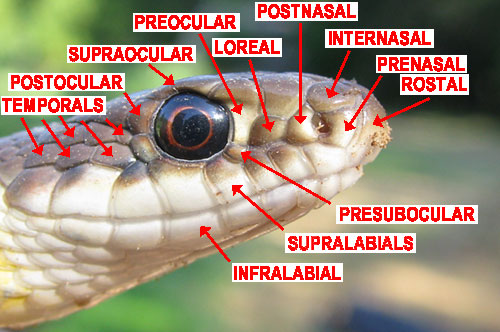
- On the head, the size, shape, relative location and sometimes even the presence of a snake's individual scales is so important for identification that each scale has a name. Few features are more important for snake identification than the nature of the head scales! The following picture identifies head scales on the head of a tropical Scorpion-hunting Snake, Stenorrhina freminvillei. It has 8 supralabial scales, as opposed to, say, a Common Garter snake's 7. Can you see the 8 supralabials?
- Scales can be "keeled," weakly keeled, or smooth. Keeled scales have a slender, rib-like ridge running lengthwise down them. The importance of noting whether a snake's scales are keeled is apparent from the following:
- Garter snakes and water snakes have keeled scales
- rat snakes have weakly keeled scales
- king snakes and racers have smooth scales.
- Anal scales, also called anal plates, are large scales covering the "cloacal opening," or anus, appearing on the snake's front or head-side. In some snake groups, the anal scale is single, or "entire," but in others it's divided, or "paired," a trench separating it into two parts. The divided anal scale of what seems to be a pink form of Scorpion-hunting Snake in Mexico is shown below in the image's center, the hidden cloaca indicated by glistening goo on the scale's back side.
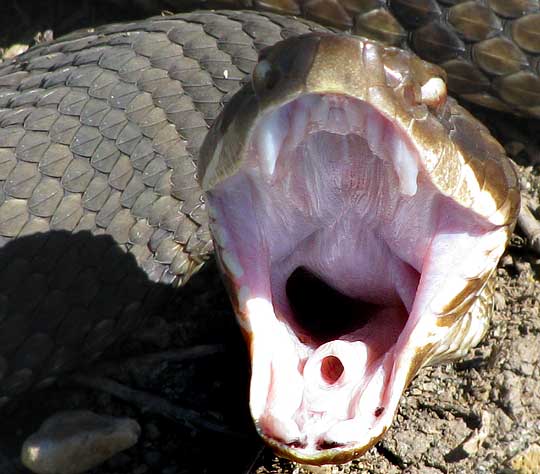
Look at the nicely keeled scales of the Cottonmouth or Water Moccasin, Agkistrodon piscivorus, shown below:
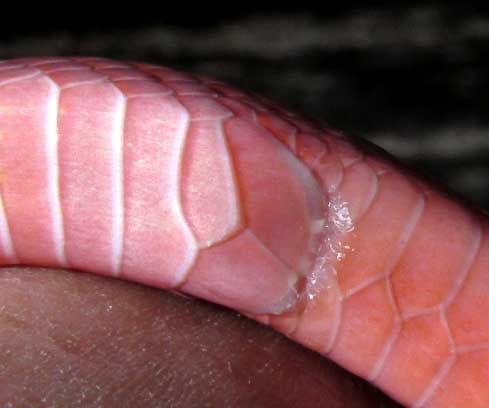
Divided anal scale
Anal plates are important when identifying groups of snakes. Garter snakes, king snakes, and pit vipers, for instance, have single or undivided anal plates, but water snakes, racers, and rat snakes have divided ones.