PLANTS | ANIMALS | ECOLOGY | FUNGI | GEOLOGY | GARDENING | TOOLS
MEXICAN PLANTS & ANIMALS HOME

Excerpts from Jim Conrad's
Naturalist Newsletter
from the July 24, 2016 Newsletter issued from Hacienda Chichen Resort beside Chichén Itzá Ruins, central Yucatán MÉXICO
ANGLEPOD FLOWERING
During the mid dry season, in February or so, along roadsides and at woods edges, a certain vine appears here bearing conspicuous, four-inch-long pods (10 cm) on its leafless, semi-woody stems. Recognizing the vine as a member of the Milkweed Family -- now lumped into the Dogbane Family, the Apocynaceae -- with the help of a German friend who specializes in the family, back in 2010 we tentatively identified the vine as a kind of Anglepod, genus Macroscepis*. It was hard to confirm the ID because there's little solid info about that species' pods on the Internet.
*UPDATE: In 2024 when these photos were uploaded to iNaturalist, user "leonardoac" recognized MACROSCEPIS YUCATANENSIS, endemic just to this northern, inland part of the Yucatan.
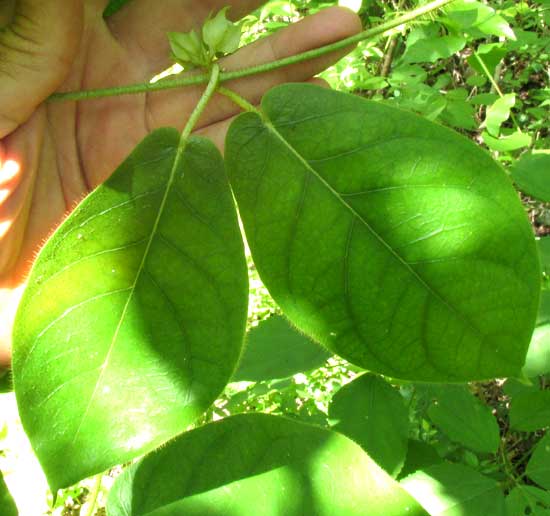
This week, deep in the forest at Hacienda Chichen, the stem of a vine climbing a tree along the trail bore fairly large, stiff, brownish hairs just like those on stems we've seen bearing Anglepod pods, so here was a chance to firm up the ID, because the vine was flowering. There's much more information on the species' flowers than its pods. Below, on this week's vine, you can see large leaves and a couple of flowers arising where the leaves' petioles join the hairy stem:
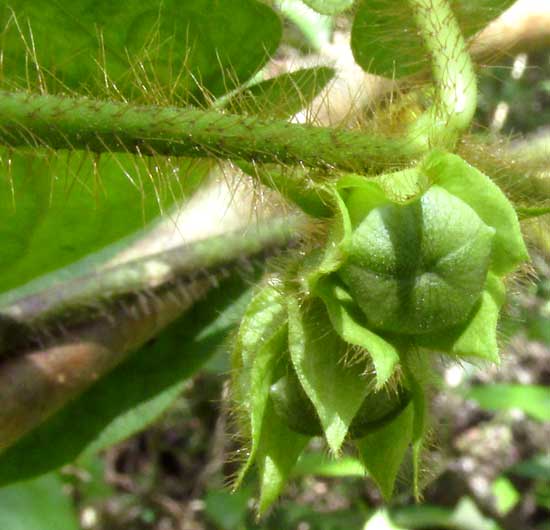
At first I could only find immature flowers. Below, a close-up shows an unopened, green corolla subtended by an unusually large, bowl-like calyx that along with the stem and petioles are truly hairy (hispid):
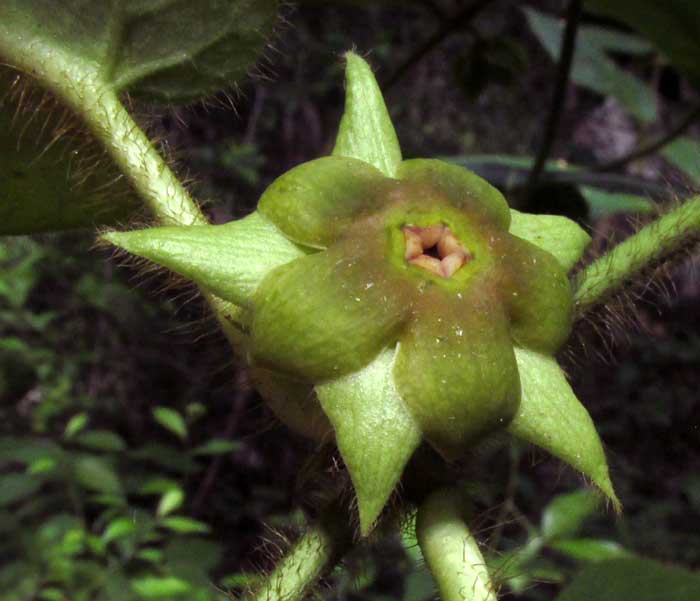
There was one open blossom, however, and it was spectacular, as shown at the top of this page.
Presumably the oversized sepals beneath the green corolla help attract pollinators, but if the flower wants to visually attract pollinators why are both sepals and corolla green? I couldn't smell any particular scent. You'll recognize something very distinctive about this blossom if you're familiar with the typical milkweed flower with its "gynostegium," or grown-together stigma and anthers. You can review milkweed flower anatomy at www.backyardnature.net/fl_milkw.htm
In our trail-side vine's blossom, the gynostegium lies flush with the throat of the flaring corolla. Normally the gynostegium rises inside a bowl-like corolla, like a pillar.
The flower definitely belongs to the Anglepod we guessed at earlier as the name for the vine producing the pods, Macroscepis. Now I just need to confirm that the vines producing these flowers eventually develop the pods we've been seeing during the dry season.
from the February 28, 2010 Newsletter issued from Hacienda Chichen Resort beside Chichén Itzá Ruins, central Yucatán, MÉXICO; limestone bedrock, elevation ~39m (~128ft), ~N20.676°, ~W88.569°
ANGLEPOD FRUIT
Hiking to Pisté to buy fruit, the moment I saw a certain thing hanging in a tree beside the road I knew I'd be writing to my old friend Ulli at the University of Bayreuth in Germany. Ulli happens to be one of the world's leading experts in a particular section of the Milkweed Family, and the thing hanging in the tree was a four-inch-long (10 cm) fruit of a twining vine in his group. You can see the interestingly four-winged pod below:
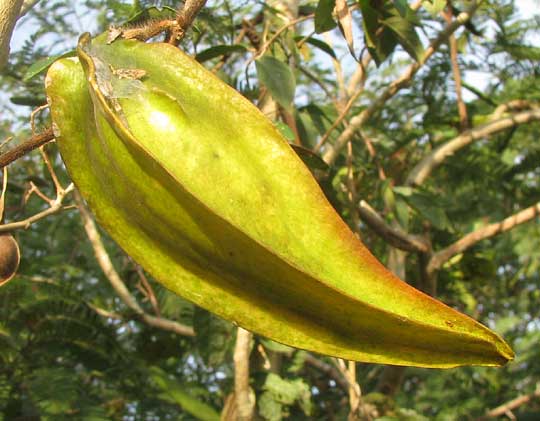
In the southeastern US similar pods are produced by a halfway uncommon Milkweed-Family vine called the Eastern Anglepod, Gonolobus suberosus, but that species doesn't occur in Mexico.
I sent these pictures to my friend Ulli in Germany, who studies this group of plants. He asked for seeds, for he grows the plants he studies in greenhouses at the University, doing genetic sequencing on them. He says that this is a very interesting genus, and that the only representative he has of it is remarkable because its flowers produce nectar that changes from clear to black! He further says that black nectar occurs in scattered species in the family, but nobody knows why.
So, here we have something little known, something that simply by posting a picture of it and saying that in February the pod was found in central Yucatán, we're contributing information that someday somebody will be glad to have. And if I can get seeds to Ulli, maybe someday he'll publish something about it himself.
Makes me feel good.
from the April 3, 2016 Newsletter issued from Hacienda Chichen Resort beside Chichén Itzá Ruins, central Yucatán MÉXICO
DANGLING ANGLEPODS
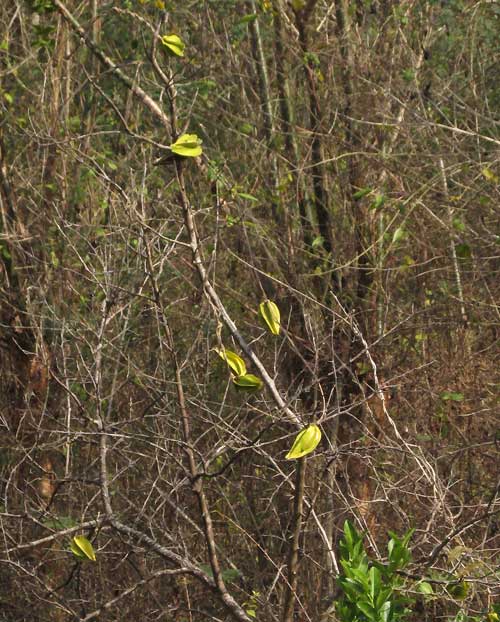
Back in 2010 we found a "climbing milkweed" pod amid a thicket of scrubby trees on the road to Pisté, which we identified as a Macroscepis. Now six years later a little more information about the plant is available on the Internet and the name seems to hold. Moreover, now I'm seeing more of them, whole groups of them dangling in dry-season-leafless shrub and small tree branches, as shown below:
A shot of another pod shows that they can have more "fins" than the one photographed in 2010, though an extra fin might be only partially developed, as seen below:
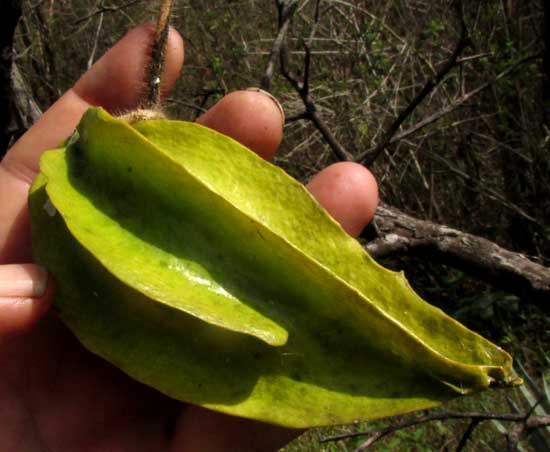
That picture confirms, however, that the stems and petioles retain stiff hairs late into the season.
from the July 31, 2016 Newsletter issued from Hacienda Chichen Resort beside Chichén Itzá Ruins, central Yucatán MÉXICO
ANGLEPOD FLOWERS FROM THE PODS PICTURED ABOVE
Last week our pictures of the poorly documented Anglepod, Macroscepis, helped firm up an ID we'd made earlier about fruit-pods suspected of being the same species. This week I found the very same vine that in April bore the pods illustrated in the above entry, now flowering. Now the flowers of that vine can be compared with those featured last week {see top entry on this page}. If the flowers are the same, it'd confirm that both flowers and pods on this page are Macroscepis. You can see flowers on this week's vine -- the same vine producing the pods we photographed last April -- below:
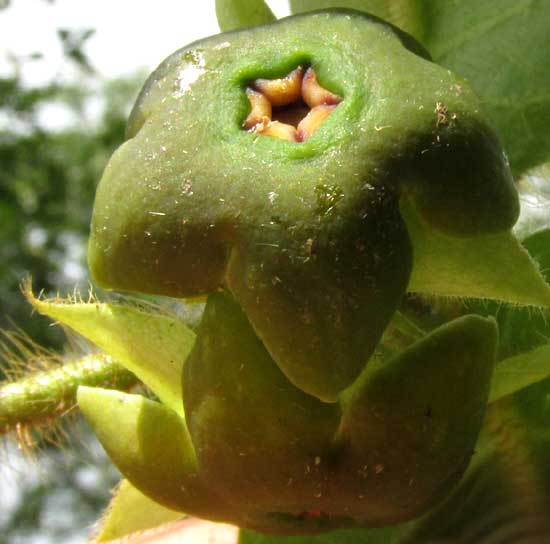
Corolla lobes of this week's flowers were much more turned downward, or reflexed, than last week's, and the sepals don't seem quite as large. However, that might be because of different ages, or because last week's flowers were photographed in deep, shadowy forest, while this week's were on a dead tree snag in a weedy field open to abundant sunlight all day long. I think they're the same species. The field vine also bore leaves we can compare with last week's deep-forest plant, shown below:
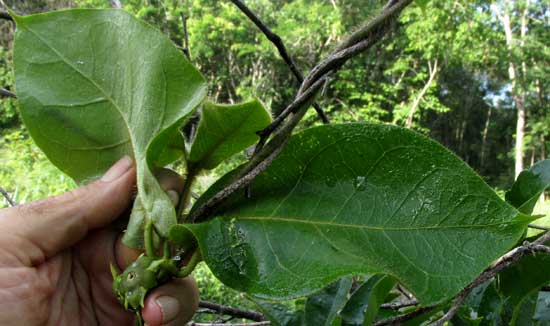
Leafshape and venation seem to be more or less alike. Therefore, now I'm more confident than ever that all flowers and pods we thought were Macroscepis really are that genus.