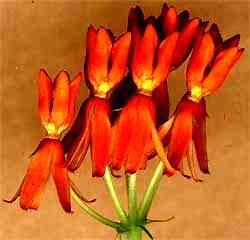
Milkweed flowers are so bizarre and interesting that it can be challenging to relate them to our Standard Blossom. You can see the situation with the flowers of the Butterfly Weed, Asclepias tuberosa, at the right. Like our Standard Blossom, milkweed flowers do bear the usual calyx and corolla, but beyond that their structure departs drastically.
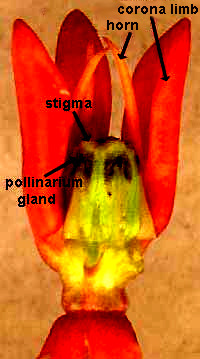
The image at the left shows one of the above flowers with two of its corona limbs or hoods removed, and corona limbs are one thing completely missing on the Standard Blossom. The five corona limbs considered together are termed the corona or crown. Nestled within the circle of limbs or hoods are slender items known as horns, also absent in the Standard Blossom.
The greenish thing in the picture's center, though, is the most mind-boggling part, also missing from the Standard Blossom. It's composed of the flower's fused-together stigma and anthers, and is known as the gynostegium. Don't let the fact pass you without notice that in normal flowers stigmas are part of the female ovary, while anthers are part of the male stamen. Notice the thing on the gynostegium labeled pollinarium gland.
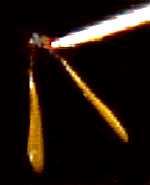
At the right you see a much magnified image of a pollinarium gland that's been removed with its two appendages and now resides at the tip of a silvery pin's head. Below the dark pollinarium gland, the two honey-colored appendages are pollinia. Pollinia consist of stuck-together pollen grains, which explains why they're yellow. The whole upside-down-V-shaped structure with its pollinarium gland and two pollinia is called a pollinarium. So: The pollinarium comprises a gland attached to two pollinia.
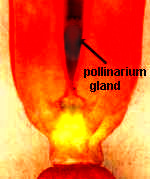
At the left, a pollinarium gland peeps between the bases of two corona limbs. Now imagine this:
An insect pollinator is attracted to the milkweed's bright flower. As the insect crawls all over the flower looking for nectar, one of its legs slips between two of the flower's corona limbs. As the leg passes through the space between the corona limbs, it snags on the pollinarium gland. As the leg is withdrawn upward, the entire, upside-down-V-shaped pollinarium is removed from the flower and remains stuck to the insect's leg!
By now you can guess that when the insect visits the next flower, the pollinarium dislodges from the leg, the pollinia with their stuck-together pollen grains come into contact with the blossom's stigma, and then pollination takes place. Sneaky, huh?
When you find a wild, flowering milkweed, see if you can find a pollinarium gland positioned as shown above, between corona limb bases. Often glands will be present between some limbs but not others, because some will have been removed. If you find one, place a pin beneath it and maybe you can lift out the entire upside-down-V-shaped pollinarium.
And while you have a flower, be sure to look for broken-off insect legs stuck in the flower, because sometimes an insect's leg breaks off before the pollinarium comes free!
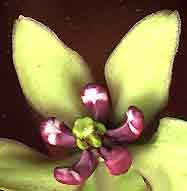
The picture at the right shows the flower of a Green Milkweed, Asclepias viridis, a common wildflower in parts of the US. It's included here to illustrate that milkweed hoods, coronas and other parts come in many, many interesting and pretty configurations. For, the Milkweed Family, the Asclepiadaceae, is home to over 2000 species in about 250 genera, and the flowers of every species are different.