Why do trees have bark?
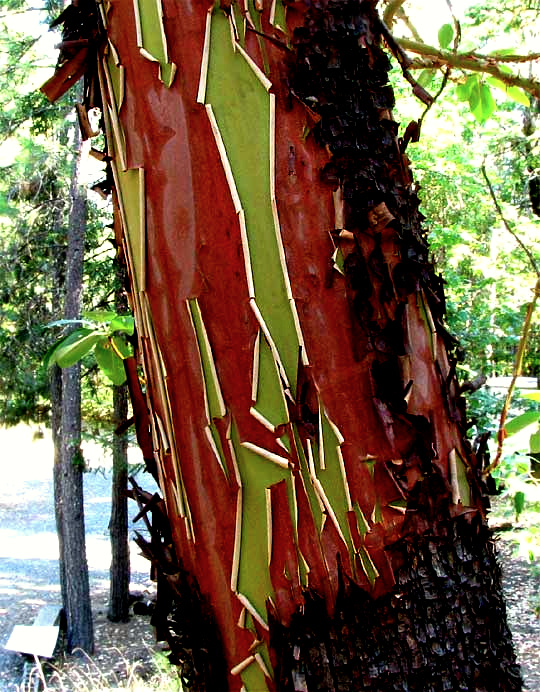 Exfoliating Pacific Madrone Trunk, Arbutus menziesii
- bark protects the delicate cambium layer just below the bark
- bark retards the loss of water
- bark protects from temperature extremes
- bark protects from intense sunlight
- bark is somewhat porous, so bark helps the tree breathe
- like a scab on a wound, bark protects against disease organisms
From species to species, tree trunk features, especially bark, are so distinctive that with practice you can learn to identify your local trees even in winter when they're leafless.
- SMOOTH
- SCALY or PLATED
- WARTY
- SHAGGY
- PAPERY
- FURROWED
- FIBROUS
Some tree trunks are graced with spines such as those shown at the left, on the Honeylocust, Gleditsia triacanthos. Those branching spines, however, are modified stems, not features of the bark. Bark is unable to branch like that.
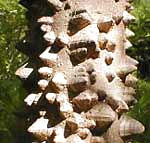
On the other hand, bark can form spiny features such as those shown at the left on Hercules-club tree, also known as the Toothache-tree, Zanthoxylum clava-herculis. If you look closely at one of those spines you can see that it's composed of layers of bark. Therefore, bark can do interesting things, but it can't branch, root our flower.
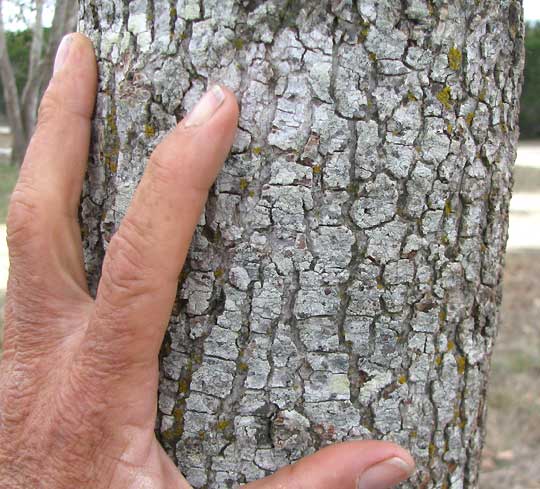
In contrast to the two above barks, the shallowly and irregularly furrowed bark at the right, of the Sweetgum tree, Liquidambar styraciflua, is about as "average" as a tree bark can get. In fact, Sweetgum bark on a tree of this age (not too young, not too old) can serve as a "Standard Bark" against which we can compare all other kinds of bark. The differences that other barks display can be thought of as what's "special" about them.
Notice these "average" features about the Sweetgum's bark:
- the bark is grayish, not very dark, not very light
- ridges between vertical furrows or fissures are flat, narrow and irregularly divided into blocky sections
- furrows are neither very shallow nor very deep
Now let's look at other trunks to see how they differ from our "standard trunk," the Sweetgum's.
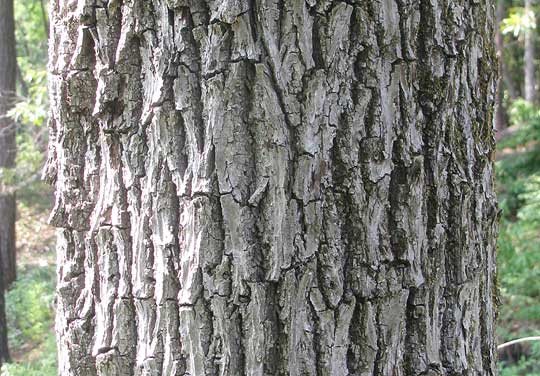
At the left, a Sand Hickory trunk, Carya pallida, displays much deeper and longer vertical furrows than on the Sweetgum, with prominent ridges which are not flat between the furrows. The horizontal breaks across the ridges are more systematic and noticeable than with the Sweetgum. The general structure is similar to that of Black Walnut, which belongs to the same plant family, but Black Walnut bark is blackish.
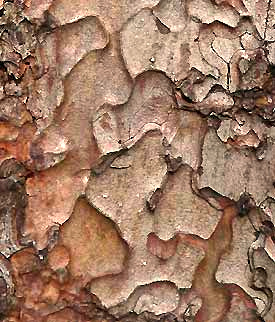
The various pine species, at least when older, tend to have flaky, reddish-brown bark. At the right, bark on the Ponderosa Pine, Pinus ponderosa, exhibits a special kind of flakiness, with its "flakes" seeming to fit together like pieces of a jigsaw puzzle. If you get close enough to notice this, you should also smell the tree's fragrant, somewhat medicinal odor of turpentine!
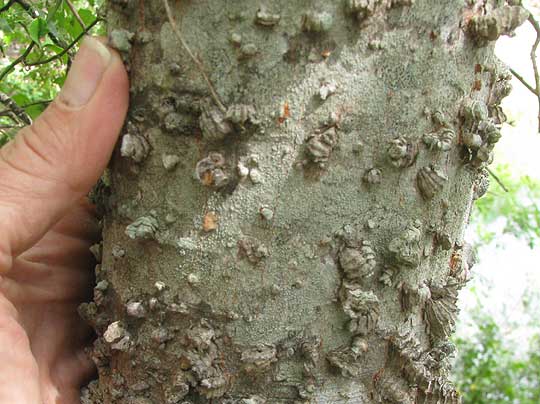
At the left, bark of the Netleaf Hackberry, Celtis reticulata, like other hackberry species, is described as warty. The warts are woody-hard and don't easily come off. Younger trees may have smooth bark, and on older ones the wart may join into irregular lines or make furrows. The dark gray color is distinctive, too.
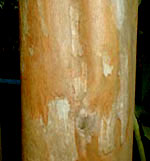
At the right is the smooth but blotchy bark of the Crape Myrtle, Lagerstroemia indica. 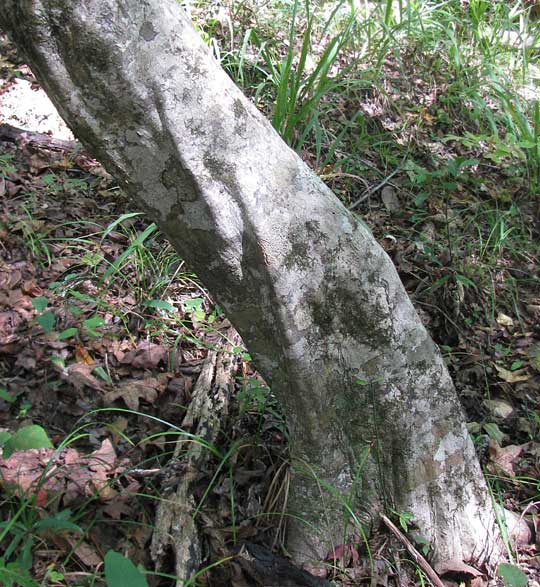 Not only are the smoothness and blotchy colors distinctive, but the trunk itself exhibits broad, rounded ridges like muscles beneath the skin. At the left, the Hornbeam, Carpinus caroliniana, is famous for its muscularity, its smooth, senewy trunks.
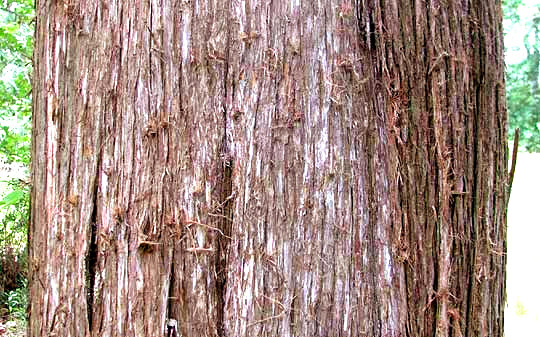
At the right, the bark of the Eastern Redcedar, Juniperus virginiana, consists of long, fibrous strips which with time come loose, at least at their ends, the whole thing having an ashy gray appearance. If you pick at the bark fibers, you'll uncover reddish bark below, and probably smell the cedary fragrance. However, this species keeps its green foliage year round and in most of its distribution area is the only juniper (usually called cedar), so it's easy to identify even without noticing the bark.
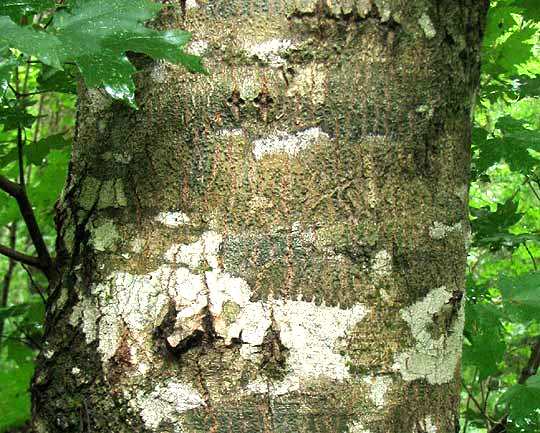
The Southern Sugar Maple trunk at the left, Acer floridanum, is conspicuously splotchy. However, the splotches are caused by brownish lichens on an otherwise smooth, pale gray trunk becoming somewhat shaggy on older trees. Especially on many kinds of trees in moist environments with little air pollution, lichen splotches often create such patterns. Lichens are to be appreciated, for they indicate clean air, but don't let them distract you from features of the actual bark.
By now it should be clear that once you start paying attention to tree bark, there's a whole world of ways bark can be. This means that even during the darkest winter days we can go into the woods and have the fun of knowing our trees just by their bark.