Except for squirrels, dogs and cats, most of the mammals in our backyards are nocturnal -- they come out at night. That keeps us from seeing most of them most of the time. However, we can still learn a lot about our neighborhood mammals by learning to identify their paw prints. With the help of someone who knows tracks, or published field guides, you can teach yourself how to identify your local tracks.
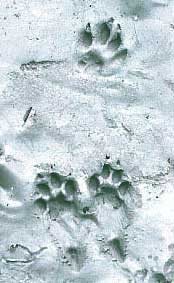
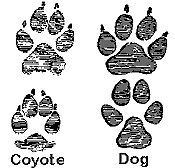
In field guides usually drawings are presented such as the above showing the subtle differences between the paw prints of a Coyote and a domestic dog. In the field the distinctions are seldom as clear as in such drawings. The slender back pad of the Coyote's back paw often aren't visible unless under almost ideal conditions, such as on firm mud. The picture at the left shows such ideal conditions. Can you decide whether those tracks are of a dog, coyote, or something else? Those are dog prints, and the bottom pair shows how the dog sat on its hind legs before proceeding forward.
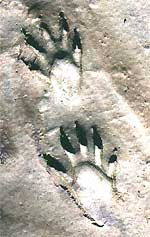 At the right you see another track, again under nearly ideal firm-mud conditions, and again the track is of one of the most commonly found wild-animal tracks in North America. It's the Raccoon. What's the most conspicuous difference between the raccoon's print and that of a dog? Well, a dog's paw print shows only four toes, while a raccoon's print shows all five!
Besides toe number, other basic things to notice when confronted with an unknown track include size, arrangement of prints on the ground, and habitat. For instance, you'd not expect a beaver track to be running along the crest of a mountain.