
 Ordinary stems of Sycamore tree bear leaves and fruiting heads
Stems can behave so strangely that sometimes to be sure that what we're seeing really is a stem, we need to remember details of the stem definition. Here's the definition given on our Stems Introduction page:
A plant stem is one or more elongating, "first-order" parts of a plant, from which further stems, buds, leaves and reproductive parts may arise.
By "first order" is meant the first stem to arise from the seed, and stems that come after it, but not the buds, leaves and reproductive structures finally terminating the stems.
STOLONS
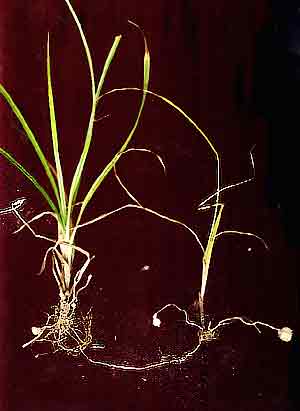
As seen at the right, stolons are slender stem-branches running horizontally away from the main plant. There's disagreement whether the "runners" can be either aboveground or belowground, an issue further addressed below.
At the right you see two plants of Nut Grass, Cyperus esculentus. The larger "mother plant" on on the picture's left side issued a stolon that has grown about six inches through the soil, then the stolon budded and from the new bud arose the smaller, younger plant at the right in the picture. Note that some stolons also end in roundish, potato-like tubers.
One indication that the "runners" are stolon-type stems and not roots is that adventitious roots arise along the runners' lengths, issuing from joint-like nodes. Nodes are explained on our Stem Introduction page. Roots don't have nodes, but stems do. When the Nut Grass's tubers sprout new plants, the sprouts will be arising from the tubers' nodes.
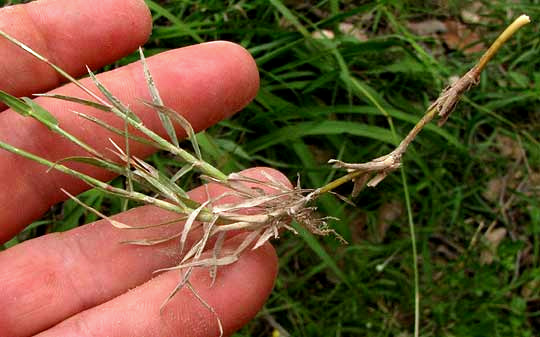
Especially in the field of horticulture, stolons may be regarded as aboveground "runners" only, with rhizomes being their underground counterparts. In basic botany, however, stolons often are considered to occur either above or shallowly below the ground's surface. The authoritative Flora of North America describes Nut Grass with its underground stems as "stoloniferous." Above and at the left, aboveground runners of Bermuda Grass, Cynodon dactylon, also are described by the Flora as "stoloniferous."
RHIZOMES
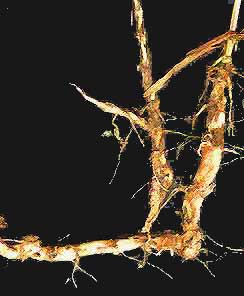
Rhizomes are underground, usually horizontal stems, often resembling roots but having nodes from which aboveground shoot may arise. This definition is the same as that for stolons, except for its emphasis on occurring underground. At the left you see a horizontal rhizome definitely dug from underground. It's from Johnson Grass, Sorghum halepense. Note its obvious joints, or nodes, and that from those nodes arise vestigial roots, as well a whole new plant, appearing at the left of the "mother plant" at the far right.
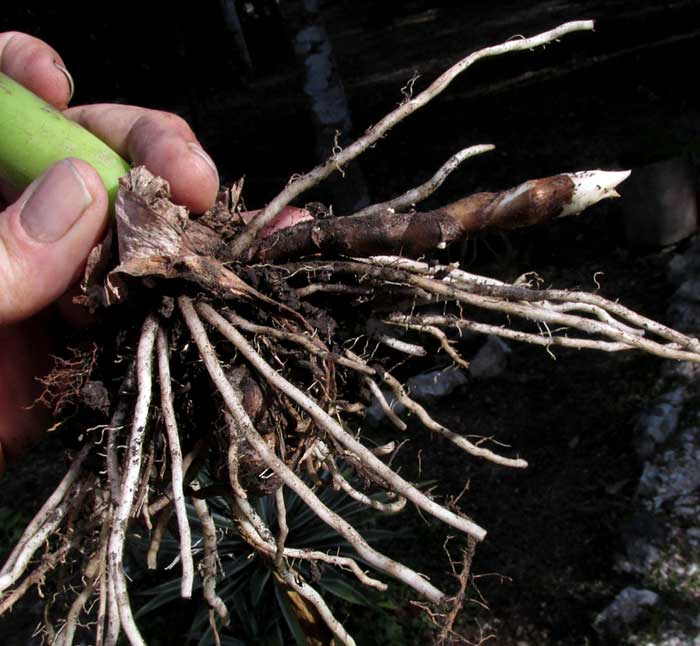 Underground shoot of Arrowleaf Elephantear, Xanthosoma sagittifolium; RHIZOME
The above Johnson Grass with its underground stem is described as "rhizomatous" by the same authoritative Flora of North America which describes both the aboveground runners of Bermuda Grass and the belowground stems of Nut Grass as "stoloniferous."
There seems to be an unexplained inconsistency here. In 2021, our survey of technical papers available on the Internet finds some authors following the traditional standards of the Flora, but, worldwide, the tendency appears to be toward regarding stolons as aboveground "runners," while rhizomes grow belowground. For example a 2021 study by Lei Guo and others in Current Opinion in Plant Biology states flatly that "While stolons grow above the ground, rhizomes grow beneath the ground."
TUBERS
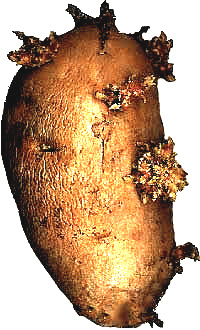
In flowering plants, tubers are enlarged, typically underground stem segments containing nutrients stored for the development of future plants arising from the tuber. The potato at the left is a tuber, which is a modified stem section.
Most of us find it hard to think of potatoes as modified stems. The key to recognizing a potato's "stemness" is to notice the bushy sprouts developing from a potato's "eyes," as seen at the left. That's an old potato left too long in storage. On new potatoes you only find shallow indentations, the "eyes," like the one on the left side of the potato in the picture.
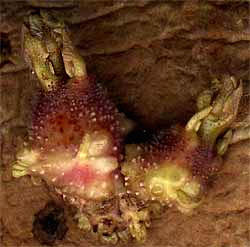
Roots don't produce sprouts, but stems can. In fact, in the picture at the right, you can see that the roundish, fleshy parts below the greenish sprouts (the future potato plants) have a kind of dividing line across the middle, and that tiny sprouts are emerging from this division. The dividing point is a stem node. In that picture we're seeing a modified stem (the potato) branching into other modified stems (the bushy growths developing from the potato's "eyes"), on which yet new stems are developing (at the tiny growth's node).
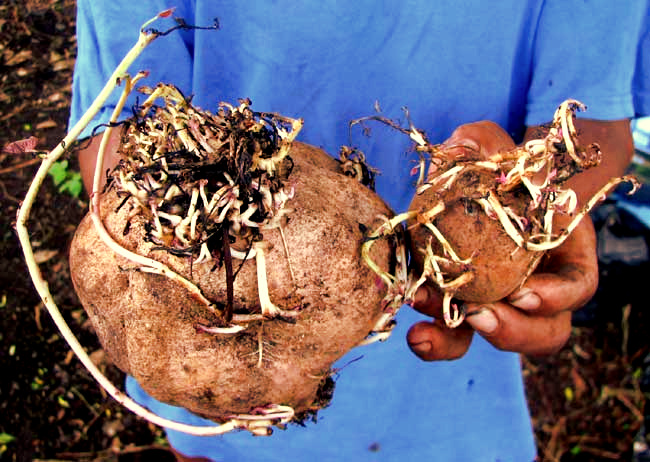
At the left, stored tubers of a traditional south-Mexico Maya cultivar of the Sweet Potato, or Camote, Ipomoea batatas, issue long, spindly stems from various nodes over the tuber's body. In hot, lowland tropical areas where regular potatoes don't grow well, such tubers are very important foods, often more productive and better tasting than white potatoes.
CORMS
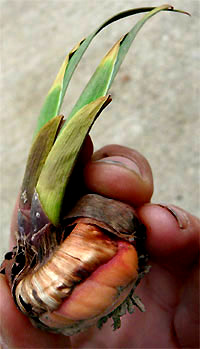
Corms are short, thickened, solid, usually subterranean, sometimes fleshy stem bases containing nutrients stored for the development of a future plant arising from the corm. This definition is the same as for tubers, except for its emphasis on being a swollen stem base, with the implication that it's oriented vertically, not horizontally, as tubers usually are. Also, typically tubers are connected to the main stem by slender, cord-like connections, while corms are, as the definition says, nutrient-storing stem bases.
The sprouting gladiolus "bulb" at the right is a corm. Note that there's no articulation between the corm body and green shoot. At the corm's base, adventitious roots are emerging.
Above, the word "bulb" is in quotation marks because -- despite garden shops selling "gladiolus bulbs" -- technically there's a difference between corms such as the gladiolus has, and "true bulbs." Despite their similarity, in corms, nutrients are stored for the next generation in stem tissue, while in bulbs, it's in leaf tissue.
WATER-STORING STEMS
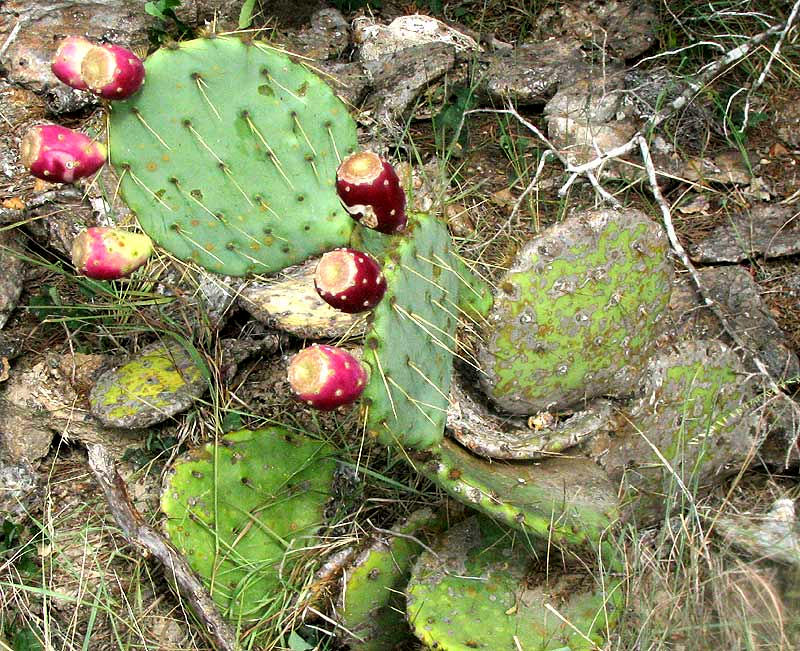
The above pricklypear cactus bears the best-known kind of water-storing stem, for the oval, green "pads" are stems modified to store water between infrequent rains. Instead of being woody, like tree stems, water-storing stems usually are fairly soft and thick; They're "succulent."
STRANGLER FIG STEMS
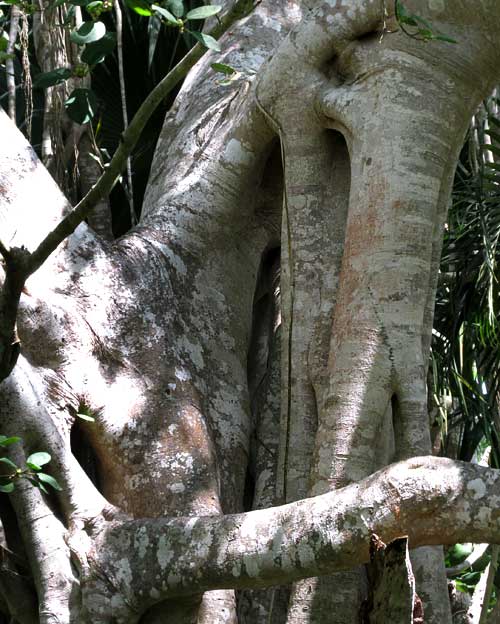
Tropical fig trees belong to one of the largest genera of all flowering plants, the genus Ficus. Many fig species are known as "strangler figs." We have a special Strangler Fig Page showing how stranglers strangle and kill their host trees. Part of the strangling story is that the fig's dangling "aerial roots" proliferate, grow and grow, and when they begin meeting one another, fuse with or "graft" onto one another, as shown at the right.
We end with this picture just to remind you that Nature is full of surprises, and that our human definitions and artificial mental compartments hardly touch the surface of what Nature-in-general is really all about.