 The term "stem" is a general one used in many contexts. Here we're dealing with plant stems.
Normally we recognize a plant stem when we see one, but describing what one is can be tricky. Here's one way of expressing it:
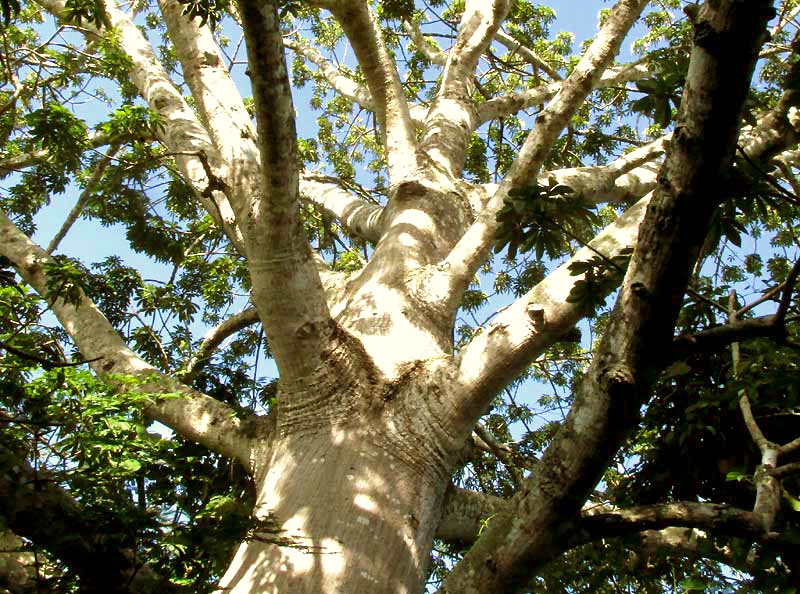
A plant stem is one or more elongating, "first-order" parts of a plant, from which further stems, buds, leaves and reproductive parts may arise.
At the right, The "first-order" part of the definition says that the tree's trunk is a stem. The "from which further stems, leaves and reproductive parts arise" part tells us that branches and sub-branches off the trunk also are stems. But buds, leaves and reproductive parts aren't. Adventitious roots may grow from certain stems, but regular roots don't.
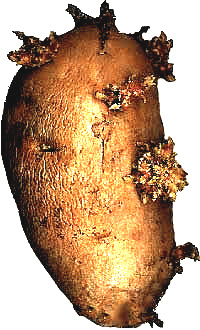
On our Modified Stems Page we see that stems can take many forms, and sometimes can be confused with roots. (Even that potato at the left technically is a section of modified stem.) Here we can practice being flexible when thinking about stems, while at the same time keeping the details of our definition in mind.
NODES

In the world of stems, the concept of "node" is huge. On the above bamboo stem, there are two nodes.
Nodes are noticeable and more or less regularly occurring points along a stem from which stem branches, buds, leaves and reproductive parts may arise.
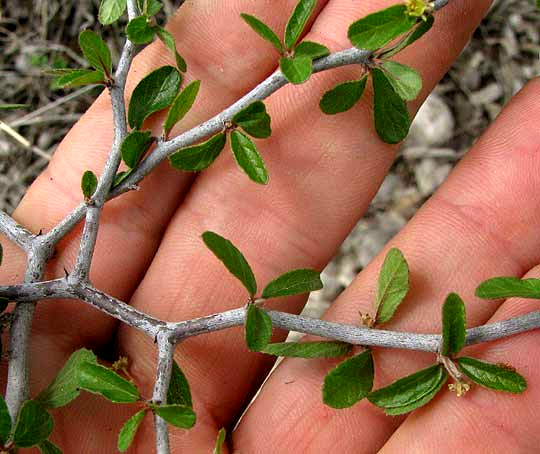
On the branching stem of the Texas Hog Plum, Colubrina texensis, at the right, the gray, woody branches are stems, with clusters of leaves and new stems arising at nodes. On this species, the stems zigzag a little, bending at each node. Notice that between the nodes basically nothing happens. Stem parts between nodes are called internodes. The main reason we'd speak of internodes is to refer to their length, which may vary among species or parts of a plant.
MULTIPLE STEMS
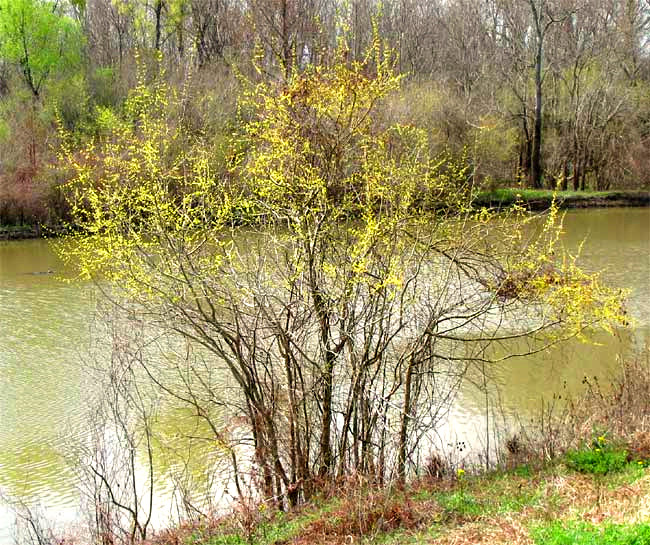
Many plants, both herbaceous and woody ones, instead of producing one central stem make several. Such plants may be referred to as "bushes" or as being "bushy." At the left, the Swamp-Privet, Forestiera acuminata, naturally produces numerous stems, and its "bushiness" helps us identify this interesting plant from whose bark a health-giving drink traditionally was concocted by indigenous Americans.
Clumped stems tend to protect one another from cold wind and hot sun, plus, if one stem breaks, it's less of a loss to the plant than if it had been the only one. On the other hand, if a plant invests its resources in many stems, then it's unable to grow as tall as it could have with only one stem, and therefore may receive less sunlight than its taller neighbors.
CLIMBING STEMS
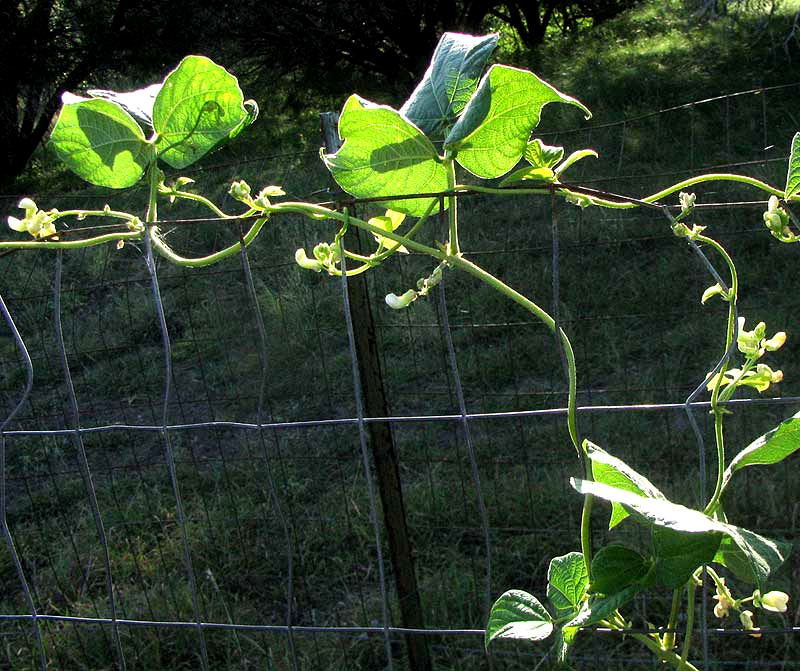
Bean vines in our gardens have climbing stems, as do grapevines and morning-glory vines. If you think about it, having a climbing stem is a kind of sneaky adaptation. Essentially it enables the climbing plant to grow toward more sunlight without having to invest its own resources in building stiff, strong trunks or stems capable of holding the plant body erect.
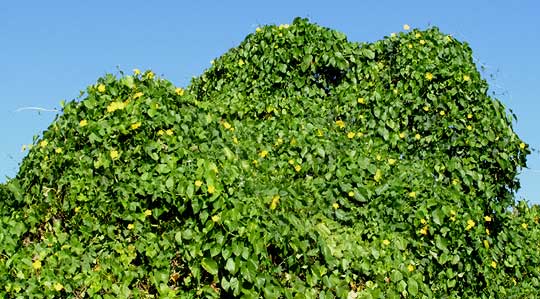
In fact, sometimes climbing stems enable a species to take so much sunlight from other species they've overgrown, that the plants supporting them die, being unable to photosynthesize enough food for themselves. At the left, that's the case with the garden-escaped "Vegetable Sponge" vine, Luffa cylindrica, choking out plants below it. The southeastern US's invasive Kudzu vines do the same. Most of the time, however, climbing stems simply enable twining species to gain a foothold in an ecosystem, thus increasing ecosystem diversity, and strengthening it.
PROSTRATE STEMS
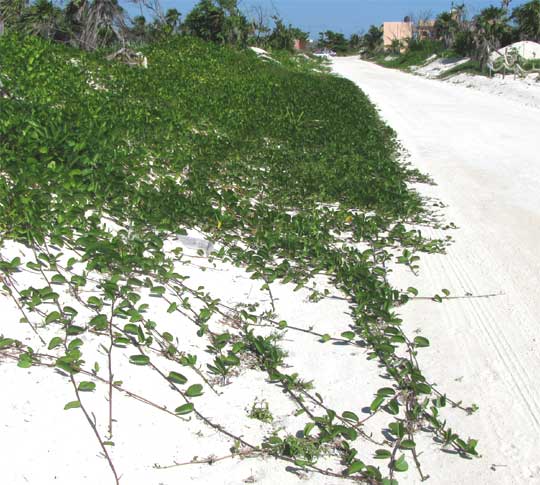
Prostrate stems trail across the ground, clamber over, or lean upon other plants, rocks, fences, or whatever happens to be in the way. Cucumber, winter squash, and sweet potato vines have prostrate stems. At the right, Beach Morning-Glory, Ipomoea pes-caprae, spreads its photosynthesizing stems and leaves onto open sand much faster than the sand can be colonized by upright species.
ARMORED STEMS
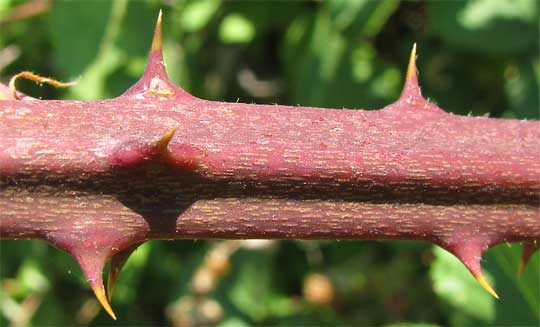
Stems often defend plants from animals who may want to eat them, or simply trample over them. At the left, the spiny stems of Himalayan Blackberry, Rubus armeniacus, often grow in such dense tangles that deer and other such herbivores are kept from grazing the plants' leaves and immature fruits.
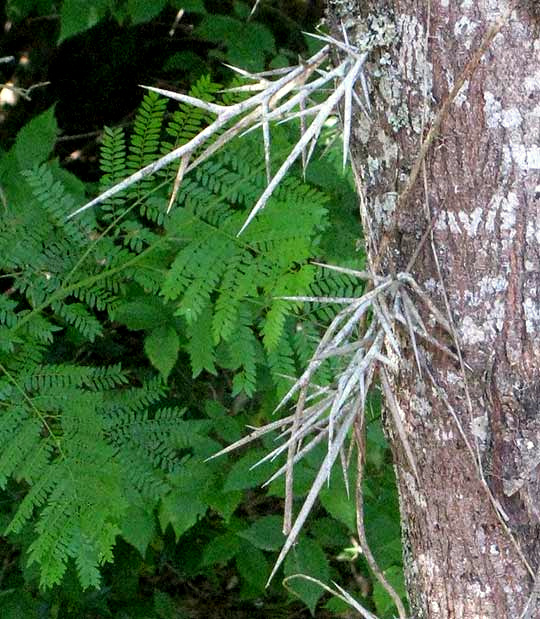
At the right, the Honeylocust tree, Gleditsia triacanthos, takes care that few animals will want to climb its trunk to graze on its soft, feathery leaves, such as those seen in the background.
By the way, the Honeylocust's spines are able to branch because, technically, they are modified, sharp-pointed stems, and branching is something that stems in general can do.
You see, stems can do all kinds of things!