 Garden seeds
Winter comes and the plant must die. The species survives because plants leave behind seeds which live through the freezes and snow, and next spring germinate and produce new plants. Without seeds, the whole species would disappear in one season.
A forest fire leaves nothing but black ashes. But soon "weeds" appear amid the desolation, their seeds having parachuted there on the wind, or maybe dropped there by birds flying overhead. Hard-coated or deeply planted seeds of trees and bushes which may have survived the fire sprout, promising a new forest. Sometimes seeds that have lain dormant in the soil for decades, even longer, germinate just when they're needed.
Without seeds, modern agriculture would be impossible and most of humanity would starve. The whole world would become unrecognizable. Why don't we have a holiday for celebrating the miracle of seeds, a holiday during which we'd all sow seeds?
SEED STRUCTURE
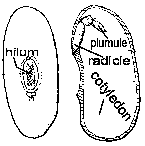
Seeds are embryonic plants protected by an outer covering. They are far more complex than pollen grains and flowers, for they contain the makings of entire plants, and bear genetic information telling how to make stems, leaves, flowers and their parts. The drawing at the right shows a bean's most conspicuous parts. In dried beans, the parts are shriveled and hard to make out. In seeds other than beans, the parts may be larger or smaller, or not even visible to the naked eye
- The HILUM is a scar visible on the bean's surface, along the edge. It marks the point where the seed was attached to its fruit.
- The COTYLEDON: When you break apart a bean, most of what you see -- the smooth, waxy matter -- are two cotyledons, one in one bean half, another in the other. Seeds of plants known as monocots contain only one cotyledon, while dicots have two. The cotyledons' tissue is endosperm which will provide food for the future emerging sprout. That nutrition will be needed until the sprout can begin photosynthesizing its own food.
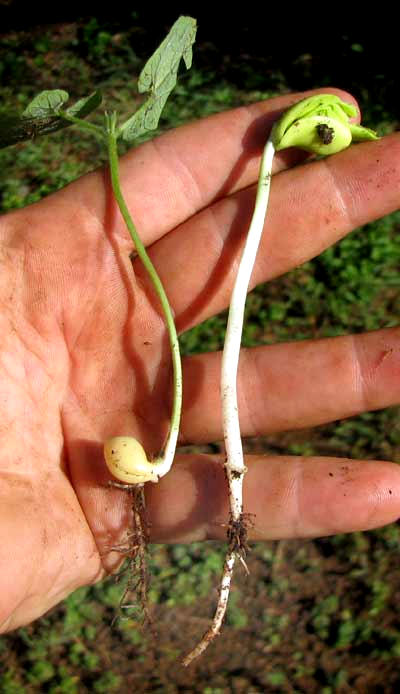
At the right you see two very different manners by which sprouts can relate to their cotyledons as the sprouts emerge from the soil. The newly germinated sprout on the picture's left side, bearing green leaves atop it, are of a morning-glory vine. Its pale, bulging cotyledons remain in the ground when the seed sprouts. In contrast, the bean sprout to its right carried its two cotyledons atop its elongating stem as it emerged, and now regular leaves are developing between the two airborne cotyledons.
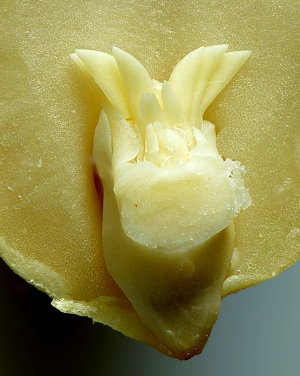
- The PLUMULE is the future above-ground part of the plant. At the right, in a picture of the bottom part of a broken-open peanut, the plumule is the bushy item (folded future leaves and stem) atop the bump. As a bean germinates and sends up its first stem and cotyledons, the plumule rides between the rising cotyledons, then enlarges into stems and leaves as the cotyledons stay at their same low elevation.
- The RADICLE shows up in the picture as the bottom part of the bump below the plumule. It's the future primary root. When the seed germinates, the radicle grows downward and eventually branches into secondary roots.
SEEDS OR FRUITS?
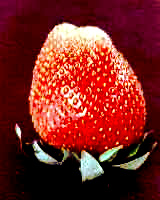
Sometimes, as with the strawberry at the left, you might wonder where the seeds are. The strawberry is a fruit, but it's a "multiple fruit," as explained on our multiple fruit page. The strawberry derived from a single flower with many separate pistils consisting of stigma, style and ovary. Each of the many ovaries developed into a tiny achene-type fruit, which is a dry fruit that doesn't split, and contains only one seed. The pale specks on the strawberry are the fruits. They're simple fruits on a compound fruit. And inside each tiny, simple, achene-type fruit, there's a single seed.
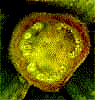
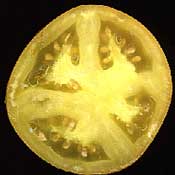
To help visualize all this, it's good to keep this in mind: Seeds are matured ovules. In the cross-section of a tomato flower ovary at the left, the ovules are the tiny, roundish items ordered in three horseshoe-shaped lines. At the right, that slice of tomato is from a tomato plant's berry-type fruit, in which the former flower's ovules have matured into seeds, even as the ovary became the tomato fruit.
HOW SEEDS GO TRAVELING
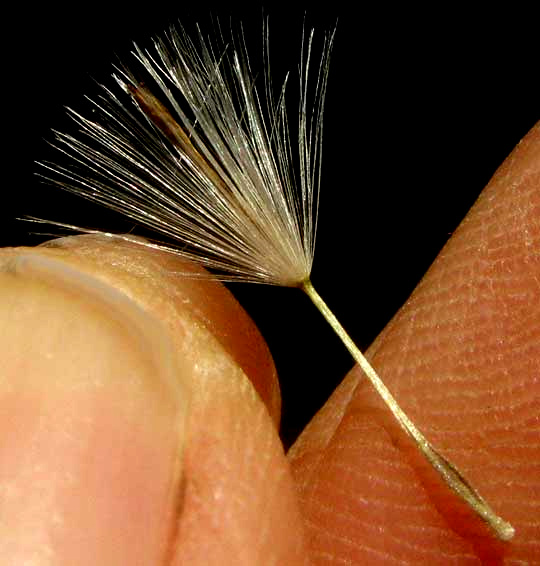
One reason for seeds to exist is to carry the makings of new plants into new places to populate. Mostly the travel arrangements are provided by the fruits, not the seeds. When an animal eats the above tomato, for example, the hard seeds pass through the animal's body and get deposited wherever the animal poops. At the right, wind can carry such parachuted fruits for long distances. Inside the slender, brownish, cypsela-type fruit body at the bottom of that parachute, there's a single seed that will produce the wildflower called Silverpuff, Chaptalia texana.
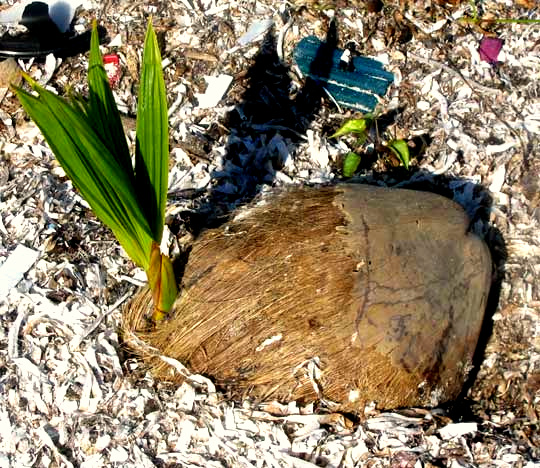
Even with the coconut at the left, which may have floated for hundreds of miles before washing up on a beach, where it rooted and sprouted, it's the fruit that provided passage. Coconuts are fibrous, one-seeded drupes, so they're fruits, not seeds. The fibrous, floating husk derives from the middle layer of the former flower's ovary wall (the mesocarp), not from the ovule, which became the seed. The coconut seed nested inside the husk begins with a hard shell surrounding edible endosperm and sweet, drinkable juice, which was meant for the growing coconut shoot, not us humans.
One way that a seed itself may take charge of its travel strategy is by providing food for wildlife. Squirrels store oak-tree acorns in underground caches. Acorns are nut-type fruits containing one seed, but the acorns wouldn't be cached if their single seeds didn't provide substantial nourishment with their endosperm.
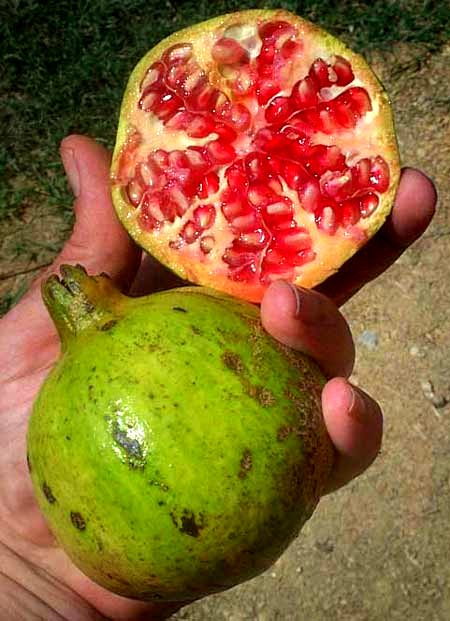
Another way a seed can contribute to its own travel needs is with modifications of its outer protective layer, the seed coat. Depending on the species, seed coats can be very thin and papery as in the peanut, or extremely hard, as in the coconut and honeylocust. It can even be fleshy and tasty, as in the pomegranate, shown at the right. Animals eat pomegranates because the seed coats inside them are nourishing, and to some of us even taste good.
Still, in most species, it's the fruits -- especially edible and tiny, one-seeded ones -- who travel, and the seeds just go along for the ride.