If you're unfamiliar with terms such as calyx, corolla and ovary, you may want to review our Standard Blossom page. And then there's this:
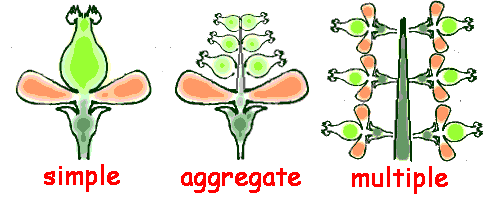
Above, the flower diagram for "aggregate" fruit type shows a side view of a single flower with several separate ovaries aggregated above the flower's green calyx and pink corolla. The ovaries can be of various types, as shown below.
WHEN OVARIES ARE DRUPELETS
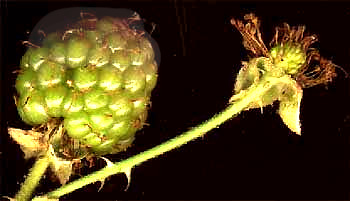
Drupelets are like little drupe-type fruits, which means that they consist of soft tissue surrounding a single hard seed, or "pyrene." Blackberries, dewberries and raspberries are aggregate fruits whose ovaries mature into drupelets. The picture at the right shows two stages of a developing blackberry fruit. At the picture's far right, the flower's petals have fallen away, but the calyx remains, as do many slender, brown, dried stamens issuing from below a cluster of green, oval ovaries just beginning to enlarge. On the picture's left side, the ovaries have expanded enormously, the stamens have mostly fallen away, and the blackberry fruit is taking shape.
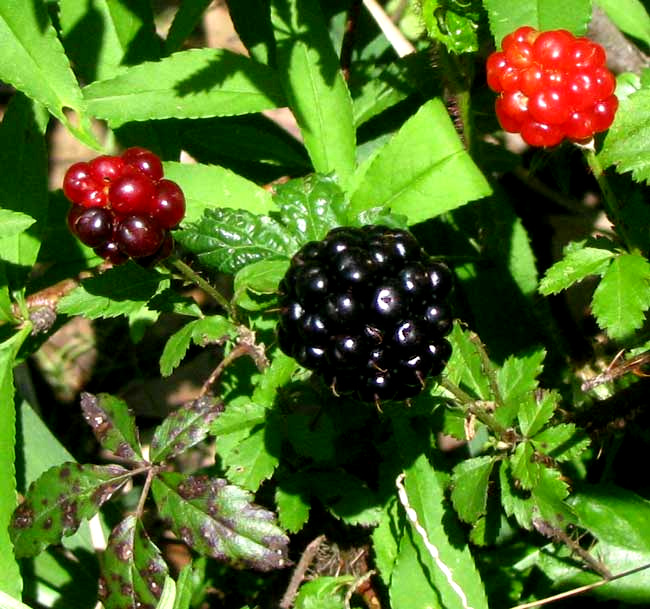
Blackberry fruits as they're developing start out green, then right before ripening turn red, and finally become a sweet, juicy, black aggregate fruit. At the left, fruits of the Southern Dewberry, Rubus trivialis, illustrate the red and black stages. Animals eating the fruits know to choose the black ones.
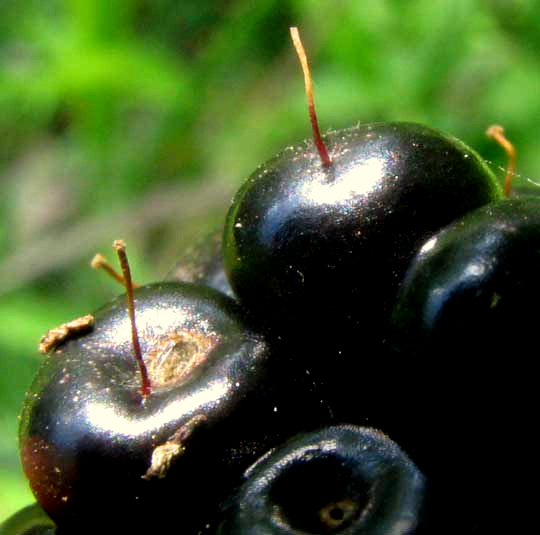
When you go picking blackberries, dewberries or raspberries, look for what's shown at the right. That's a close-up of ripe dewberry drupelets showing shriveled remains of a stigma-tipped style atop each drupelet. That makes sense because each drupelet began as one of several ovaries in a single flower.
WHEN OVARIES ARE ACHENES
Achenes, as defined on our Simple Dry Fruit page, are hard and dry, and contain just one seed. Probably the best known achene-producing aggregate fruit is the strawberry.
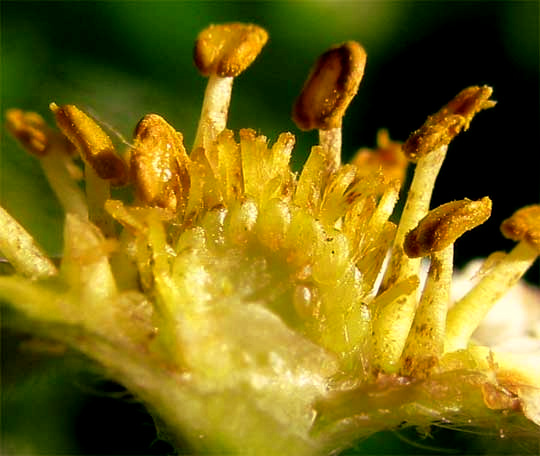
At the left, a strawberry flower has been broken down the middle. The larger items with whitish "stems," or filaments, bearing brownish bun-like items (the pollen-producing anthers) are stamens. The whitish, spongy-looking part at the picture's very center is the receptacle, which is like a spherical platform holding the ovaries. The small, shiny, yellowish, oval items crammed very close together atop the receptacle are the ovaries, the future achene-type fruits. Notice that atop each ovary arises a yellow, finger-like style topped with a blunt stigma, where pollen grains should land.
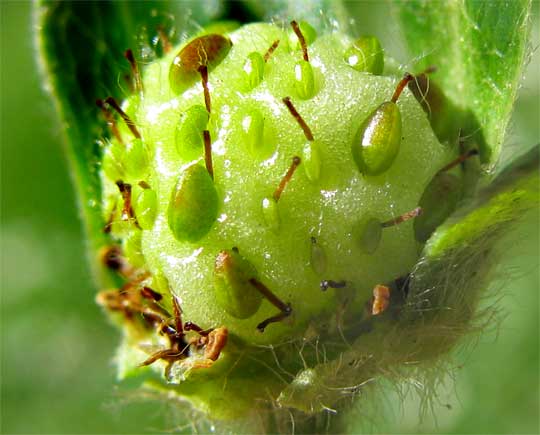
At the right, the pale spherical, greenish, spongy-looking item occupying most of the picture is a half-developed strawberry. It consists of a fast-enlarging receptacle, the spongy-looking part, covered with shiny, oval ovaries -- the future achene-type fruits -- partly embedded in the receptacle's surface. Notice the slender, brown items atop each ovary. Those are the stigma-topped styles which, now that the flower has been pollinated and the styles are no longer useful, are drying up and have turned brown. The flower's green calyx remains below the half-developed strawberry.
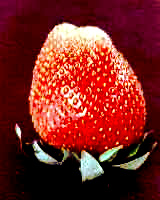
And of course at the left, that's a ripe strawberry ready to eat.
Now the receptacle has finished expanding, ripened, turned red, and that's what tastes so good. The tiny, pale-colored items sprinkled over the surface of the strawberry are the mature, achene-type fruits adorning this aggregate fruit.
WHEN OVARIES ARE FOLLICLES
Follicles, as defined on our Simple Dry Fruit page, are non-fleshy fruits which at maturity split down only one side to release their seeds, unlike a legume, which splits on both sides.
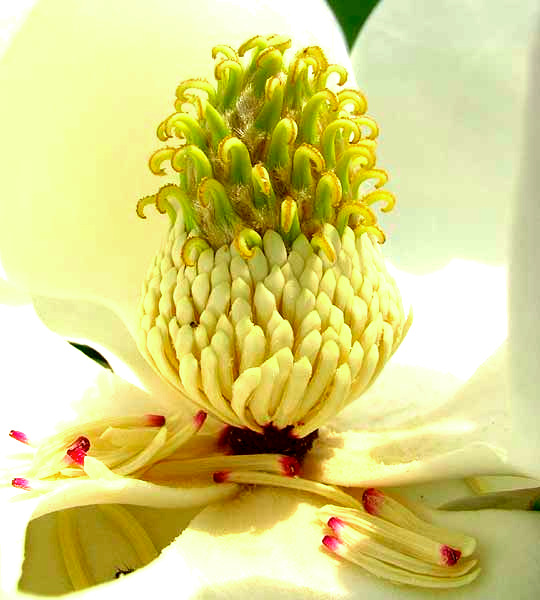
At the right, a side view of a flower of the Southern Magnolia, Magnolia grandiflora, shows how an aggregate fruit consisting of clusters of follicles can start out. The dense cluster of finger-like, white things in the image's center are stamens. Several stamens, their pollen released, litter the flower's "floor." The yellow, curly items above the stamens are stigmas arising atop hidden ovaries, each ovary a future follicle.
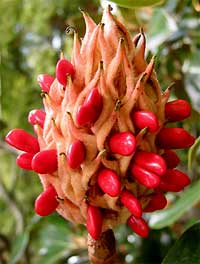
At the left, the flower's white petals and stamens have fallen away and the stigmas, now that the flower has been pollinated, have shriveled up, turned brown, and mostly fallen away. The ovaries, no longer hidden, have enlarged greatly, matured, and now are follicle-type fruits splitting down one side, releasing red seeds. The seeds' redness attracts animals who will eat them for the nutrition in their leathery coverings, then disperse the hard seeds to new locations, in their poop
WHEN OVARIES ARE SAMARAS
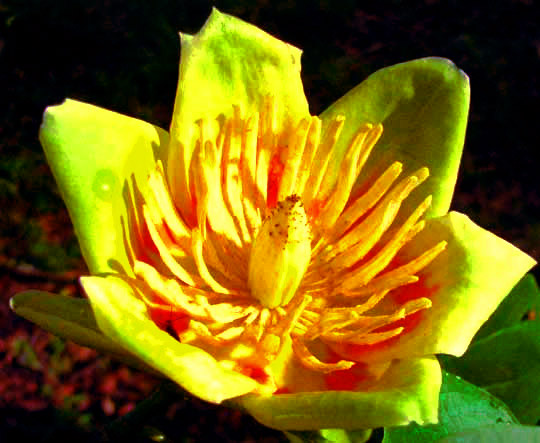
Samaras are defined on our Simple Dry Fruit page as dry, winged, one-seeded fruits. At the right, the saucer-size flower of a Tulip Poplar tree, Liriodendron Tulipifera, is very similar to the above magnolia flowers, though the object in the flower's center will produce achene-type, not samara-type aggregate fruits. In fact, Tulip Poplars and magnolias belong to the same Magnolia family. In the picture, the slender, finger-like items are the stamens, which surround a clump of tightly clustered ovaries, the future aggregate fruit.
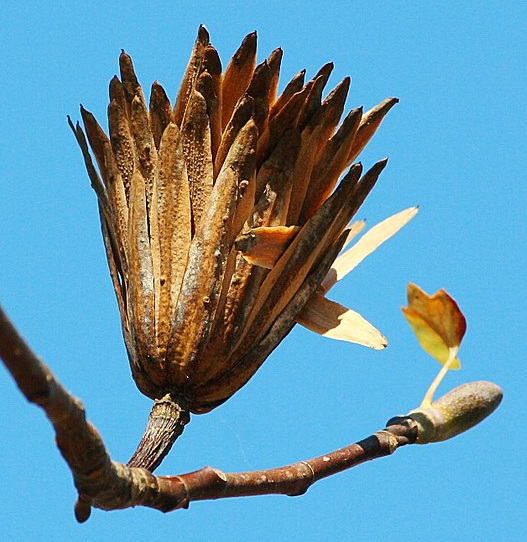 Tulip Poplar tree's cluster of mature samaras; image courtesy of James DeMers of Virginia and Wikimedia Commons
At the left you see what happens to the cluster of ovaries when winter comes. This aggregate fruit has matured to the point that it is spreading open and its parts -- individual samara-type fruits -- are beginning to break away from the fruit, to be disseminated by wind, or animals who may feed on them. The wings help the wind carry the seeds into new territory. The wings consist of flat, brown projections like narrow strips of stiff paper, extending from one side of the tongue-depresser-like fruit. In the picture, one fruit has come lose and beomce stuck sideways within the cluster.