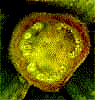
Simple dry fruits are those in which the fruit wall -- the skin, rind, or husk -- is leathery, papery, or woody. To benefit from the following you should understand that at the right you see a cross section of a tomato flower ovary, which is the future tomato fruit, subdivided with three locules, and that inside each carpel reside several ovules, or future seeds.
Among the most important simple dry fruits are the following:
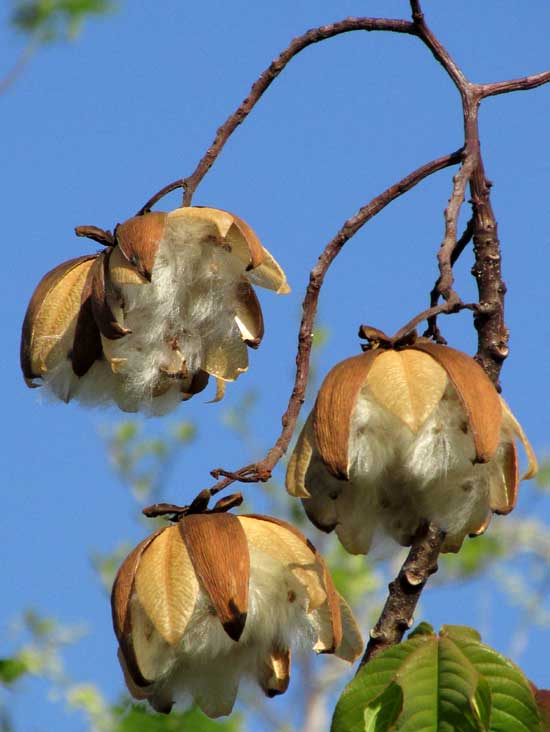
- Capsules develop from ovaries with more than one carpel, plus the mature capsules split in various ways, or don't split at all. A good example is that of the Silk Cottontree, Cochlospermum vitfolium, pictured at the right. Its leathery-husked, baseball-size capsules split along several lines to release seeds equipped with cottony fuzz, which serves as a kind of parachute for dispersing the seeds by wind. In our backyard gardens, poppies and daturas produce capsules, as do horsechestnut trees.
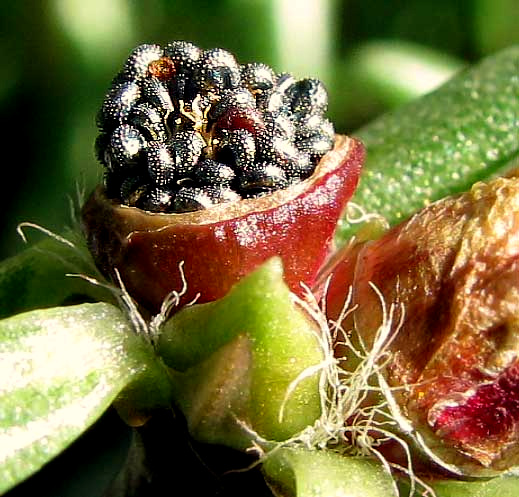 But remember that capsules come in many sizes and configurations. At the left is an open capsular fruit of the Rose-Moss, Portulaca grandiflora. This very small capsule splits horizontally around its center, instead of the usual lengthwise. Its top has come off, revealing a heap of tiny black seeds ready to be shaken or splashed onto the ground.
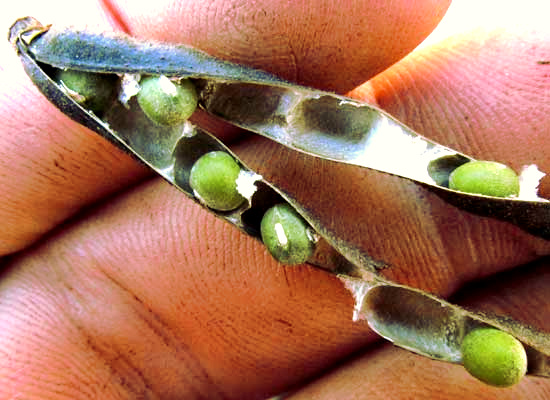
 - Legumes develop from superior ovaries having only one carpel, and at maturity split along two fracture lines so that the legume's sides split apart, releasing seeds which are called beans. Species in the Bean Family produce legumes. The picture shows the long, stiff legume of the Mung Bean plant, Phaseolus aureus. The greenish mung beans ready to drop from their legume are famous among those who sprout beans.
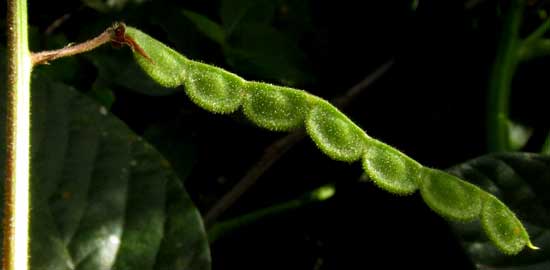
- Loments are just like legumes -- developed from a superior ovary with a single carpel, and splitting along one side -- but with the added feature that each fruit section containing a seed breaks apart from its neighboring sections. At the right, a loment of the Tick Trefoil, Desmodium affine, bears tiny hooked hairs that latch onto animal fur. When something hairy passes by the mature fruit, each individual loment section ( each mericarp) can break away and hitch a ride to a new location, were its seed can germinate and maybe form a new plant.
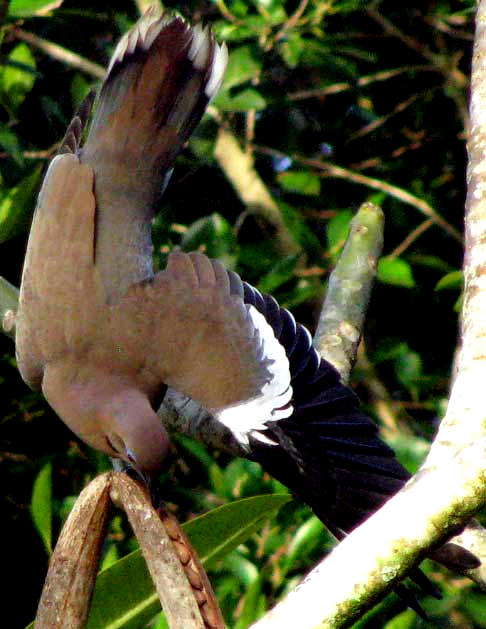
- Follicles also are just like legumes -- from a superior ovary with a single carpel -- except that the fruit splits only along one side. In our backyards we might see follicles on ornamental peonies, larkspurs, and columbines, as well as wildflower and weedy species of milkweed. At the right, a White-winged Dove feeds on winged seeds exposed inside the splitting follicle of a Frangipani tree, genus Plumeria. The picture shows two follicles issuing from the tip of a branch. Notice that the follicle the dove is taking seeds from splits along just one side.
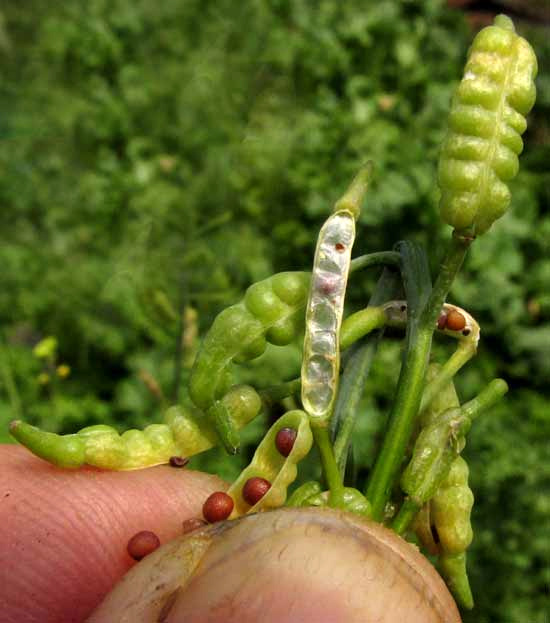
- Siliques are dry fruits developed from ovaries with two carpels, with a membranous partition separating the mature fruit's two compartments, plus, siliques normally are more than twice as long as wide. Mostly siliques occur in the Mustard Family, though they also turn up in the closely related Capper Family. At the right, a garden-planted Southern Giant Mustard, Brassica juncea, has one of its siliques opened,
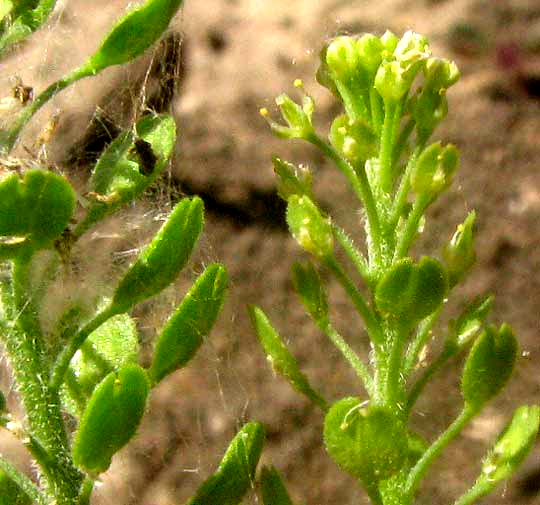 showing the membranous partition inside as well as some escaping mustard seeds. Silicles, such as the roundish ones shown at the left of the Southern Pepperwort, Lepidium austrinum, are the same as siliques, except that usually they're less than twice as long as wide.
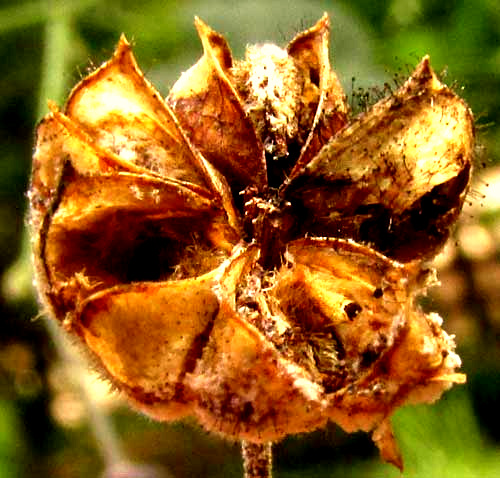
 - Schizocarps are dry fruits which derive from ovaries having two or more carpels. When mature, each carpel forms a separate unit, the mericarp, which usually contains one seed, but sometimes more. Normally it's said that schizocarp mericarps do not split at maturity. At the right, the schizocarp of the Big Yellow Velvetleaf, Wissadula amplissima, has fractured into five mericarps. The Flora of North America explains that in this genus, Wissadula, the schizocarps' mericarps are 2-celled, with one non-splitting cell containing one seed, and a second cell which does split, with two seeds. Our picture shows the top cell splitting to reveal two hairy seeds. Since schizocarp mericarps normally are described as not splitting, this is a good example of Nature not paying strict attention to human definitions.
- Achenes are produced by such familiar plants as roses, strawberries, buttercups, amaranth, cannabis, and more (note the sidebar). Achenes are dry, none-splitting fruits derived from ovaries with just one carpel and containing just one seed. Below you see wind-dispersed achenes of the Sycamore tree, Platanus occidentalis:
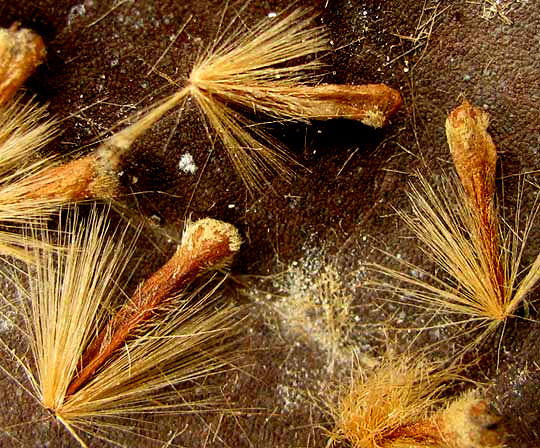
Sycamore achenes bear tufts of hair enabling the fruits to "parachute" on the wind, away from the parent tree, but many achenes bear no hairs.
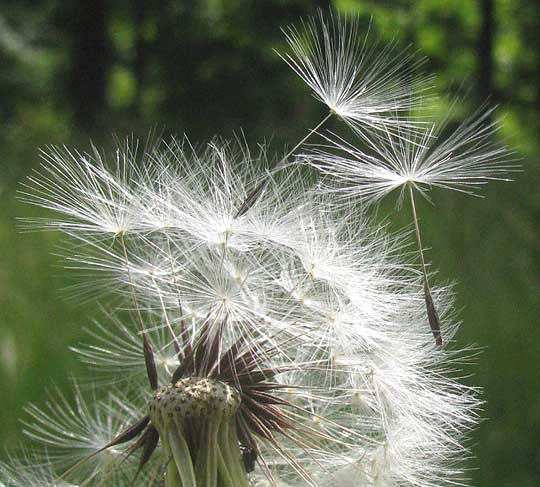
- Cypselae, singular cypsela, as explained in the above sidebar, are visually the same as achenes, differing only in technical details not apparent by viewing the mature fruit. At the right, cypselae of the False Dandelion, Pyrrhopappus carolinianus, are ready to launch into the wind. Nothing about their appearance suggests that each cypsela developed from an inferior ovary with two carpels, of which one carpel failed to produce a seed so that the mature fruit holds just one seed, exactly as defined for the achene. Some define the cypsela as a form of achene, others insist on the cypsela's formal recognition, and some just forget about cypselae and call the False Dandelion's fruit an achene.
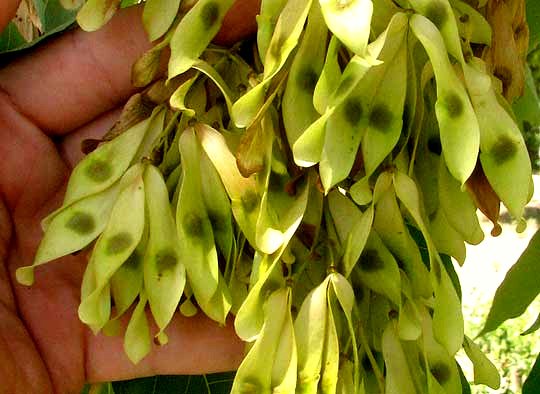
- Samaras are achenes bearing "wings." At the right, a big panicle of samaras adorns a Tree of Heaven street-tree, Ailanthus altissima. The green spot in the center of each pale samara is a bulge over the enclosed single seed. In our neighborhoods, samaras appear on trees such as maple and ash, which bear their wings on one side of the seed, not surrounding it, as in the picture. Such one-winged samaras, when detached by a breeze, spin through the air to land a certain distance from the tree, which is the idea of the wing.
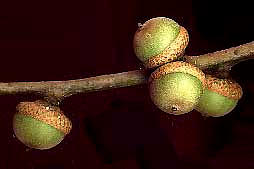
- Nuts, experts often say, are achenes that are exceptionally hard and bony, and larger other achenes. However, some experts who insist that achenes must derive from an ovary with only one carpel, may have the opinion that since some nuts derive from ovaries with two or more carpels, of which only one produces the matured nut's single seed, nuts can't be achenes. Whatever the case, at the right, those are definitely nuts of a Water Oak, Quercus nigra. Moreover, they're a special kind of nut occurring on oak trees, known as acorns.
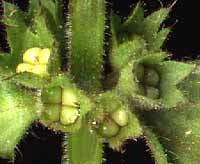
- Nutlets, of which at the right four are seen in each matured calyx of the Hedge Nettle, Stachys arvensis are sometimes defined simply as "small nuts." However, more technically they're said to be small, relatively hard-coated, one-seeded units of a dry fruit that splits into single-seeded parts when ripe. In each of the Hedge Nettle's calyx, earlier there was just one pistil, but as it matured, the corolla fell off and the ovary split into four nutlets as showed. It's a weird process, but characteristic of the Mint Family's many species, and numerous species in the Verbena Family.
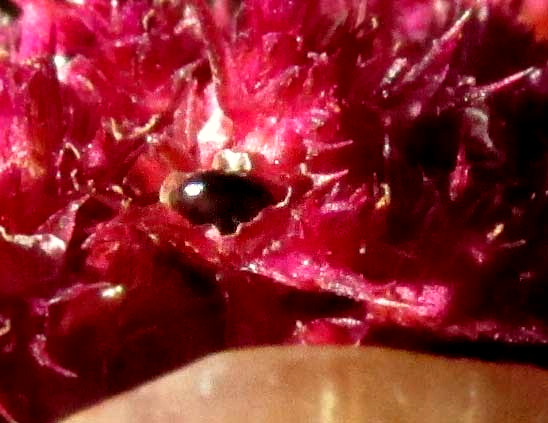
- Utricles, also are similar to achenes, except that the matured ovary wall surrounding the seed makes an inflated, bladder-like covering. Probably amaranth species are the best known plants with utricle-type fruits. At the right, a tiny part of a mature inflorescence of Red Amaranth, Amaranthus cruentus, shows a single black, shiny seed residing in the cup-like bottom half of the ovary's split-open covering, from which the top has fallen. Since these utricles may or may not split, they can't be considered achenes, which do not split at maturity.
Traditionally grass achenes often have been called caryopses (singular caryopsis) or grains, but morphologically they're the same. Also, in the huge Aster or Composite Family, the dry, one-seeded, none-splitting fruits, technically known as cypselae (singular cypsela), differ from achenes only in the technical matter that they derive from inferior ovaries with two carpels and have "accessory perianth tissue adnate to the pericarp," as the Flora of North America says. However, cypselae look like achenes. The persnickety simply must remember to call Aster-Family fruits "cypselae."