
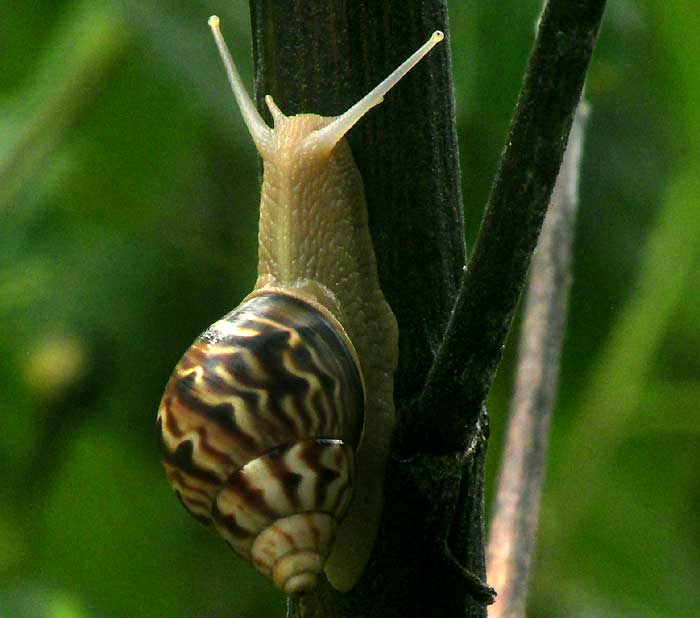
How would you design the most simple land animal imaginable, the main requirements being that it could move about and eat, protect itself reasonably well, and reproduce?
First you'd give it a foot, but only one, to keep it simple. You'd dump all the basic organs into a fleshy, bag-like body, not bothering with complicated matters such as a skeleton and a complex network of interconnected blood-veins. It would have eyes so simple that they can distinguish between light and darkness, but not much more, and antennae to feel where it's going. Finally, such a creature wouldn't have much intelligence or fancy self-defense mechanisms so you'd just place a simple shell over its soft parts and give it just enough brainpower so that when the creature felt threatened it'd automatically withdraw into its shell.
 MOLLUSK or MOLLUSC? In North America "mollusk" is preferred, but the rest of the world likes "mollusc."
In other words, basically you'd have a mollusk -- a member of the primitive phylum Mollusca. The best-known mollusks are snails and slugs, clams and oysters, octopuses and squids. Fossils of ocean-living mollusks are abundant in rocks deposited long before any land animals existed.
A MOLLUSK'S THREE MAIN BODY PARTS
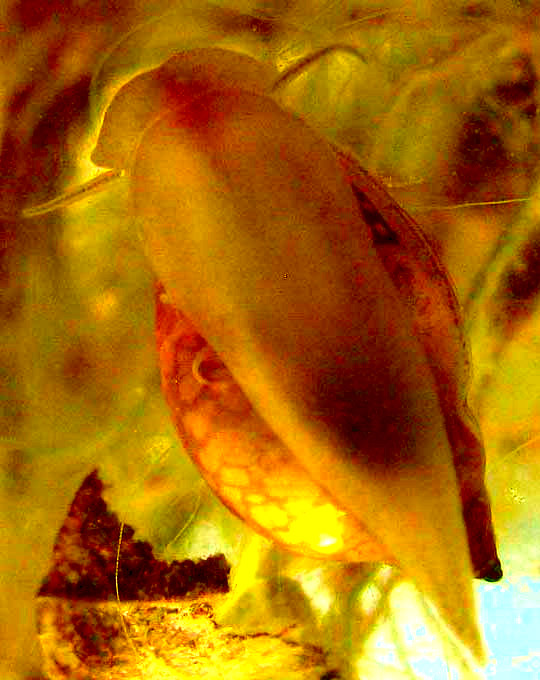
Although at first glance there's a world of difference between a slug and a clam, or a clam and an octopus, these creatures are fundamentally alike in being composed of three main body parts:
- A foot, on the animal's bottom, consisting mainly of muscle tissue. You've had a good view of a mollusk foot if you've watched a snail creep up the inside of an aquarium wall, as shown at the right
- A soft, fleshy body, located above the foot, and containing guts, heart, and other internal organs
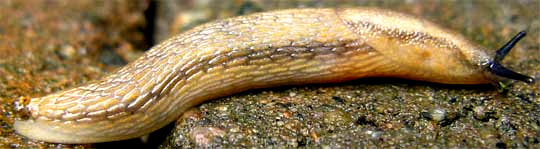
- A mantle, covering the fleshy body. In most species the mantle secretes a shell, but slug mantles don't. Below, you can see the cape-like mantle behind the slug's head, covering only about ¼ of the body, with no hint of a shell forming
LIKE A BUCKET OF STONES
You know that in humans the heart pumps oxygen-rich blood from the lungs, through arteries, to all parts of the body where tiny capillaries carry the oxygen to where it's needed. Then veins return the oxygen-depleted blood back to the heart and lungs, where it is enriched with oxygen, and recycled again. In humans, blood is always in the process of being transported someplace as if it were in a system of pipes.
In mollusks, in contrast, a very simple heart pumps blood into open body cavities, or sinuses. It's a system a little like pouring water into buckets filled with stones, with the buckets being the sinuses, and the stones being organs. Mollusk blood simply washes over the organs. As blood enters the sinuses, other blood in the sinuses fairly haphazardly drains into vessels, which typically transport the blood to gills, where the blood is recharged with oxygen. Then the blood returns to the heart and is pumped to more sinuses.
SIMPLY SUCCESSFUL
Though the mollusk circulatory system seems almost comically simple when compared to ours, it well serves slow-moving critters like most mollusks. In fact, it works so well that mollusks constitute the second-most-diverse phylum of animals on Earth -- (the most diverse being the arthropod phylum).
Maybe 150,000 to 200,000 mollusk species are alive today, and thousands of now-extinct fossil forms have been described. Mollusks range in size from 60-foot Giant Squids, down to almost microscopic species.
BUT THE SYSTEM WORKS BEST IN WATER...
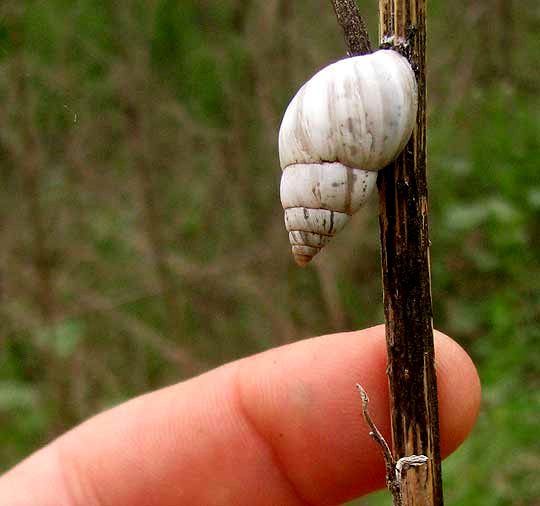
One limitation of the mollusk manner of being is that it works better in water than on dry land. The vast majority of mollusks are aquatic. The best known land mollusks are snails and slugs, who have adapted so well to dry land that sometimes they appear in our backyards. In our backyards, however, mostly they keep to the moist places. One way land snails deal with dry periods is to "glue" their foot to something, withdraw into their shell, and wait for wetness, like the one at the right, on a plant stem in dry Texas.
MOLLUSK CLASSIFICATION
Mollusks have their own phylum, the Mollusca, and that's a big deal. To understand how important the mollusks are, remember that the Arthropod phylum, for example, embraces all insects, spiders, crustaceans and more. The phylum of animals with backbones, the "chordates," includes all mammals, fish, birds, reptiles and lizards. Our Classification Page can help you get oriented.
The best known "classes" of mollusk are the
- Class Bivalva, the bivalves -- clams, oysters, etc.
- Class Cephalopoda (cephalopods -- octopus, squid, etc.
- Class Gastropoda, the gastropods -- snails, slugs, etc.