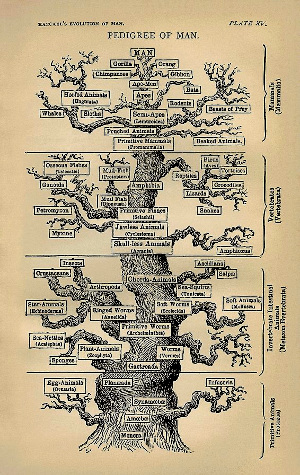
 Tree of Life, 1879 vintage, public domain image first published by Ernst Haeckel
Understandings of how the living things of Nature have evolved, with one species becaming the ancestor to new species, and then those species becoming the ancestors of yet new species, on and on... has changed profoundly over time. The drawing at the left shows how scientists in 1879 thought things evolved.
Moreover, it continues to change right now. Below is a much more accurate portrayal, though even it now is outdated:
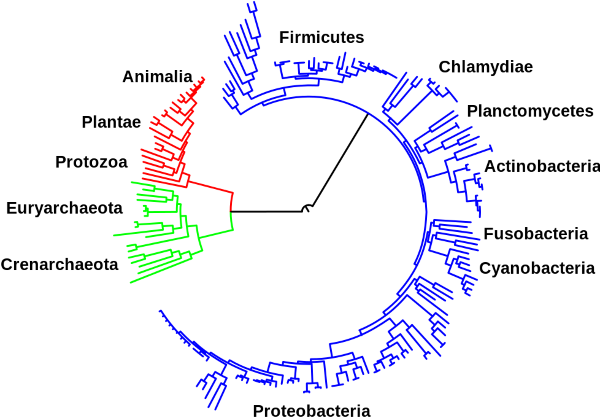 Tree of Life, outdated 2007 vintage; image courtesy of 'PatríciaR' & Wikimedia Commons
In the old days we learned that all living things were either plants or animals. Then for several decades books taught that five or six kingdoms of living things existed, of which plants, animals and fungi were three. Nowadays, concepts have changed a lot, and they continue to change.
THE TREE OF LIFE
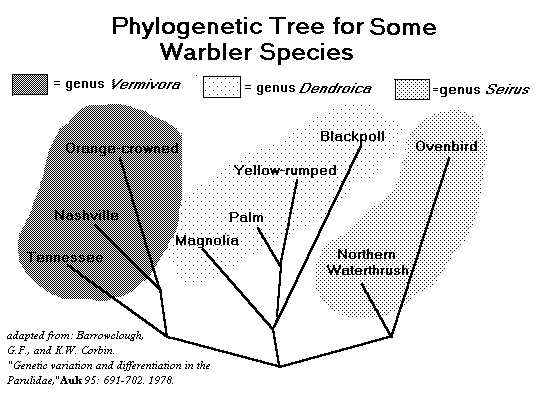
The above two diagrams represent the Phylogenetic Tree of Life. At the Tree's root stands the first form of life. From it, through evolutionary processes, newer forms of life arose, or "branched" from the "trunk," and then those newer forms branched, and those newer branches branched, on and on. Today, the Earth's living species occupy the tips of the Tree's outer branches. Most branches inside the tree are dead, their species extinct. It's worth thinking about that 99.9% of all species that ever existed, now are extinct.
THE TREE OF LIFE'S BRANCHES
Major branches and sub-branches within the Tree of Life have special names. We use those names to refer to the "classes" of mammals, or the "orders" of primates, etc. Here's how this classification system helps organize our thinking about the Tree of Life:
domain: eukaryotes, cell nuclei contained within membranes
kingdom: animal
phylum: chordate (vertebrates)
class: mammal (with hair, female makes milk)
order: primate (apes and monkeys)
family: mankind, (with Neanderthals, etc.)
genus: Homo
species: sapiens
Now let's do the same thing with House Sparrows:
domain: eukaryotes, cell nuclei contained within membranes
kingdom: animal
phylum: chordate (vertebrates)
class: bird (egg-layers with feathers)
order: passerine (songbirds)
family: thick-beaked birds such as finches
genus: Passer
species: domesticus
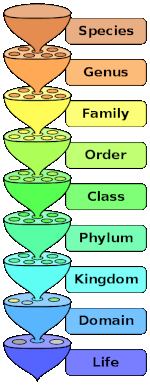 Domain to species; image courtesy of Peter Halasz and Wikimedia Commons
Notice that each of the above diagrams begins the same, at the ROOT, but after the Tree of Life branches three times, at the next branching, the "class," one branch leads to mammals, while the other goes toward birds.
Also notice that in each case the final branching provides us with the scientific names, or binomials, of the living organism. With us humans, it's Homo sapiens; House Sparrows are Passer domesticus. It's like that with all scientifically documented and named living things.
The genius of this system -- this "thought tool" -- is that if we know the basic evolutionary innovations accounting for the major branchings leading to any organism, automatically we know a lot about that organism whether we've identified it or not!
For example, we humans are members of the Primate Order, so in recognizing that we're automatically reminded that we share a common ancestor with apes and monkeys. If we know that we're members of the Class of Mammals, we're not surprised that we bear hairs instead of scales or feathers, and that our mature females develop mammary glands.
BEYOND STANDARD PIGEONHOLES
Here's an interesting project: Go to the NCBI Taxonomy Browser , then in the search window at the top left where it says "Search for," type in the scientific name for any plant or animal, click on "Go," and see what comes up. The resulting page will have a section beginning with "Lineage (full)" and after that you'll see the entire system of current taxonomic classification for that organism. And there'll be many more subdivisions, or branches, than the few outlined above.
For example, in 2021 when Homo sapiens is typed into the "Search for" box, here's what comes up, with words in parentheses being our explanations, and the traditional categories being shown in red:
cellular organisms
Eukaryota
Opisthokonta
Metazoa
Eumetazoa
Bilateria
Coelomata
Deuterostomia
Chordata
Craniata
Vertebrata
Gnathostomata
Teleostomi
Euteleostomi
Sarcopterygii
Dipnotetrapodomorpha
Tetrapoda
Amniota
Mammalia
Theria
Eutheria
Boreoeutheria
Euarchontoglires
Primates
Haplorrhini
Simiiformes
Catarrhini
Hominoidea
Hominidae
Homininae
Homo
sapiens
In other words, nowadays many more important branches are recognized within the Tree of Life than our traditional categories provide for. Moreover, sometimes branchings are added and removed or renamed, so if you compare the above breakdown with your own search at the NCBI Taxonomy Browser, you may encounter some new changes.
These are times of explosive learning and new insights.
By the way, the formal way to call a branching with "no rank," as we refer to it above, is to designate it a clade. A clade is a grouping of organisms believed to have evolved from a common ancestor, according to the principles of "cladistics." Cladistics is a method of reconstructing evolutionary trees, the basic assumption being that the more genetic material species share, the more closely related they are, having arisen from common ancestors.