PLANTS | ANIMALS | ECOLOGY | FUNGI | GEOLOGY | GARDENING | TOOLS
MEXICAN PLANTS & ANIMALS HOME

Excerpts from Jim Conrad's
Naturalist Newsletter
from the January 10, 2010 Newsletter issued from Hacienda Chichen Resort beside Chichén Itzá Ruins, central Yucatán, MÉXICO
EAR TREES, OR PIICHES, DROPPING LEAVES
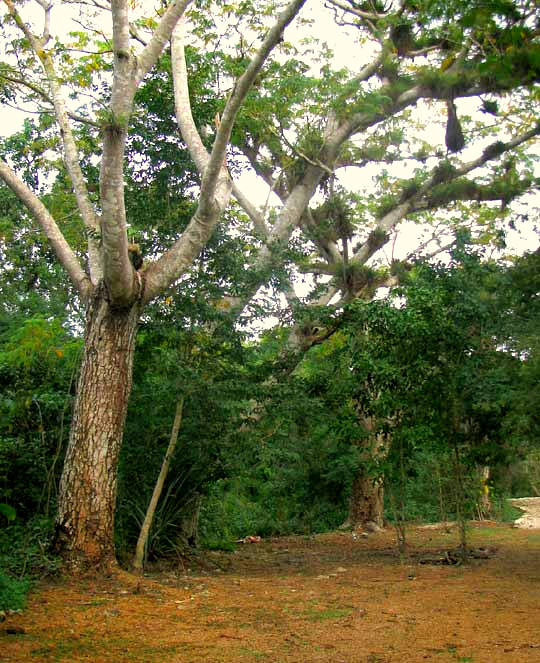
Most of our regenerating forest here is very dense and grows only 20 or 30 feet high. However, here and there big trees occur. They're species that by nature rise above the general forest canopy, plus some were left standing for shade when maybe 30 years ago most of this area was covered with cattle-grazed ranchland.
One of the giant tree species is the Piich, as they're called in Maya, or Guanacaste in Spanish; I can't find a good English name for it, though some authors call it "Ear Tree" because of its legumes' shape. It's ENTEROLOBIUM CYCLOCARPUM, a member of the Bean Family, and it's one of the three or four largest trees inhabiting the forests of Central America and southern Mexico.
Piich leaves are doubly pinnately compound, rather like acacia or mimosa leaves, which belong to the same family. During the dry season Piiches drop their leaves, and this week has been their main leaf-fall time. Above, you can see a couple of largely defoliated Piiches along our forest trail, with the ground below covered with dried-up leaflets, and their big branches bearing gardens of bromeliads, orchids and the like (and a dangling, baglike Altamira Oriole nest).
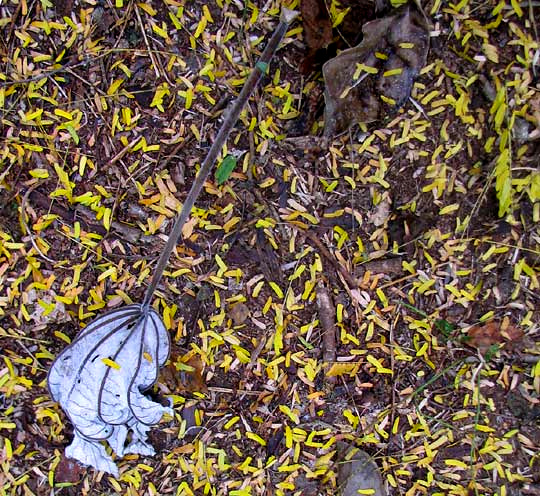
Thumbnail-clipping-size leaflets litter the ground alongside a fallen silvery Cecropia leaf below:
Leaves still bearing some shriveling leaflets are seen below:
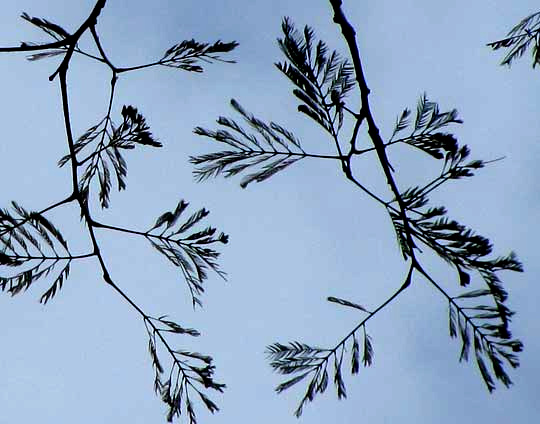
The Piich tree trunks in the picture are about 3 feet thick (1 m) but some here are twice that thick. When a big Piich drops its leaves, suddenly light floods into a large area where earlier it was very shadowy. However, the shrub and herb understory species below the Piich can hardly take advantage of the bounty of light, for it's so dry they can't sprout new growth.
from the April 11 2010 Newsletter issued from Hacienda Chichen Resort beside Chichén Itzá Ruins, central Yucatán, MÉXICO
PIICH TREES ACQUIRING THEIR EARS
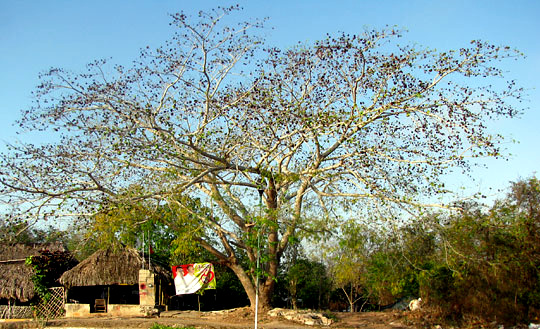
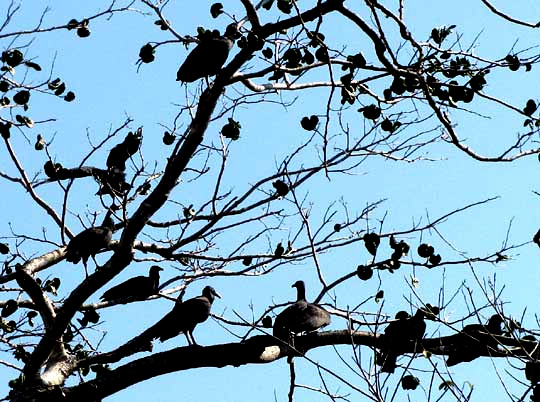
Last January I showed you how our big Piich trees, ENTEROLOBIUM CYCLOCARPUM, were losing their leaves, admitting abundant light onto the forest floor where previously it had been shadowy. Since then most Piich have been completely leafless, but two or three weeks ago they began cluttering their branches with dark, roundish items as seen on a tree near the ruins' entrance below:
A shot from closer up, with some Black Vultures for scale, is seen below:
A close-up of the items themselves is next:
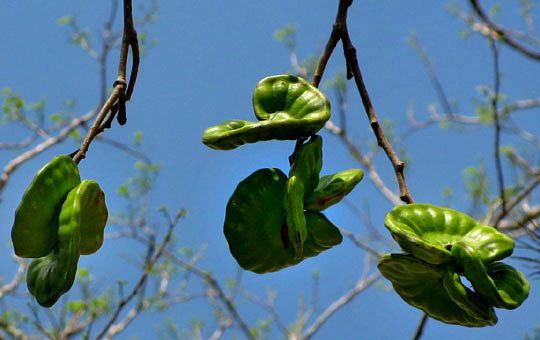
Those are immature fruits. Since Piich is a member of the Bean Family, the fruits are legumes, but instead of being long and more or less straight like most legumes, these are curled, almost forming circular disks. The bumps on the fruits are enlarging seeds. Some tourist books call the tree "Ear Tree" because of the legumes' looks.
In a month or so the matured legumes will be dark and fall off. If I'm here then I look forward to collecting seeds, roasting them, grinding them, and brewing a nice hot, coffee-like drink from them. I've always read about that but never tried it. Stay tuned.
One further note: While some of our fruiting Piich trees are completely leafless as their legumes mature, others are sprouting the next season's frilly, compound leaves. Rains aren't due for another month or so, so this is a little surprising, especially since fruiting here in the depths of the dry season requires a good bit of water just for the growing fruits. One wonders where the leafing-out Piich get their water. Most other leafless tree species are staying leafless, but then they aren't nearly as large and, presumably, deep-rooted as these big Piich trees.
from the April 25, 2010 Newsletter issued from Hacienda Chichen Resort beside Chichén Itzá Ruins, central Yucatán, MÉXICO
PIICH TREES FLOWERING & LEAFING
In the April 11th Newsletter you saw that our big Piich trees, while fruiting, were leafless. Now just two Newsletters later, in what has to be one of the most spectacularly quick turnarounds in the American tropics, the Piiches are lushly green with half-grown, feathery, bipinnate leaves and loaded with jillions of white, spherical flower heads, as shown below:
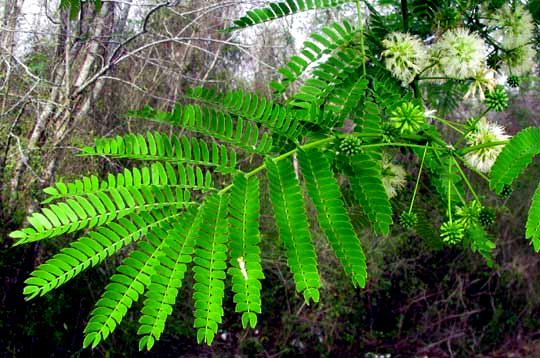
Both the leaves and the flowering heads are very similar to those of many Acacia species, to which the Piich is closely related. However, a flower close-up shows an important difference if you know what to look for:
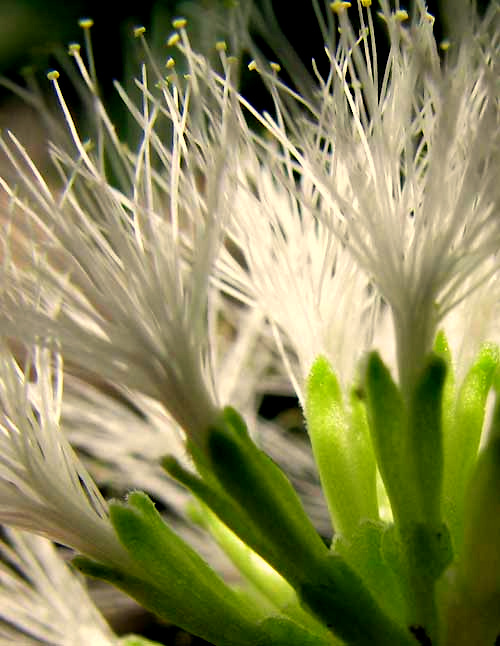
As in an Acacia flower, the Piich's blossom has many fuzzy, white filaments topped by small, yellow, pollen-producing anthers issuing from the corolla. However, notice that each flower's many filaments (the stamens' "stems") join together into a cylinder that continues into the corolla's tube. Acacia filaments don't do that. They remain separate all the way to the base of the flower (they're "free").
That may not seem like much of a difference but to a botanist such a detail is like an animal having hands with separate fingers as opposed to flippers; the feature just signifies a whole different organism. You can see the "staminal column" I removed from one flower, clearly showing the well formed cylinder, below:
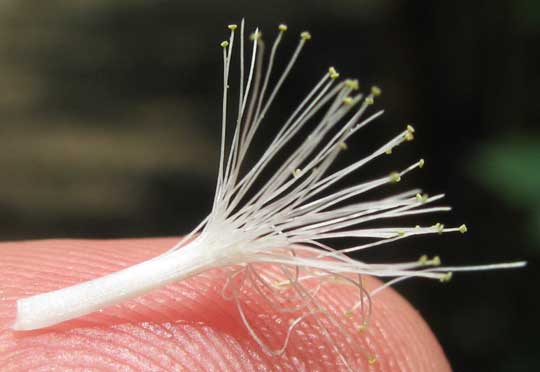
Note that this week the Piiches bear both flowers and fruits. In other words, it takes a year for their fruits to develop. Later when we experiment with making a hot drink from roasted, ground-up Piich seeds you'll see that the fruits are substantial, primitive- looking things that well might take a year to form.
Walking beneath a big Piich loaded with flowers on a calm, humid morning is a heady experience because of the flowers' sweet fragrance.
Piich trees, sometimes called Guanacastes, are frequent in open forests from Mexico to Venezuela, and are one of the three or four largest trees in that area. Tree lovers in Mexico and Central America simply need to know this tree. Our main page about it is at www.backyardnature.net/mexnat/piich.htm.
from the August 30, 2015 Newsletter issued from Yuxunah, 20kms southwest of Chichén Intzá, Yucatán, MÉXICO
PIICH TREES CLOSING THEIR LEAFLETS
There's a big Piich tree, sometimes called Ear Tree in tourist books, towering above my hut here in Yaxunah. Each morning as I enjoy my steaming stew I like to look into the tree's sprawling branches, for often birds perch there, plus it's just a restful view.
During the night, the tiny leaflets of each of the Piich's feathery, twice-compound leaves close upon one another, giving the tree's branches a more airy look. While I'm breakfasting at dawn, when the sun reaches a little above the horizon, the leaflets move apart, making the tree look much denser. A picture showing the tree's "airy" leaves as they are before the sun rises, on the left, and the same leaves about an hour later, on the right, after a little sunlight, is shown below:
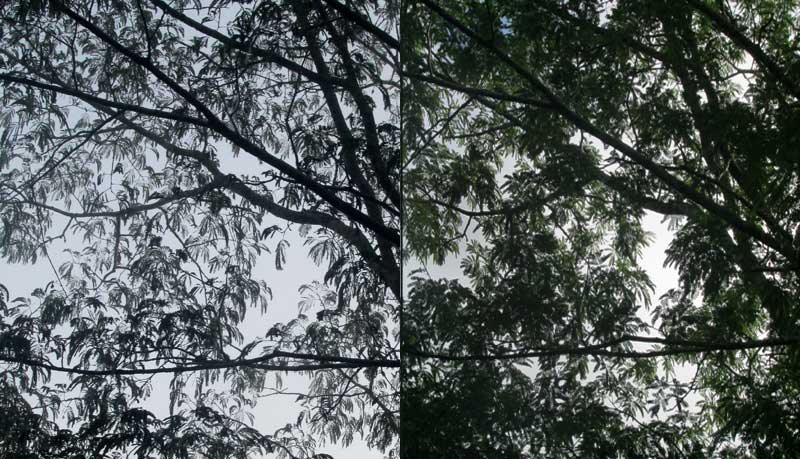
A close-up of some leaflets folded together for the night, just beginning to "open" at dawn is shown below:
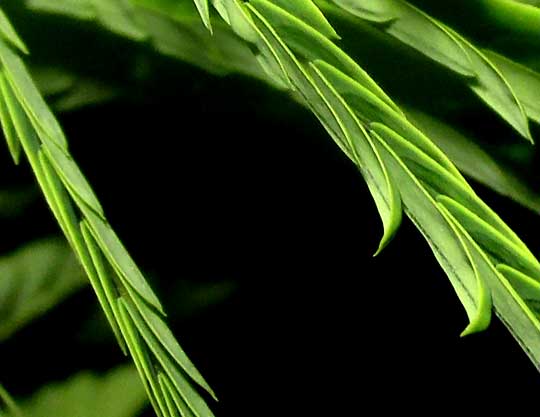
During the dry season the Piich's leaves also "close up," giving the same airy look, and I've always understood that to be their way of cutting down on the evaporation of water from the leaflets' surfaces. However, the leaflets in our above picture closed during a drizzly night, and were wet when the picture was taken.
A good guess is that the dawn opening has to do with the tree's change from respiring during the night (using oxygen) to photosynthesizing (producing oxygen), during the day.
from the October 12, 2018 Newsletter with notes from a recent camping trip into northern Guatemala's Petén regon
A REALLY BIG GUANACASTE/ PIICH/ "EAR TREE"
On the first of this month, while camping in El Rosario National Park adjacent to Sayaxché in northern Guatemala's Petén department, one of the most imposing presences at the campground's edge was a gigantic tree, the trunk bottom of which is shown below:
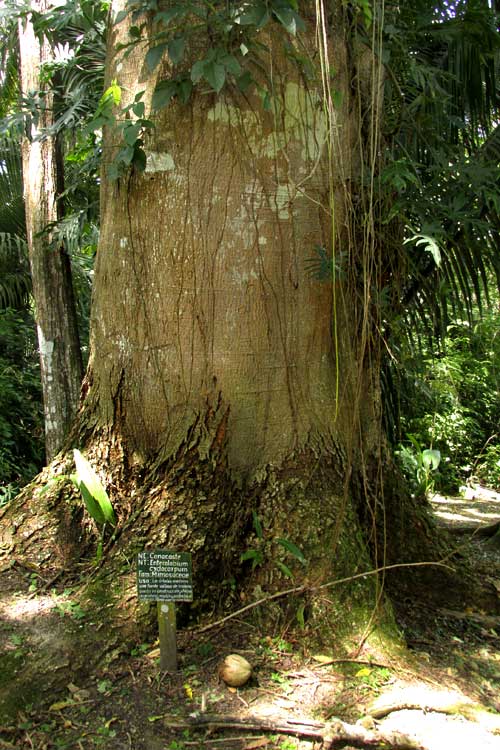
The sign identifies the tree as the Guanacaste, which is one of many names the species goes by. It's Enterolobium cyclocarpum of the Bean Family, a tree commonly encountered from southern Mexico through most of Central America. In the Yucatan the Maya call it Piich, and the tourists know it as the Ear Tree, because of its big, ear-shaped, legume-type fruits. In the current picture, the trunk's massiveness can be judged from the husk-covered coconut lying beside the sign.
In the Yucatan, where usually the soil is very thin to nonexistent atop the limestone, mature Guanacastes/Piich/Ear-Trees often send thick, long, only half-buried roots snaking across the ground. I'd assumed that this was because of the thin soil. However, this tree in El Rosario seemed to grow in reasonably deep soil, yet it also produced long, snaking roots, as shown below:
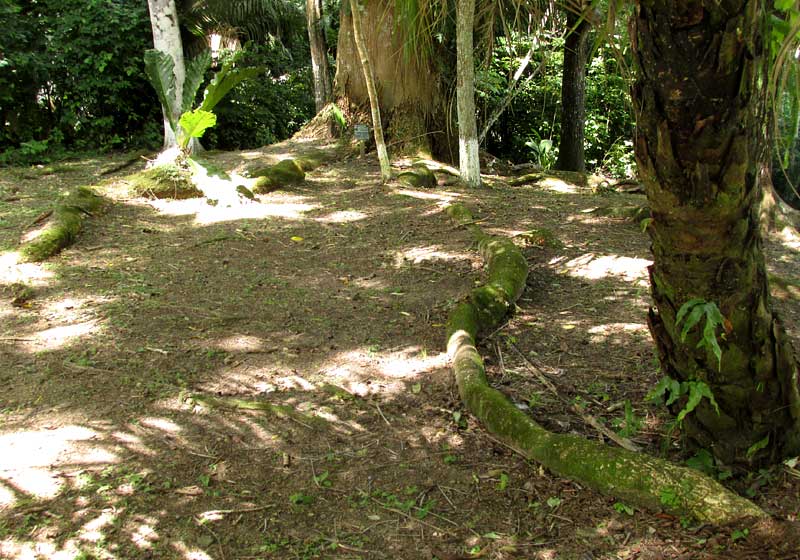
Such roots help the big tree stand upright. Often the species's crown rises well above the general forest canopy, exposing itself to hard winds, so such a broad base is necessary.
Once back at Hacienda Chichen beside Chichén Itzá ruins in the Yucatan, a German tour leader came to me saying that she planned to return later with a group of people wanting to absorb the Earth's healing energy in a sacred place like Chichén Itzá. Could I suggest a specific spot where the Earth's energy was likely to be concentrating? I took her to a big "Ear Tree" nearby, where the roots radiated out in all directions as in the above picture. The tour leader couldn't have been happier with the spot.