 commonly seen in North America
commonly seen in North America
commonly seen in North America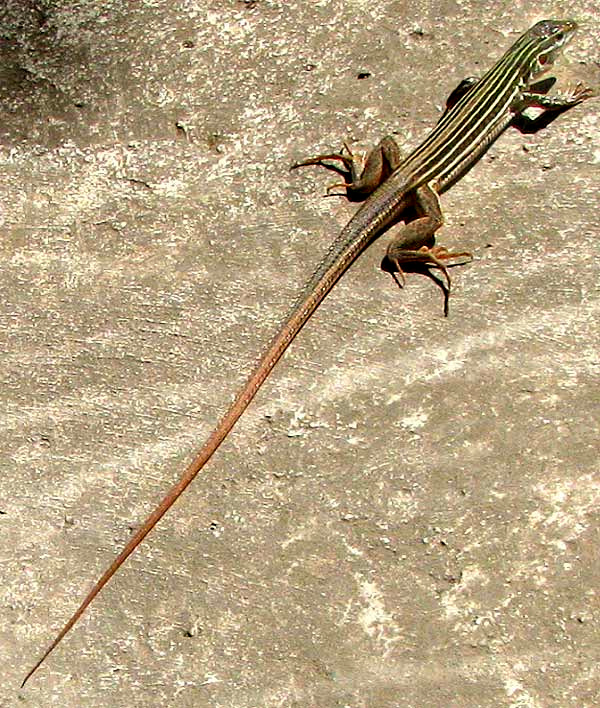
These are very slender and fast lizards, often with narrow stripes running from head to tail, and sometimes are common in backyards. Racerunner species occur in the southeastern and central US, while whiptails appear in the southwestern US. At the right is a Texas Spotted Whiptail, Aspidoscelis galuris. In this family, the Teiidae, several all-female species are known, those species being hybrids. The all-female species reproduce with embryo development without fertilization by sperm. Among sexually reproducing species, hybridization is common. The pictured whiptail hybridizes with at least two other species. If you have racerunners or whiptails in your area, it might be interesting to look up the species' reproductive cycle.
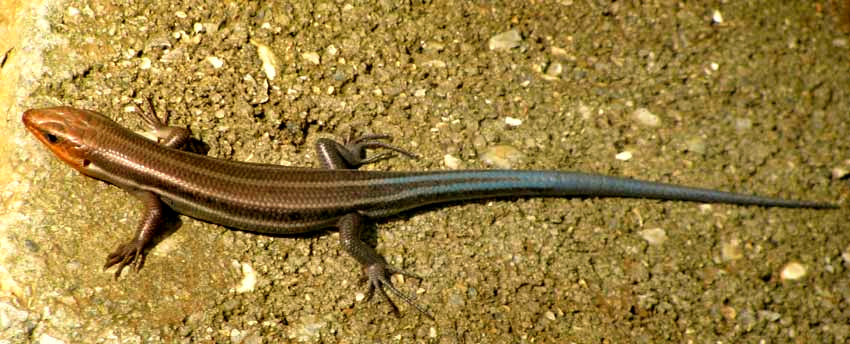
Occurring on every continent but Antarctica, skinks are thick-bodied lizards typically with stripes running from head to tail. Normally the stripes aren't as narrow as among the whiptails and racerunners. Some species have amber-colored lower jaws. Shown above is the Five-lined Skink, Plestiodon fasciatus, common in the eastern US and southern Canada. The males aggressively defend their territories against other males. Females may create communal nests. When one female leaves the nest to feed, another female stays, so the nest always is guarded. Skinks may disconnect their tails if attacked.
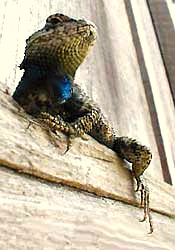 Iguanas are the most famous members of the Iguana Family, because they're so large and conspicuous in the tropics. You might enjoy looking at our page on the big Black Iguanas often seen in Mexico. In the US a smaller member of the family occurs throughout southern and south-central US, along forest edges and other half-wild places. It's the Eastern Fence Lizard, Sceloporus undulatus, shown at the right, basking on a barn door in Mississippi. In recent years its numbers have declined because it occupies the same ecological niche as the invasive Fire Ant, which can kill the lizard in less than a minute. A study shows that fence lizards in Fire Ant territory have evolved longer legs and new behaviors to escape the ants, but they still suffer greatly.
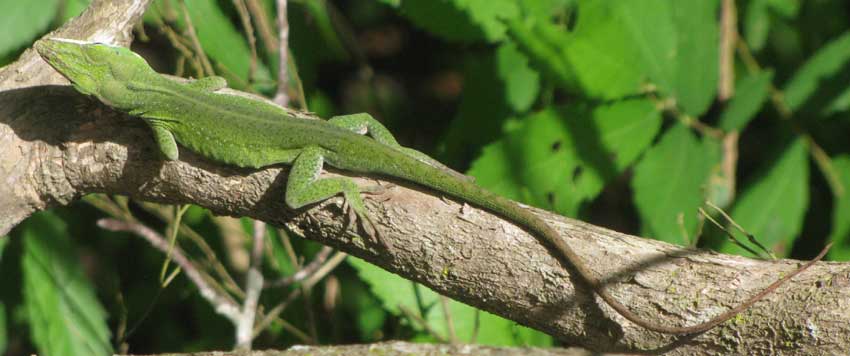
Anoles (pronounced uh-NO-lehs) are mostly tropical American, but the species shown above, the Green Anole, Anolis carolilnensis, is common in the US Southeast. Green Anoles are fun to watch as they slowly stalk their prey of flies, beetles, moths, spiders and other such critters. Often Green Anoles are known as "chameleons" because in just a few seconds they can change color between green and brown. If you're lucky, you'll see one fan out his brightly colored "throatfan." Anoles possess sticky toe pads that allow them to cling to many kinds of surface.
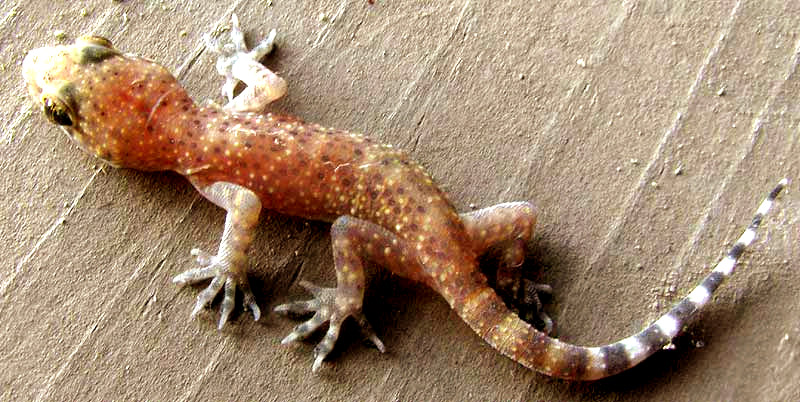
Geckos are unique among lizards for their chirping, clicking and sometimes hissing sounds. Pictured above is the Mediterranean House Gecko, Hemidactylus turcicus, native of the Mediterranean area but well established across the southern US and Mexico. They may be the most conspicuous of geckos seen in North America because they can live among humans and are attracted to outdoor lights where they eat many disoriented moths.
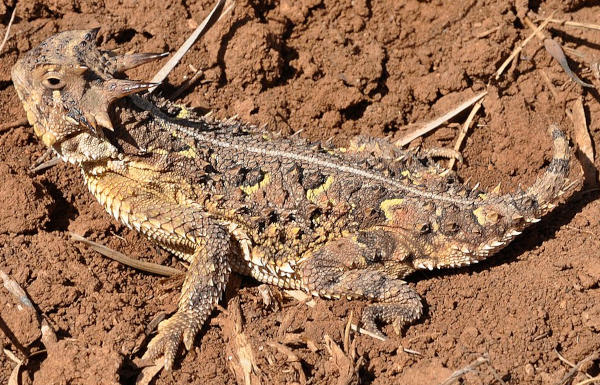
These are the "Horny Toads" of old western movies, even though they're lizards. The Texas Horned Lizard pictured above is typical of the family, in that it's adapted for the hot desert, though some species live at moist forest edges. Horned Lizard populations are disappearing fast because of habitat destruction, the planting of non-native grasses on ranchland, chemical pesticide use, predation by domestic dogs and cats, and invasive Fire Ants. So far, the Texas Horned Lizard has completely disappeared from about half of its natural area of distribution.
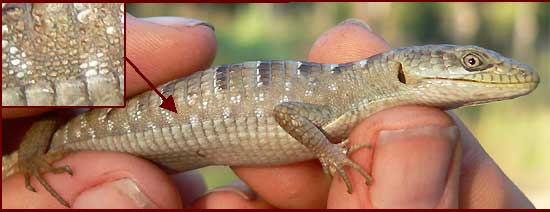
The above Southern Alligator Lizard, Elgaria multicarinatus, seldom reaches a foot long (30cm), and isn't closely related to regular alligators. Alligator lizards at first glance are similar to fence lizards, but a peculiarity of alligator lizards is that bonelike scales, or "osteoderms," cover thir bodies. This armor makes the lizard's body so stiff that it would be hard for the animals to breathe were it not for a flexible band of soft, granular scales along the side, shown in the inset at the picture's upper left. In North America, alligator lizards are found only in the West.
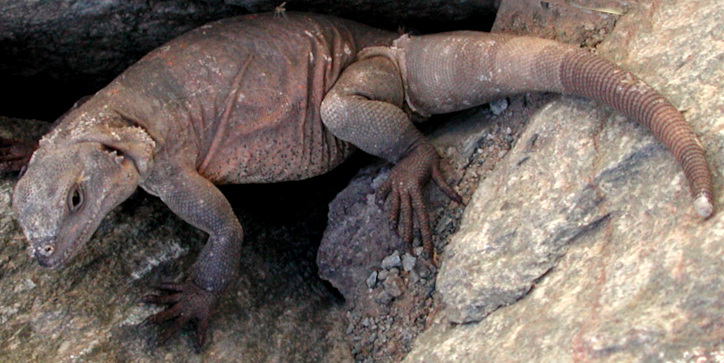
Six chuckwalla species are recognized. The one shown above, sometimes called the Common Chuckwalla, is Sauromalus ater, and inhabits the Sonoran and Mojave Deserts of the southwestern US. This species reaches about 20 inches in length (51cm) and weighs up to two pounds (0.9kg). It emerges in the morning and basks in sunlight until its body temperature reaches about 100º F (38º C), and then it begins searching for food. It's a harmless vegetarian eating mainly leaves, buds, flowers and fruit.
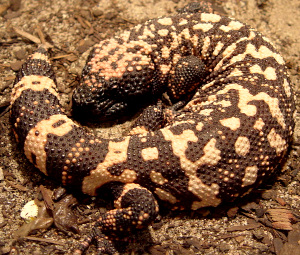
Gila Monsters, Geloderma suspectum, are the only venomous lizards in North America. They occur in the southwestern US and nearby Mexico. Since they're so sluggish and retiring, they rarely threaten humans. One reason they're sluggish is that they're so big, their chunky bodies up to two feet long (60cm). Gila Monsters feed on many kinds of small animals, the adults taking in as much as a third of their body mass in one meal, and the young, up to half.