H
A
N
E
R
O
Z
O
I
C
E
O
N
(542
mya
to
now)
E
N
O
Z
O
I
C
E
R
A
(65.5
mya
to
today)
Quaternary Period (2.588 mya to present)
Holocene Epoch (±11,650 years to today): Neolithic agriculture, Sahara Desert forms, current interglacial begins, humans impact the planetary environment.
Pleistocene Epoch (±1.58 mya to ±11,650 years ago): four major glaciations profoundly affect Earth's landscape and living organisms; great extinction of species, especially the great mammals; first human social life
- ±0.125 mya, or 125,000 years ago, the interglacial period before the one we are in right now was at its peak, the Earth's temperature was about 2°C higher than it is now (3.6°F) and the sea level was about 5 meters higher (16.4 ft). That earlier interglacial period is called the Sangamon in the US but the Eemian in Europe.
- ±0.5 mya, Homo sapiens, arises
- ±0.8 mya, fossils from this time found of Homo erectus, considered the ancestral species from which modern humans, Homo sapiens arose
- ±1.6 mya, fossils from this time found of of Homo habilis, an early human
Neogene Period (±23.03 to 2.588 mya)
Pliocene Epoch (±5.3 to ±2.58 mya): continued rise of North Americas western mountains, much volcanic activity; decline of forests and advance of grasslands, with corresponding fast development of monocot plants; mastodons, saber-tooth tigers, sloths, llamas & other "great mammals" roam the landscape
- 3.2 mya, "Lucy" fossil, Australopithecus afarensis, a particularly well preserved fossil skeleton of Australopithecus, discovered in Africa in 1974 and made famous by books and interviews with specialists.
- ±4.2 mya, hominid Australopithecus anamensis, thought to represent the root of the human evolutionary tree
Miocene Epoch (±23.0 to ±5.3 mya): North America's Rocky Mountains rise for a second time, much volcanic activity in the US Northwest, climate cooler in North America; mammals reach peak of evolution; first manlike apes appear
- ±6 mya, hominids (humans and their immediate direct ancestors) split from the ape branch of the primate tree of evolution
- ±15 mya, Earth's climate starts cooling, the great forests largely are replaced with open grasslands and savannas, thus setting the stage for human evolution (apes coming down from trees and standing upright)
- ±20 mya, first modern-type snakes appear
Paleogene Period (±66.0 mya to ±23.0 mya)
Oligocene Epoch(±33.9 to ±23.0 mya): landscape in North America lower with few great mountains; climate warmer; maximum extent of forests
- ±25 mya, apes arise from Prosimians
Eocene Epoch (±55.8 to ±33.9 mya): In North America the mountains have eroded and there are no great inland seas; the climate is warmer; placental mammals diversify and specialize; carnivorous mammals and hoofed ones become established; small ancestors of the horse occur during the early Eocene
- ±36 mya, monkeys arise from Prosimians (humans did not arise from monkeys)
- ±40 mya, first primates, called Prosimians (looked like a cross between a squirrel and a cat)
- ±50 mya, mammalian bats arise
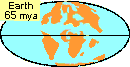 Paleocene (±65.5 to ±55.8 mya): small mammals roam the land while sharks & rays swim the seas
E
S
O
Z
O
I
C
E
R
A
(252
to
66
mya)
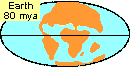 Cretaceous Period (±145.0 to ±66.0 mya): primitive mammals radiate across Earth;during the mid-Cretaceous today's largest bird order, the Passeriformes, or songbirds, arises; reflecting continental drift, the map at the left show North America, Europe and Asia still stuck together, with South America, Africa and Antarctica well separated. The large island off Africa's eastern coast is India.
- ±65 mya, dinosaurs go extinct, apparently because of the effects of an asteroid hitting the earth; at this time already some familiar angiosperms were present, such as sycamores, walnuts, oaks and dogwoods
- 80-90 mya, flowering plants achieve dominance in most of the Earth's land environment
- ±100 mya, dinosaurs are the dominant land animals while mammals occupy a small-body niche ecologically similar to that of frogs today
- ±110 mya, first lobster, Palinurus palaceosi; fossil found in Chiapas, Mexico
- ±120 mya, Africa and the American continent begin splitting apart
- ±140 mya, modern-type birds arise
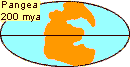
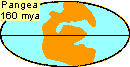 Jurassic Period (±201.3 to ±145.0 mya): dinosaurs dominant; flying reptiles; on land cycads, conifers and ginkgoes are dominant plants; the maps at the left show North America, Europe and Asia squashed together above the equator, and South America, Antarctica and most of Africa below the equator.
- ±150 mya, first flowering plants
- ±150 mya, Archaeopteryx, part reptile, part bird
- 188-213 mya, earliest "true frogs"
- ±195 mya, Pterosaurs, flying reptiles, evolve from gliding reptiles
- ±200 mya, first turtles
- 200+ mya, first crocodilians, arising from thecodonts
Triassic Period (±251.9 to ±201.4 mya): first mammals and dinosaurs; land dominated by mammal-like reptiles; oceans dominated by ammonoid cephalopods
- ±220 mya, dinosaurs evolve from cold-blooded Thecodonts
- ±225 mya, first mammals arise from warm-blooded Therapsids; the earliest fossil is of Brasilodon quadrangularis, a shrew-like creature around 20cm long (8 inches)
- 230-210 mya, reptilian Therapsids are dominant land vertebrates
- ±230 mya, world's climate warms, shifting the advantage to cold-blooded Thecodont reptiles who eat one-tenth as much food as warm-blooded Therapsids (mammal-like reptiles)
A
L
E
O
Z
O
I
C
E
R
A
(541
to
252
mya)
Permian Period (±298.9 to ±251.9 mya): continents rise, Appalachians form; decline of lycopods and horsetails (non-flowering plants); decline of amphibians, though earliest froglike amphibians arise toward end of Period; primitive mammal-like reptiles occur; trilobites and many other marine forms go extinct
- 286-249 mya, amphibians begin leaving marshes for dry uplands, many, such as Cacops, having bony plates & armor, and some as large as ponies
Carboniferous Period (±358.9 to ±298.9 mya)
Pennsylvanian
(±323.2 to ±298.9 mya): land generally low, tropical, producing great coal swamps consisting largely of forests of seed ferns and gymnosperms; first reptiles; many primitive insects, spread of ancient amphibians; ocean reefs and banks inhabited by algae and sponges
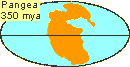 Mississippian (±358.9 to ±323.2 mya): climate at first warm and humid then cooler later as land rises; lycopods and horsetails are dominant land plants while gymnosperms grow more widespread; amphibians go onto land, first coal-swamp forests; in oceans echinoderms and bryozoans dominate, spread of ancient sharks
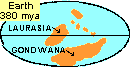 Devonian Period (±419.2 to ±358.9 mya): first land vertebrates, amphibians ; land higher, more arid, some glaciation; first forests, with the first gymnosperms; in seas, many corals, brachiopods & echinoderms, as well as early fish -- lungfishes and sharks are abundant; between 360 mya and 287 mya sharks are the dominant vertebrates in the seas
- ±360 mya, Acanthostega, part fish part amphibian
- ±370 mya, Ichthyostega, earliest amphibian, arise from lobe-finned fishes
- ±385 mya, Earth's first forests, formed of a fern-like plant of the genus Wattieza
- ±390 mya, lobe-finned fishes arise, ancestral to amphibians, now largely extinct
- ±410 mya, fish develop jaws (spiny sharks)
- ±410 mya, Cooksonia, first known vascular land plant, producing spores, fossil found in what is now New York, USA
Silurian Period (±443.8 to ±419.2 mya): land rises, with more arid regions;oldest land life-- land plants, scorpions & insects (wingless); first jawed fishes, seas dominated by marine arachnids
- ±425 mya, first seed plants, in form of gymnosperms
±430 mya, first vascular plants
Ordovician Period (±485.4 to ±443.8 mya): great submergence of land, climate over land mostly warm; first vertebrates (jawless fishes); seas dominated by trilobites, brachiopods, bryozoans, corals, graptolites, nautiloid cephalopods, marine algae abundant
Cambrian Period (±541.0 to ±485.4 mya): land low, land climate mild; trilobites and brachiopods dominate oceans; first metazoans with skeletons; no known land life; most modern phyla arise in oceans
R
E
C
A
M
B
R
I
A
N
(4,600
to 541
mya)
R
O
T
E
R
O
Z
O
I
C
EON
(2500
to
541
mya)
- ±590-±505 mya, first animals with backbones, which were a kind of jawless, toothless, finless fish
- ±600 mya, present concentration of oxygen in atmosphere achieved
Mesoproterozoic Era(±1600 to ±1000 mya)
- ±1000 mya, first green plants, in the form of algae
- ±1500 mya, oldest fossils with compartmentalized cells
Paleoproterozoic Era(±2500 to ±1600 mya)
- ±1900 mya, eucaryote radiation, high atmospheric oxygen
- ±2000 mya, aerobic respiration
- ±2100 mya, multicellular eucaryotes
- ±2400 mya, aerobic photosynthesis, rapid increase in atmospheric oxygen
- ±2500 mya, anaerobic procaryotes and oceanic plankton diversify
Archaean Eon
(±4000 to ±2500 mya)
- ±3800 mya, oldest definite fossils, Stromatolites, exhibiting the life processes of cyanobacteria (formerly called blue-green algae)
Hadean Eon
(±4600 to ±4000 mya)
Before life appeared, the Earth and Solar System formed by coagulation and gravitational contraction from a large cloud of gas and dust around the sun
- ±4200 mya, first anaerobic bacteria
- ±4600 mya, first life forms