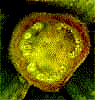
Simple fleshy fruits develop from a single ovary and the fruit's covering is fleshy instead of woody, leathery or papery. To benefit from the following descriptions you should understand that at the right you see a cross section of a tomato flower ovary, which is the future tomato fruit. The ovary is subdivided into three locules,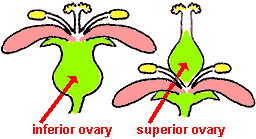 and inside each locule reside several ovules, the future seeds. Also, keep in mind the difference between an inferior and superior ovary, shown at the left.
Among the most important simple fleshy fruits are the following:
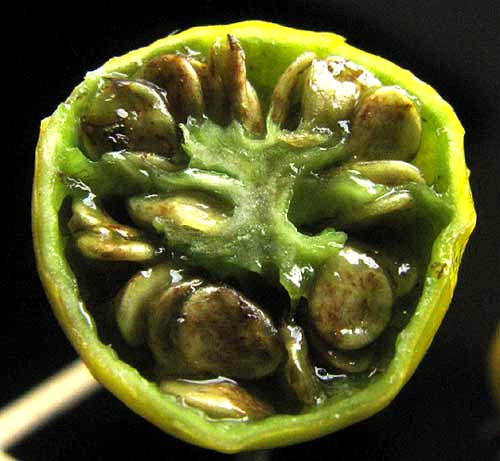
- Berries are fleshy fruits with soft, thin coverings. They don't split open at maturity, and contain few to many seeds embedded in their flesh. When you cut open a tomato you see exactly what a berry is because, botanically, tomatoes are berries, while blackberries and strawberries are not. At the right you see a cross section of the berry of a Silverleaf Nightshade, Solanum elaeagnifolium, a wild species closely related to the tomato plant.
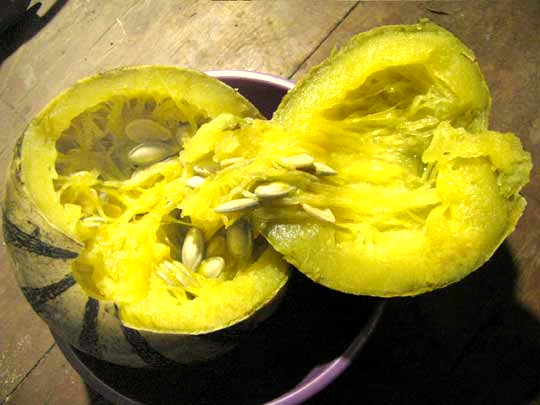
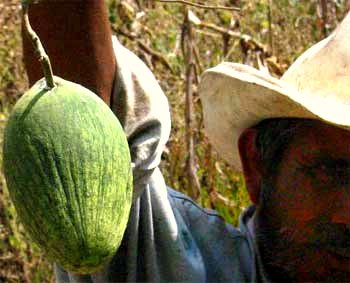
- Pepos, sometimes considered special forms of berries, are fleshy fruits developed from a single inferior ovary partitioned into two or more carpels to produce a fruit consisting of one chamber (locule) with seeds attached to the the fruit wall. The fruit wall consists of much expanded "accessory" tissue from the flower (the hypanthium). Cucumbers, watermelons and squash such as the heirloom Globe Squash shown at the right are pepos.
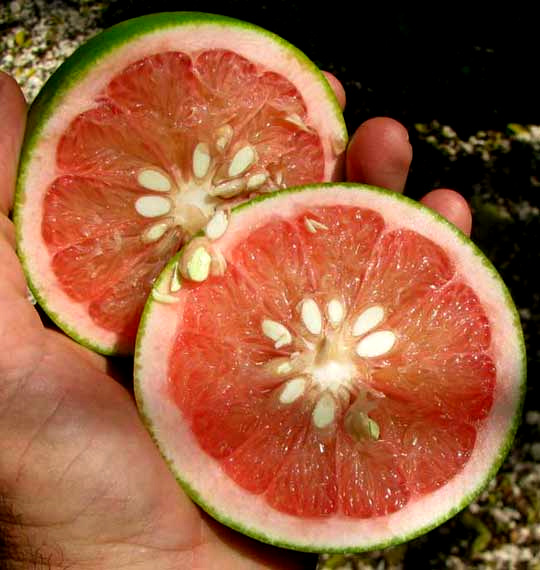
- Hesperidiums, also sometimes considered special forms of berries, are typical of citrus fruits such as oranges, lemons, grapefruits, tangelos and kumquats. They have a leathery rind surrounding a fleshy interior (endocarp), which is divided by thin, parchment-like partitions. Within the partitions, the edible flesh consists of juicy, unicellular "vescicles," among which seeds are embedded. All this is seen at the right in a cut-open grapefruit from an old cultivar producing less flesh and more seeds than in supermarket grapefruits.
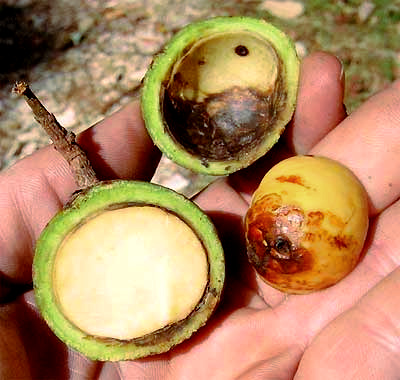
- Drupes are fleshy fruits with one or more seeds enclosed in a woody or stony case called an endocarp. Cherries and peaches are drupes, as are avocados, a wild Mexican species of which is shown at the right, probably Persea shiedeana. In the picture's lower, left corner a fruit has been cut lengthwise. Its greenish, edible flesh (mesocarp) is covered with a thin peel(exocarp). The picture's topmost item is a cut-open fruit with the seed, revealing the woody endocarp. At the picture's far right, that's the seed itself.
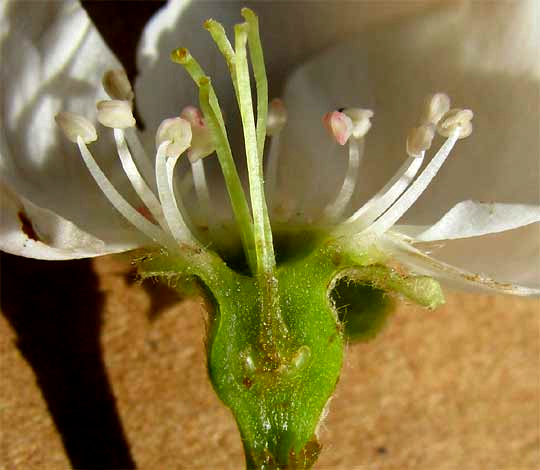
- Pomes are fleshy fruits formed from inferior ovaries having two or more carpels, the fleshy part being derived from the former flower's ovary wall (pericarp), and a hypanthium (explained below). Apples and pears are the best known examples of pomes. At the right, a broken-open pear-tree flower shows stamens arising from a crown of green tissue encircling the ovary's top. The green crown's firm-looking tissue continues downwards as a thick wall covering the ovary, fusing with a slightly darker green area, which is the ovary itself, with pale ovules at the style's base. The green crown and ovary-covering tissue is the hypanthium.
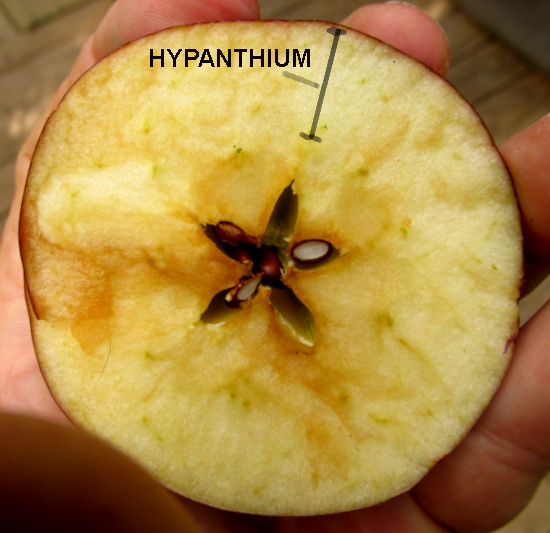 When you eat an apple or pear, mostly you're eating much-expanded hypanthium flesh, not part of the former ovary. At the left, an apple is shown in cross-section with the hypanthium zone identified. Hypanthium flesh imperceptibly merges with flesh developed from the former ovary's wall (mesocarp). The star-like seed chambers are the ovary's five locules, in which ovules have matured into seeds.
 - Capsule- and follicle-type fruits typically are dry fruits, and are profiled on our Simple Dry Fruit page. However, sometimes capsules and follicles also become fleshy. For example, at the right is a fleshy follicle of a Gonolobus edulis, a climbing vine of the Dogbane Family. Its soft flesh is gladly roasted and eaten by country people in much of tropical Latin America.