
The best way to learn about your neighborhood mushrooms is to have a local expert teach you. Most of us don't have that option, however, so another option is to purchase a field guide. On the Internet, see what is available by searching on words such as "books mushrooms identification" and "mushroom field guide."
For example, if you have an idea which genus the mushroom belongs to, with a search engine's image-search feature, you can search on the genus name as the key word. Note the mushroom-identifying websites listed in the "On the Web" sidebar below.
IMPORTANT FIELD MARKS FOR IDENTIFICATION
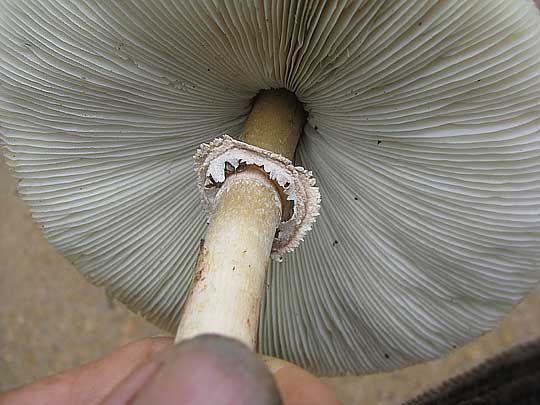
"Field marks" are distinctive features an organism has which are especially helpful for identification out in the field. On the mushroom at the left an important field mark is that the stem, or stipe, bears a collar-like ring or annulus around it. Stems of most mushroom species don't have rings but some do. The presence or absence of a ring is one of the first things to notice when identifying mushrooms; It's an important field mark.
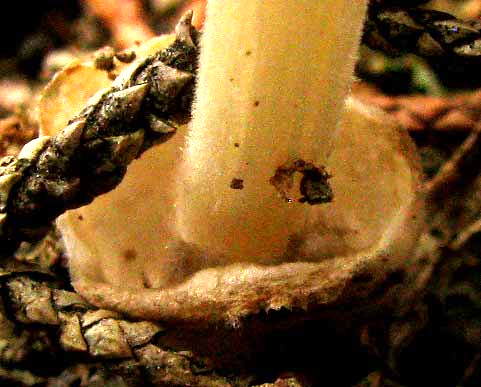
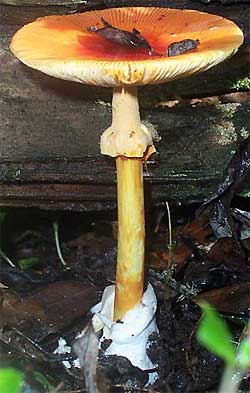
The same is true about the cuplike affairs known as cups, or volvas, from which stems sometimes arise, as shown at the left. The colorful mushroom at the top of this page displays a more obvious cup. Most mushroom species don't have cups, so they're good field marks. However, often you need to brush away leaves to see them.
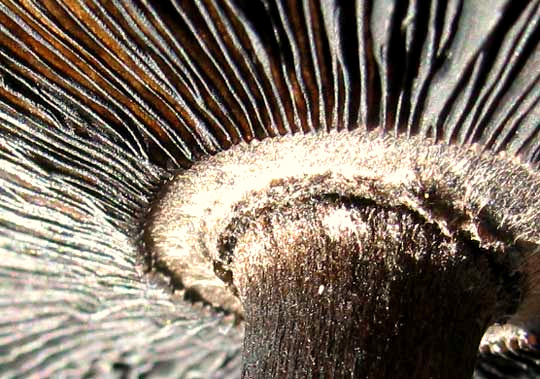
Another important field mark on many mushrooms is the exact manner by which the mushroom's stem connects with the cap's underside. The Shaggy Mane, Coprinus comatus, at the right displays a kind of bare area between the stem and gills, but that's unusual.
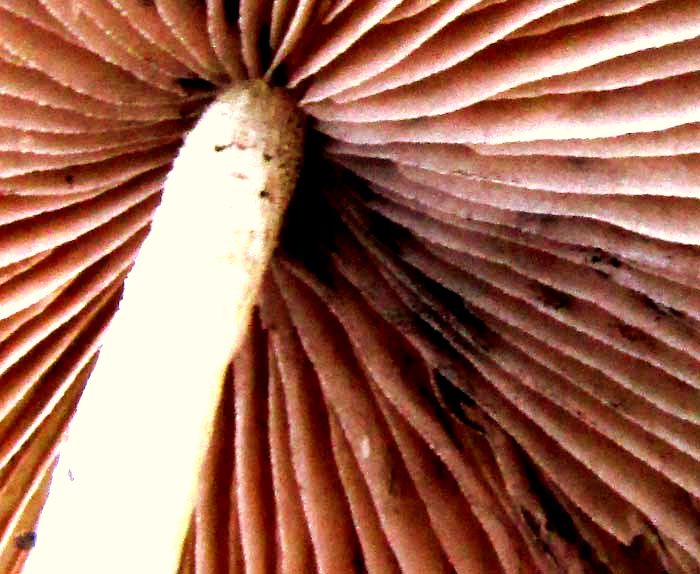
Compare that with the connection made by the Psathyrella mushroom at the left. There, instead of a bare area, there's a deep "notch" between the stem and cap.
On other mushroom species the gills simply connect directly to the stem, and on some species the gills actually descend as they gradually diminish down the stem.
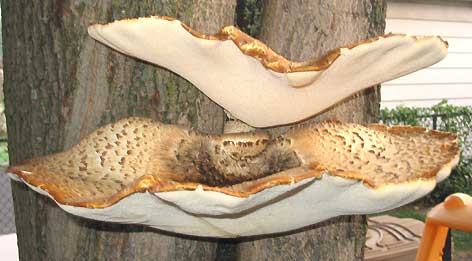
And then of course many mushrooms bear neither gills beneath their caps, or stalks, as with the Dryad's Saddle, Polyporus squamosus, shown below:
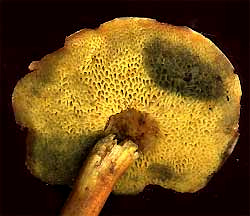
A curious but very useful field mark for identifying a few species is that they bruise easily, and sometimes the bruise is of a certain color. the Boletus at the right bruises bluish.
IDENTIFICATION & TOXIC MUSHROOMS
Many folks like the idea of collecting mushrooms in the wild, and eating them. Wild-mushroom hunting and eating was an important feature of life for our ancestors, and the idea is a good one even today. The fact is, however, that a few mushroom species, if you eat them, can kill you.
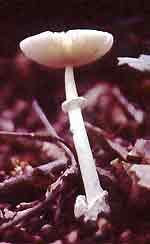
Therefore, for wild-mushroom eaters, getting a mushroom's identification right is critically important. A good first step in that direction is to be able to recognize the genus Amanita, the genus responsible for about 95% of fatalities resulting from mushroom poisoning. Important field marks for Amanitas are on display at the left. Note that a collar-like ring surrounds the stem a little down from the cap, and that the stem arises from a cup. You can't see it in the picture, but the spores are white. Amanita identification covered in more detail on our Eating Mushrooms page.
Other mushroom species besides Amanitas can kill you, and a further depressing number of species can make you very sick. In case you're thinking of eating the mushroom you're trying to identify, to encourage yourself to do a good job with the identification, you might benefit from reading a report entitled "Poisoned by A Chlorophyllum Mushroom."
IS MUSHROOM IDENTIFICATION EASY?
MycoKey from Denmark, an online identification key that displays a mushroom that changes to look like the one you're IDing as you work through the key. The key is for northern Europe but many of the same genera are found in North America.
Michael Kuo's Key to Major Groups of Mushrooms at MushroomExpert.co.
David Fischer's Mushrooms of Lawn, Garden & Home at AmericanMushrooms.co.
Mushrooms of California: site describes over 435 species and includes over 1800 photo.
The Boletes of California: Genus Boletus (caps have pores, not gills).
U.C. Berkley's CalPhotos fungus photo database; click on scientific name, see picture
The problem is that there are just so many mushroom species, with many very similar to one another, that no easy-to-use field guide can cover them all. The problem is compounded by the fact that mushroom spores can travel for hundreds, even thousands, of miles on wind currents, so any truly comprehensive mushroom field guide would have to include species usually found only far away. When I find a new mushroom, my picture-filled field guide called Mushrooms of North America, by Orson Miller, Jr., despite its impressive name, provides an identification in which I have confidence much less than half the time.
In mushroom identification there's one particularly interesting technique worth giving special mention to. Mushroom spores come in many different colors, and the color remains constant within the species! There are white spores, black, brown, rusty, smoky-gray, salmon, pink, and even yellowish and greenish spores! Spore color is invaluable in mushroom identification.
Unfortunately, usually you can't just sit down next to a mushroom and immediately determine its spore color. You must remove the cap, take it home, and place it on a small sheet of clear glass or paper. Ideally, the paper should have both black and white surface areas so that if the spores are white they'll show up on the black part, and vice versa.
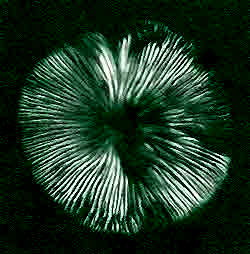
After a few hours, if you're lucky, a beautiful spore print such as that at the left will result. The lines coincide with the gills beneath the cap, from which the spores have fallen. Notice the absence of spores in the very center, where the mushroom's stalk was attached. The spore-print-making process slows down mushroom identification but, once you've done it, it adds to your confidence in the identification... plus you have a work of art! The best mushrooms for making spore prints are those about three-quarters grown. Sometimes the largest, most mature mushrooms in a group have already dropped their spores, while the smaller mushrooms may be too young to produce them.