(Without Killing Yourself)
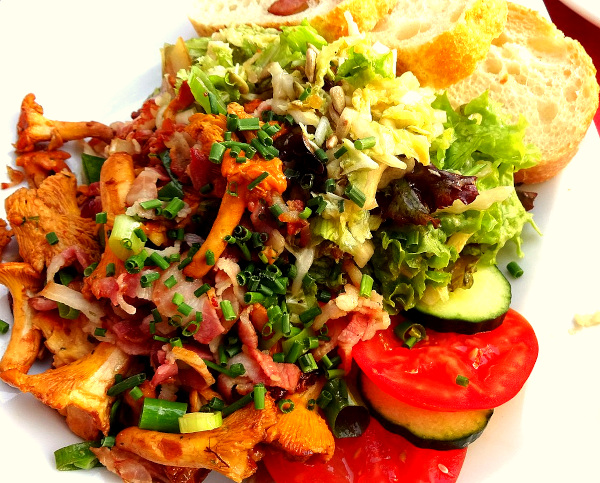 Mixed salad with fried, orange-colored Pfifferling mushrooms, and bacon; Photographed in 'Bierhausla' in Kulmbach, Germany; image courtesy of 'Benreis' and Wikimedia Commons
Most hardcore, long-term wild-mushroom eaters do not wander around with a published field guide randomly identifying mushrooms they encounter, and eating the ones the book says are edible. Rather, one way or another, they've learned how to recognize and prepare one to three or so local edible species, and to eat them year after year, always with a sense of heartfelt ceremony.
That's the surest, safest, most enlightened way to eat wild mushrooms.
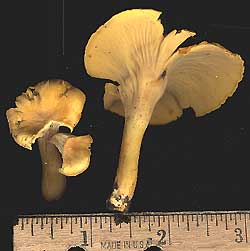
The above photo shows a dish famous in Germany, made with wild Pfifferling mushrooms, Cantherellus cibarius. In eastern North America, the Smooth Chanterelle, Cantharellus lateritius, shown at the left (same genus as the Pfifferling but different species), at certain times during summer and fall, in forests with oaks and hickories, may emerge in such prodigious numbers that bucketsful can be picked. And they're soooooo good lightly sautéed with onions and made into omelets. Other similar chanterelle species occur in other parts of the world, and many, many species other than the various chanterelles are wonderful to eat.
MUSHROOM-EATING "TRICKS"
After eating mushrooms for over 40 years, in 2006 I got poisoned. I made a series of mistakes, one of which was depending too much on my books' descriptions, and the other was nibbling too much during my first nibble test. On that species' page you can see the mushroom and, at the page bottom, read the account of my poisoning.
Once people know that you're eating wild mushrooms, they'll tell you their "tricks" for determining whether a mushroom is edible or not. Unfortunately, there are no tricks for determining if a mushroom is edible. Depending on silver spoons to change color when exposed to a poisonous species, or for the shape of a mushroom's cap to identify it as poisonous -- is a good way to get your stomach pumped. The only certain way to know whether a mushroom is edible is to know the mushroom's identity, and know that that species is edible.
Experienced mushroom hunters have developed a process for fudging the matter. If they find an unknown species, they'll taste a tiny bit (See above sidebar). If things go OK, then later a little more is eaten. Finally, if there are no problems, the mushroom is devoured. Of course, if you tend to be hypochondriacal, the moment you eat the first sliver you begin imagining all kinds of effects, so the nibble-a-little strategy doesn't work for some personality types.
THE AMANITAS
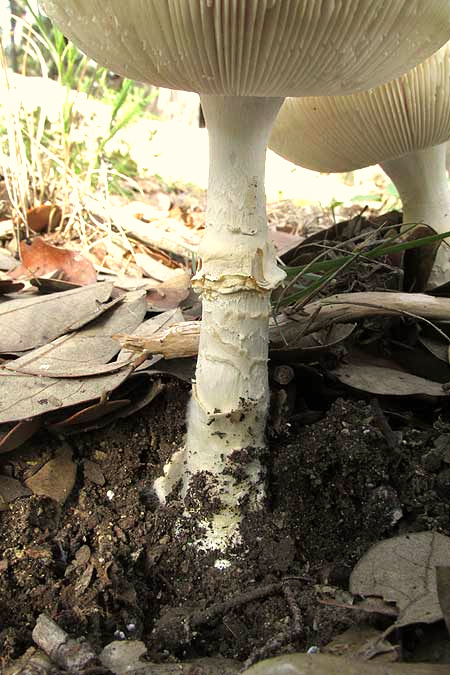
With around 600 species, the genus Amanita is responsible for about 95% of fatalities resulting from mushroom poisoning. If you eat wild mushrooms, you should be able to recognize the Amanitas. Important field marks for Amanitas are on display at the left, on the stem of the deadly Destroying Angel, Amanita bisporigera.
Notice that the stem bears a frilly ring. Also, the stem arises from a cup. Only a small portion of the cup is visible, but that's the way it often is in the field: If you find a mushroom suggestive of an Amanita, but it seems to produce no cup, be very careful deciding that no cup exists. Cups often lie buried beneath leaf litter or loose soil, and may be so fragile that they easily disintegrate when you poke around for them. Watch out for that cup!
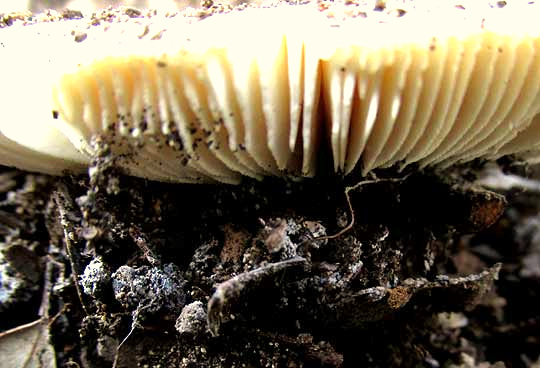
Another important field mark for the Amanitas is that they produce white spores. In the field, sometimes you can see spore color by looking beneath the mushroom's caps, as seen at the right. There a Destroying Angel is emerging from the ground, with spores descending from its gills accumulating on the soil beneath them, like after a snow shower.
For more details about Amanitas, check out Wikipedia's Amanita page.
THE SNEAKY PARASOL MUSHROOM, for example
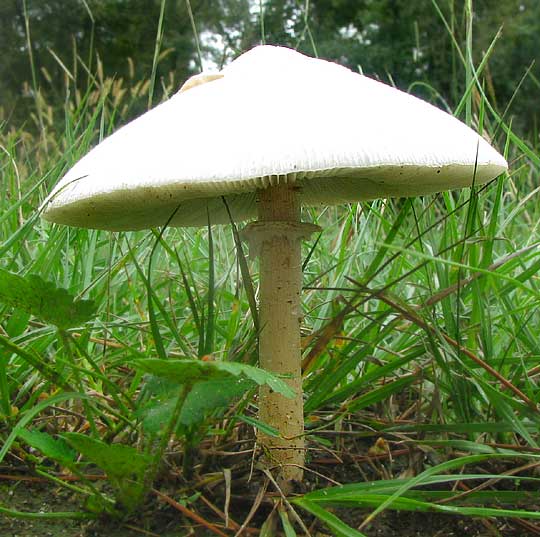
Don't only be afraid of the Amanitas. Though only about 3% of known mushroom species are poisonous, that still amounts to a fair number we might encounter. Also, numerous species can make you sick without killing you. The species poisoning most North Americans, but seldom killing them, is the innocent-looking Parasol Mushroom Chlorophyllum molybites, shown at the left.
Parasol Mushrooms are sneaky because most toxic mushrooms are stinky, bitter or generally disgusting tasting, but these Parasols are fairly odorless, pretty, typically appear in abundance, and... taste like custard. Yet, they can make you very, very ill, as described in the previous sidebar
This species often grows in large groups in grassy livestock pastures, and may form "fairy circles" -- group themselves into a big circle or portion of a circle.
ADVICE FOR EATING WILD MUSHROOMS
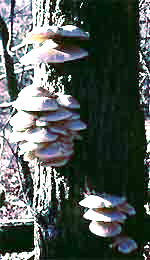
Here are three suggestions:
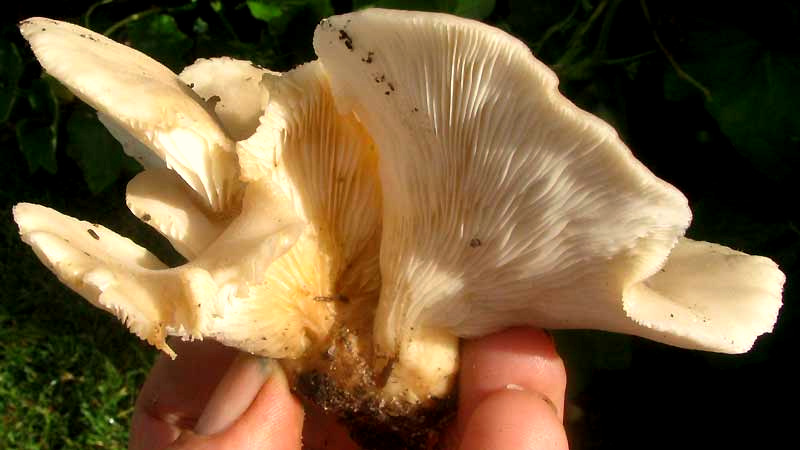
- Start with something easy to identify and known to be safe, like the plate-sized Oyster Mushroom, Pleurotus ostreatus," pictured above and at the right. That's an abundant, easy-to-recognize species found on dead trees worldwide, and there's no poisonous species looking exactly like it.
- Don't pick mushrooms that are past their prime, for often old mushrooms are filled with tiny maggots
- Don't overcook. Fry your mushrooms lightly and quickly in butter, with a little black pepper, or else add them to salads like the one pictured atop this page. They make good soup, too. Look for mushroom-using recipes on the Internet