PLANTS | ANIMALS | ECOLOGY | GEOLOGY | GARDENING | TOOLS
MEXICAN PLANTS & ANIMALS HOME

Excerpts from Jim Conrad's
Naturalist Newsletter
from the March 24, 2008 Newsletter written in the community of 28 de Junio, in the Central Valley 8 kms west of Pujiltic, elev. ~700m (2300ft), ~N16.331°, ~W92.472°; southeastern Chiapas state, MÉXICO
PASSIONFLOWER VARIATIONS
About 500 species of passionflower, genus PASSIFLORA, of the Passionflower Family, are recognized, so there's a lot of variation on the passionflower theme. Nowadays a fairly common, somewhat weedy passionflower vine flowering and fruiting here is shown below:
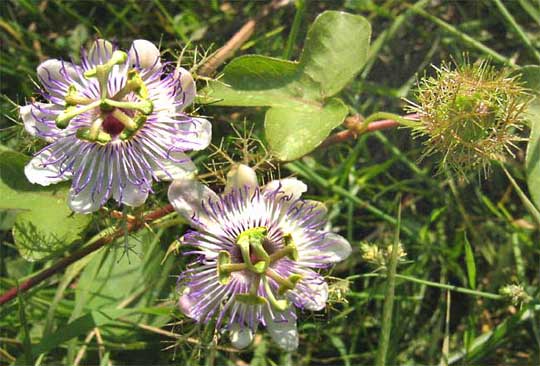
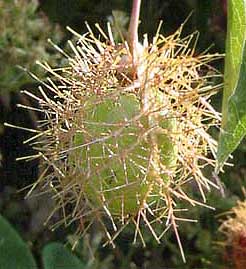 Blossoms on that plant are only about two inches across, so they're smaller than the Maypops or Wild Passionflowers often seen in the southeastern US. The most unusual thing about the pictured species concerns its three bracts, or modified leaves, just below the flowers. They're so repeatedly divided into needlelike segments that they give the impression of the flowers being subtended by a spiny collar. Unopened flower buds and mature fruits appear to be encased within a very spiny armature. You can see such a fruit at the right.
The spines are more apparent than real, however, because they're very soft -- they're all bluff. Animals appear to have discovered the deception, however, for often you see gnawed-open fruits, their tasty contents completely removed. Remember that even the South's Maypop fruits taste good when they're fully ripe, and that the "Granadilla," one of the tropics' favorite fruits, is a passionflower fruit.
Though passionflower blossoms look very complex their basic structure is similar to the Standard Blossom, which is the most average flower I could think of for teaching flower anatomy. I provide a nicely illustrated page just on passionflower anatomy at www.backyardnature.net/fl_passn.htm.
Not far from the above passionflower species with its pseudo-spiny collar yet a second passionflower species was weedily twining up an acacia. It's shown below:
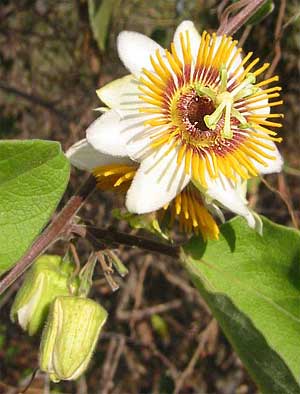
As you can see, its flowers are about the same size and have the very same structure as the other's but the colors are different and its three subtending bracts aren't at all divided into segments. What a treat it'd be seeing all 500 variations on the passionflower theme!
For those of you still be in an Easter frame of mind it may be appropriate to mention that the passionflower name derives from the Y-shaped structure atop the flower's ovary, composed of three stigma-bearing styles. The styles are similar enough to the cross design that they remind the religious of "Christ's passion."
from the April 21, 2008 Newsletter written in the community of 28 de Junio, in the Central Valley 8 kms west of Pujiltic, Chiapas, MÉXICO
PASSIONFLOWER VINES FRUITING
On this page the top-pictured species, with its flowers subtended by lacy, much-dissected bracts, now is fruiting in a rather spectacular manner, as shown below:
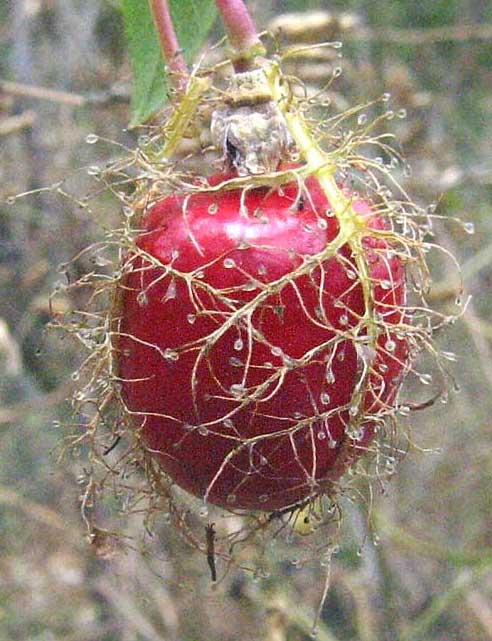
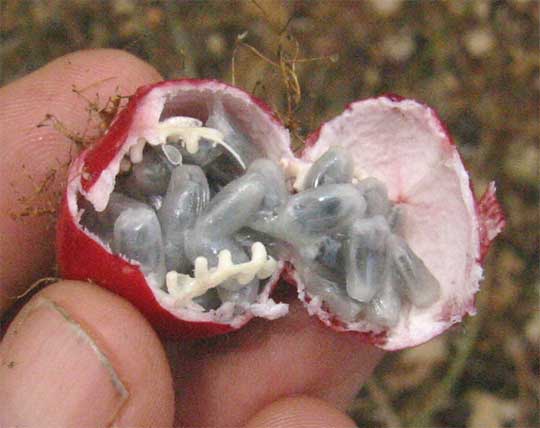
With such a bright, red color, fruits are visible from far away. When you're ready to pick them, however, you wonder about all those sticky-looking glands terminating each bract segment. A human can just ignore them, break open the fruit, and enjoy a sweet treat. An open fruit showing what's to eat can be seen below:
The translucent glands are as sticky as they look. If you touch one and then pull your finger away, the substance stretches about ten times the gland's diameter before releasing. I'm guessing that any insect wanting to burrow into a fruit or lay an egg in it might have a hard time negotiating the sticky defense.