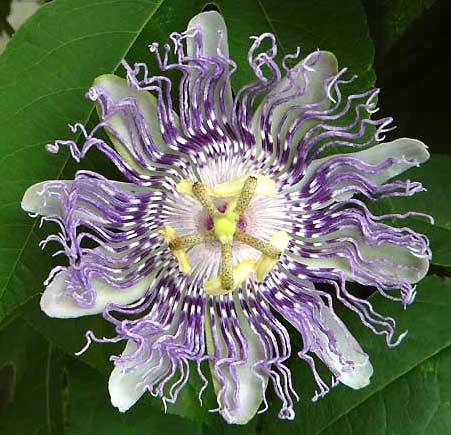
The above Passionflower looks impossibly complex. However, structurally it has a lot in common with our Standard Blossom, which you may want to consult to clarify some of the following terms:
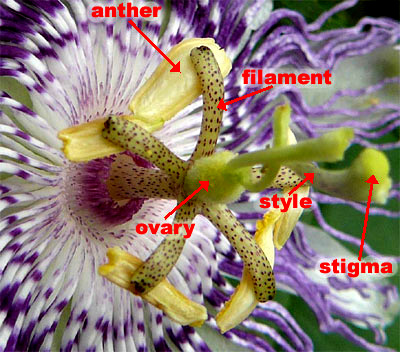
At the right, the anther and filament constitute the male stamen, with pollen emerging from the anthers. Pollen grains are deposited on the female stigma, they germinate and send pollen tubes carrying male sex germs down through the style to an ovule inside the ovary. The ovary will ripen into an edible, yellow, lemon-sized fruit, and the ovules in the fruit will mature into seeds.
In the topmost picture you can see that the flower appears to have ten whitish petals. If you look closely you can see that every other "petal" is a little more scoop-shaped and green-margined than the next. The green-margined ones are sepals and the flatter, whiter ones are petals. So, except for the almost-look-alike petals and sepals, to this point, passionflowers are fairly "normal" -- if you can say that about any flower -- as described in our Standard Blossom.
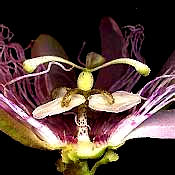
Still, passionflowers do have some unusual features. For example, all the flower's sexual parts -- its stamens, stigma, style and ovary -- are held above the sepals and petals on a special kind of stalk known as a gynophore. When the fruit develops it'll still have itsthis stalk attached. This is a good way to distinguish passionflower fruits from other kinds of lemon-sized, yellow fruits.
Also, maybe the most spectacular part of the flower, at least in this species, consists of the many slender, white-and-purple items radiating out from the base of the gynophore.
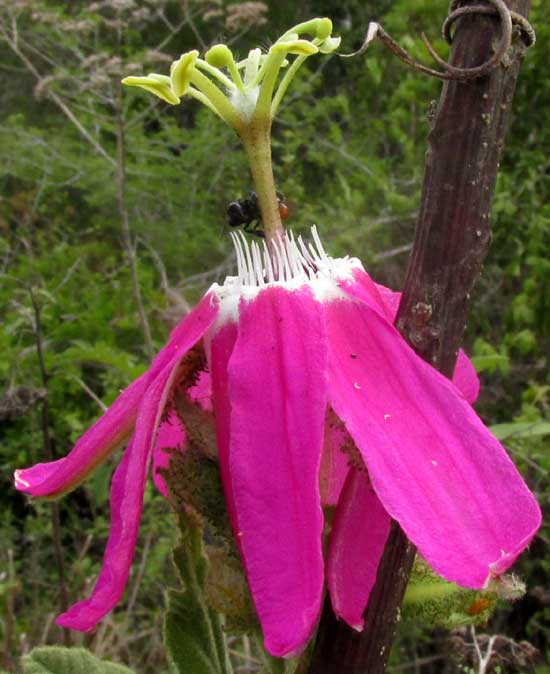
It happens that in a few kinds of flowers a special kind of outgrowth develops on the blossom where all the sepals, petals and sexual parts come together. The outgrowth is often known as a corona, or "crown." Daffodils have spectacular crowns -- the cup-like things rising in the blossoms' centers. Passion-flower crowns arise the same way, but instead of being cup-like they may be divided into many hair-like items. At the right, you see the Birdwing Passionflower, Passiflora tenuiloba, in which the corona fringe is much shorter. It's supposed that such coronas help attract pollinators.
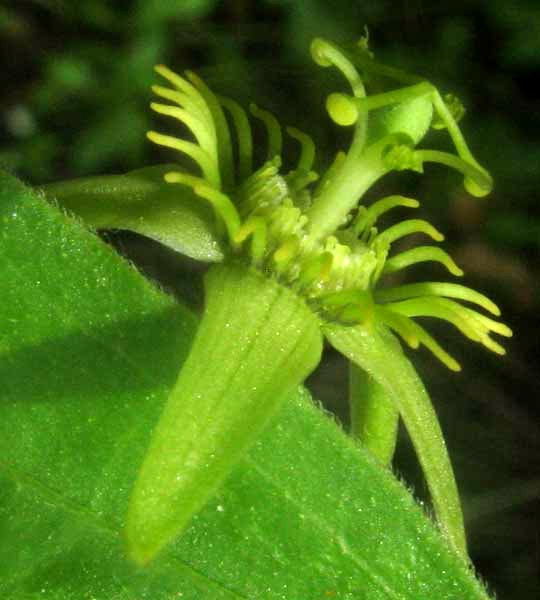
Another variation on the passionflower theme appears at the left, on the Corky-stemmed Passionflower, Passiflora suberosa, with blossoms less than an inch across (2cm). It appears to have two fringed crowns, plus no petals, its green sepals doing petal service.
About 550 naturally occurring species of passionflower, genus Passiflora, are recognized. Most are native to the tropics and subtropics, and many grow as understory plants in rainforests.
Numerous garden cultivars have been developed, such as "Blue Bouquet" with solid blue flowers; "Elizabeth" with 5-inch-wide (12cm) lavender blossoms, and; "White Wedding" with large, pure white flowers.
Herbage of passionflower vines often serve as food for caterpillars of various butterfly species.
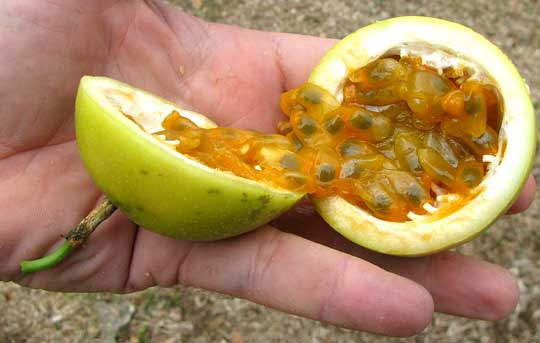
Mature passionflower vine fruits of certain species are tasty. The fruit at the right is from a vine often grown in the tropics and subtropics for food. It's Passiflora edulis, the species name edulis meaning "edible."