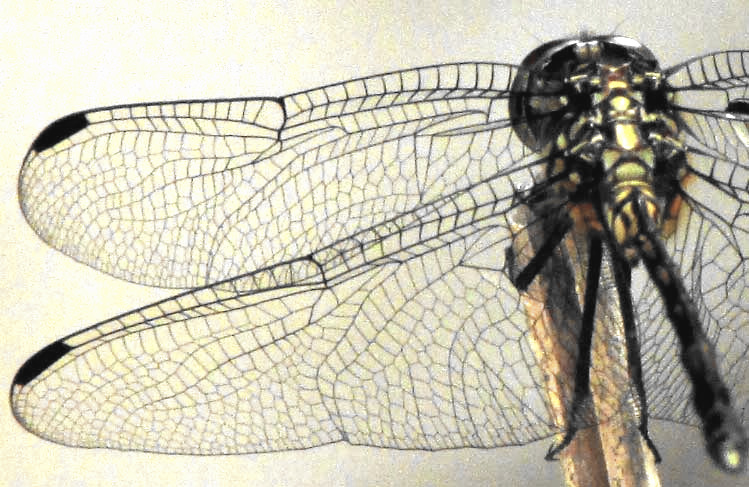
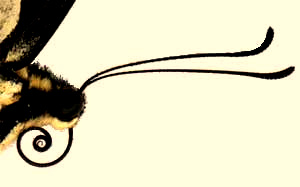
 When you examine any insect up close, you find structures and designs unlike anything you've ever seen. Just pause a moment and dwell on the beautiful intricacy of the veins in the wings of the Brown Setwing, Dythemis sterilis, at the right. And the elegant flow of antennae and coiled proboscis of a Tiger Swallowtail, Pterourus glaucus, shown below:
There's something in insect design reminiscent of the spirit of the master engineers who built early steam engines. Some of us could spend hours admiring all the dials, knobs, levers, cogs, belts, whistles, and bells on a steam engine. It's the same with insect parts. Every insect part gives the impression of being both very useful to the insect, and thoughtfully and artfully crafted.
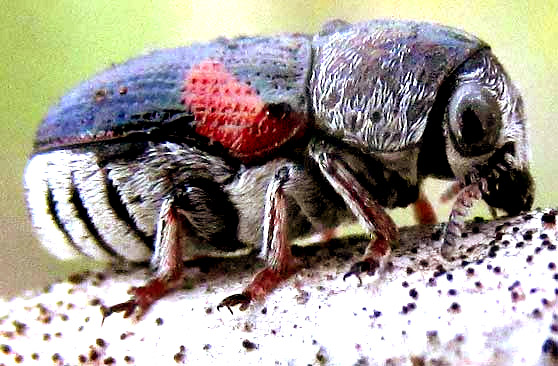
A basic feature distinguishing insects from all other arthropods is that their bodies are divided into three segments: head, thorax and abdomen. These are easily seen on the Case-bearing Leaf Beetle, Coleorozena pilatei at the right.
- the head bears mouthparts, eyes and antennae
- the thorax bears legs and, when present, wings
- the abdomen is used for food digestion, breathing, excretion and reproduction
ON THE HEAD
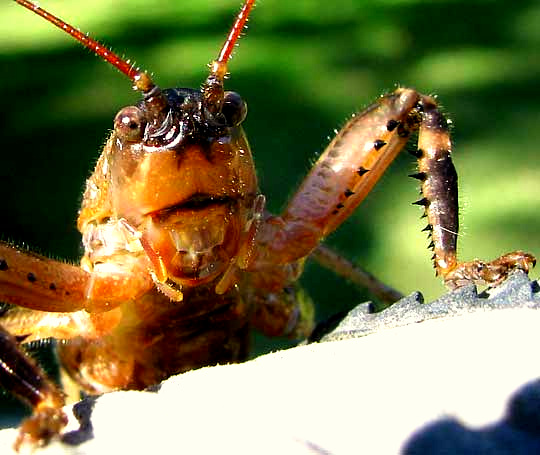
Heads vary tremendously among the various insect kinds. One reason is that so many kinds of foods are eaten in so many kinds of ways, and the mouthparts are adapted for each species' special needs. Usually insect mouthparts are easily recognizable as serving for biting/chewing or piercing/sucking. At the right, a shield-backed katydid chews into plant leaves for a living. Insect mouthparts are such a huge and important topic that we have a special Insect Mouth Parts Page.
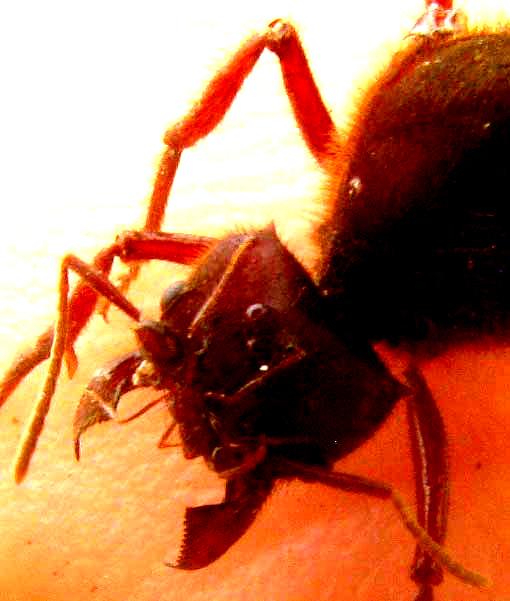
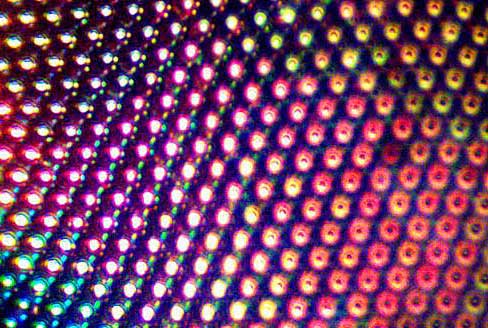
Insect eyes come in two main types: simple and compound. At the left you see both simple and compound eyes on a leafcutter ant, Atta texana, in Texas. In that picture, the Simple eyes, also called ocelli, look like tiny bubbles atop the head, and are little more than simple windows. Two larger compound eyes are present, one on each side of the head. Compound eyes consist of many very small window-like structures called ommatidia. As a general rule, most flying insects have both simple and compound eyes, while those who don't fly bear simple eyes. Below is a microscopic view of a horsefly's compound eye composed of thousands of ommatidia.
Antennae come in a bewildering variety of shapes and sizes, from mere stubs, to very large, colorful, feathery ones on some moths, and special terms are used for each type. Atop this page, the dragonfly's antennae are hardly noticeable short, thin, hairlike things, and are said to be "filiform." Below the dragonfly, the butterfly's antennae, slender but enlarging at the tip, are said to be "clavate." Below that, the beetle's antennae with flattened segments attached by their sides along the filament are said to be "lamellate." The Amateur Entomologists' Society provides a fine page showing and describing the various insect antenna types. On that page, you might look for the term describing the antennae of the Imperial Moth, Eacles imperialis, shown below:
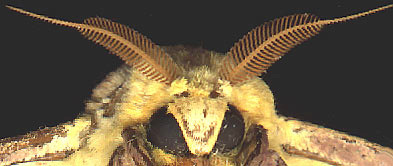
One detail about insect intennae important for us identifiers is that the number of antenna segments is often constant within a group. Scarab beetle antennae, for instance, are 8- to 11-segmented, while those of ladybird beetles are 3- to 6-segmented. The antennae on yellowjackets are 12-segmented in females, 13-segmented in males. However, sometimes counting antenna segments isn't easy, as with the above moth.
ON THE THORAX
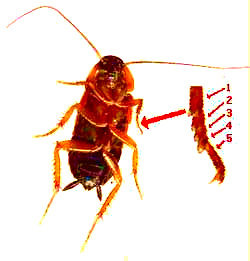
Legs are important in insect identification, too, especially the tarsus part, which more or less corresponds to a jointed foot. As with antenna segments, it's often important to notice how many segments comprise the tarsus. Tarsi on members of the order Odonata (dragonflies and damselflies) consist of 3 segments, while those in the order Isoptera (termites) possess 4 segments, and flies in the order Diptera have 5. At the right this Wood Cockroach, Parcoblatta pensylvanica displays 5-jointed tarsi.
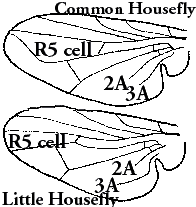
During the insect identification process, wings, especially the veins in them, often are even more useful than legs. Good insect field guides may include drawings such as those to the left, showing how the wings' individual veins connect with one another. Each open space framed within the veins is known as a "cell," and each vein and each cell has it own name. In the drawing, though Common Houseflies and Little Houseflies are very similar to one another, it's easy to see the difference between their wing vein patterns. BugGuide.Net has a page on wing venation.
ON THE ABDOMEN
One of the abdomen's main jobs is reproduction. A very conspicuous abdominal feature of many female insects is that they bear ovipositors, or egg-laying tubes, seen below on the Black Field Cricket, Teleogryllus commodus, as the dark, stiff, sword-like item between two smaller "cerci," the latter described below.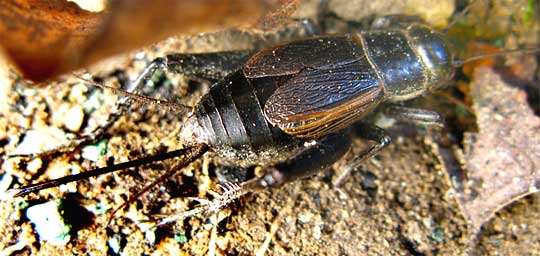
Possibly you can see in that picture that the ovipositor is slightly split at its tip. That's where eggs issue during egg-laying time. Some ovipositors are adapted to be inserted into the ground, others into tree bark, into leaves, or wherever the particular species happens to lay its eggs.
Not all female insects bear ovipositors. They're most commonly noticed on grasshoppers, katydids, crickets, parasitic wasps and sawflies. Most field guide illustrations show their species without ovipositors, so don't let the presence or absence of an ovipositor confuse you when you're identifying something.
Among stinging insects, the stinger is regarded as a modified ovipositor to which venom glands are attached. Among stinging members of the order Hymenoptera (bees, wasps, ants), eggs emerge from the base of the ovipositor instead of passing through it.
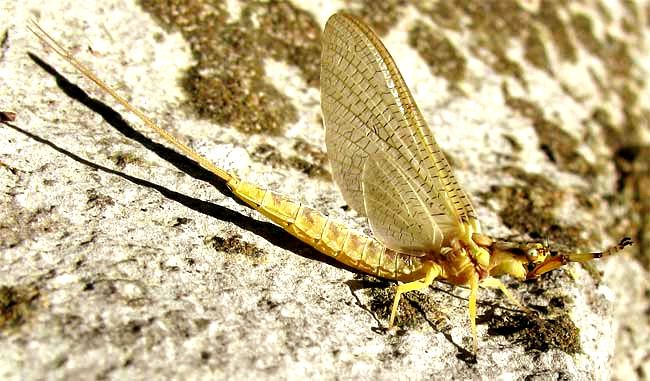
In the above cricket photo, the two hairlike items beside the cricket's ovipositor are cerci (singular cercus). Many insects and arachnids bear cerci. They're mostly used for feeling what's going on behind the insect, but in some species they may be used for fighting or during copulation. The mayfly, probably genus Hexagenia, shown below displays dandy cerci.