
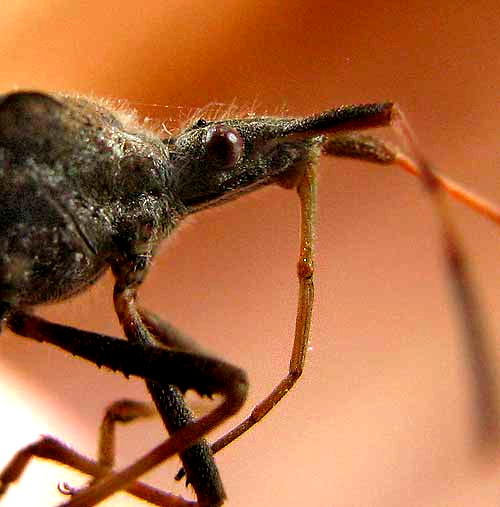
 One fun thing to do when you encounter any insect is to decide what kind of mouth parts it has. Often this means deciding whether it's a "sucker" or a "chewer."
For example, the Western Leaf-footed Bug, Leptoglossus clypealis, shown at the right takes sap from plant tissue with its brown, slender, jointed, proboscis, in the picture's center, suggesting a bent straw. Unlike a straw, however, this bug's proboscis is pointed, plus when a leaf-footed bug's proboscis is being used to feed on plant sap, the bug's saliva contains a toxic secretion which further injures, softens and makes juicier the plant tissue.
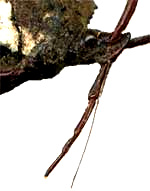 Moreover, the close-up of a leaf-footed bug's proboscis at the left indicates that the proboscis isn't really as simple as a cylindrical straw. Note the hairlike item at the right of the thicker, downward projecting item.
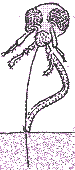
We can better understand what's being seen if we've ever paid close attention to a mosquito as it pierces the skin of its victim, as drawn the right. A mosquito's proboscis has a groove down its front, inside which reside several extremely slender, sharp, saw-toothed stylets. When a mosquito "bites" you, it's not inserting its entire proboscis into your skin. Rather, as in the drawing, its thick outer part, known as the sheath, bends, or "buckles," as the needle-like stylets enter your flesh. These stylets hold together in a way that allows blood to be sucked up. It's similar with leaf-footed bugs and their stylet-surrounding sheath.
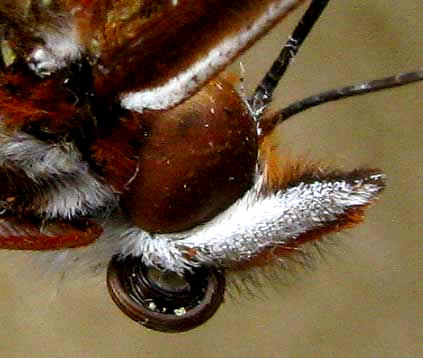
When Leaf-footed Bugs aren't using their long proboscises, they tuck the straw-like things up beneath them. However, butterflies and moths have less rigid proboscises which they can coil up neatly right below their heads, as shown at the bottom of the picture at the left. That's the head of a Gulf Fritillary butterfly, Agraulis vanillae. Such delicate proboscises must be used carefully, and the mostly white, fuzzy part arising near the proboscis helps with that. That's a labial palp, another palp hiding on the opposite side. The palps' hairs, sensitive to touch and other stimuli, help the insect figure out what's good food and what's not.
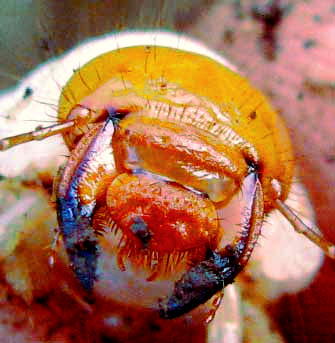
Compare the above sucking proboscises with the chewing mandibles of the white grub of a June Bug, genus Phyllophaga, shown at the right. As the grub tunnels through the soil, those mouthparts are used to feed on plant root roots, especially of grasses. The oval part between the mandibles, with mustache-like hairs on its bottom part, is the labrum, which amounts to the insect's "upper lip." At the labrum's bottom the two in-curving things surrounding by the fringe on hairs at the labrum's bottom, looking like thick hairs, are abial palps that help the grub feel and maybe taste in a weird way the food being eaten.
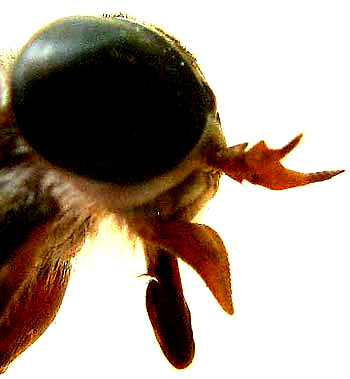
At the left you see a horse fly head with complex mouth parts that can cut right into a horse's (or human's) hide. At the picture's bottom, the dark item pointed downward is the horsefly's mouthpart. The cylindrical part, the labium, wraps around unseen, slender, sharp, swordlike parts that slash into flesh, cutting across blood vessels. When blood flows to the skin's surface, then the oval, spongelike part at the labium's base sops up the blood and the blood flows upward through the labium. The pointed item at the labium's right is one of two maxillary palps, which help the fly feel and possibly smell/taste what the palps touch. The antler-like thing pointing toward the picture's right is an antenna.
MOUTHPARTS OF SELECTED
INSECT ORDERS
Odonata (dragonflies): chewing
Isoptera (termites) chewing
Hemiptera (true bugs): sucking
Homoptera (cicadas, aphids, etc): sucking
Neuroptera (antlions, lacewings): chewing
Coleoptera (beetles): chewing
Lepidoptera (butterflies & moths): sucking
Diptera (flies): sucking
Hymenoptera (wasps, bees): chewing, chewing-sucking
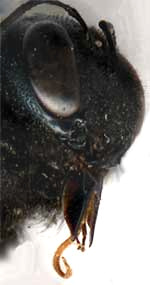
At the left you see the head of a Large Carpenter Bee, genus Xylocopa. The honey-colored, wormlike thing at the bottom of the mouth structure is its glossa, sort of like a tongue. The dark, downward projecting items right above the glossa are quite stiff and sharp. If you feel them with your finger you can understand how a carpenter bee can cut its way through solid wood, which it does when it excavates its nest-tunnels. Carpenter bees, however, being members of the Hymenoptera, are chewing insects, but you can see that their "chewing" involves a bit of slashing. A number of Hymenoptera similarly don't fit clearly into either the sucking or chewing category.
And just imagine what goes on with the mouthparts shown below, of the beetle often known as the Caterpillar Hunter, Calosoma scrutator.
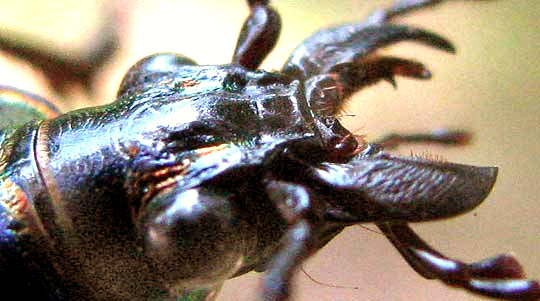
Those large mandibles, aren't necessarily used only to make life short for caterpillars. Male stag beetles with similar mouthparts sometimes use them while fighting other males of their species to establish dominance. Notice the hairy, banana-shaped structure at the base of and between the mandibles. That's the palps, or short "feelers" used mostly for "tasting" food, though the hairs help them "feel" it, too.
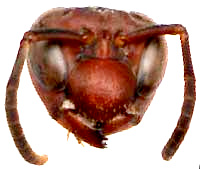 Mandibles on the paper-wasp's head at the left, at the bottom of the "face," are much shorter, but do a good job enabling the wasp to chew up other insects, especially soft caterpillars, to feed to their young. Note the toothed edges on them.
Finally, here's a trick question: What kind of mouthparts do you see on the head of the Polyphemus Moth, Antheraea polyphemus, shown below?
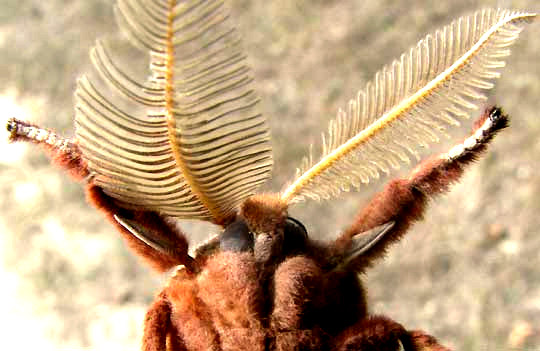
Answer: Polyphemus Moths possess only useless, vestigial mouthparts and no digestive tracts at all. They never eat! When the adult Polyphemus Moth emerges from its silken cocoon, if she's a female she emits sex pheromones that can be detected by males well over a mile away (2kms). The male finds her using pheromone detectors in his oversized, featherlike antennae very apparent in the above photo. Pheromones are chemicals released by an organism to attract an individual of the opposite sex. Once the pheromones have brought the pair together, they mate, the male promptly dies but the female flies off, lays her eggs, and then she dies too.
In other words, paying attention to insect mouthparts can actually be a fairly mind-boggling business.