
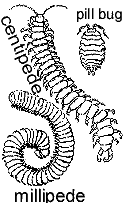
The drawing at the right gives a general idea of the differences between centipedes, millipedes and pill bugs. They're all arthropods -- creatures with, among other things, segmented bodies and jointed legs.
HOW THEY'RE RELATED TO OTHER THINGS:
We would say that the arthropod phylum is divided into several subphyla and classes (see our page on classification). Here are some of those subdivisions:
- SUBPHYLUM CHELICERATA
- The arachnids (Class Arachnida -- spiders, scorpions, mites, ticks, etc.)
- SUBPHYLUM UNIRAMIA
- The insects (Class Insecta -- beetles, grasshoppers... you know... )
- The centipedes (Class Chilopoda)
- The millipedes (Class Diplopoda)
- SUBPHYLUM CRUSTACEAE (Crustaceans)
- Class Malacostraca (crabs, shrimp, water fleas, pill bugs, etc.).
Sometimes centipedes and millipedes are lumped together as myriapods.
In the above list you can see that pill bugs are actually closer related to shrimp and crabs than to centipedes and millipedes, and that centipedes and millipedes, despite looking so similar superficially, are in different classes, and classes are very large subdivisions. To put it in perspective, as subdivisions of the the vertebrate subphylum, there's the reptile class, the bird class and the mammal class. Therefore, centipedes and millipedes are about as closely related as we mammals are to snakes and birds.
PILL BUGS:
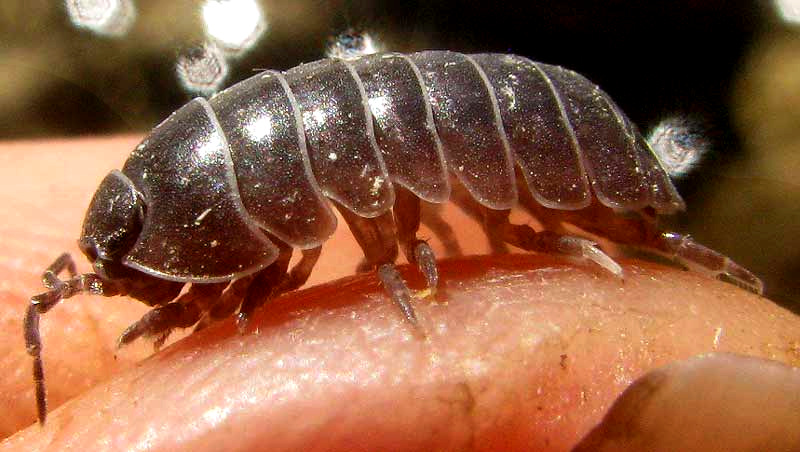
Pill Bugs such as the one above take their name from their habit of rolling into a ball when bothered, thus protecting their soft underside. Pill bugs are about 0.6 inch long (1.4cm). The image below shows that each pill bug segment bears only one pair of legs.
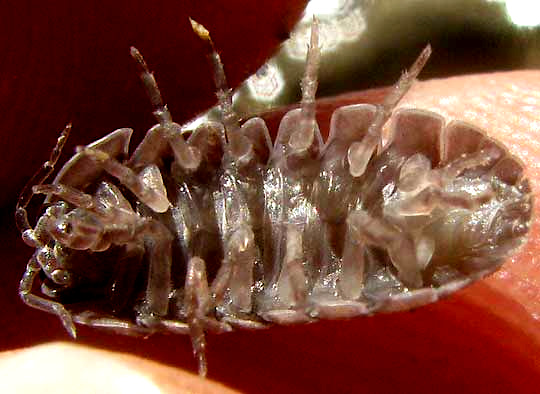
As we've seen, pill bugs are crustaceans. Most crustaceans, such as lobsters and crabs, live in or near water, so pill bugs are unusual dry-land crustaceans. However, they still need moist habitats because their delicate gill-like breathing organs must be kept moist. Pill bugs are found under logs, stones, and in damp basements, where they feed mostly on decaying vegetation, so obviously they are not going to bite you. Pill bugs are often called sow bugs, but specialists like to reserve the name sow bug for some species that look a little like pill bugs, but can't roll into balls. Both pill bugs and sow bugs are sometimes known as woodlice.
CENTIPEDES & MILLIPEDES:
You won't confuse pill bugs with centipedes or millipedes but, at least at first, you may have problems telling millipedes and centipedes apart. Here's how to distinguish them:
- MOST OBVIOUSLY: Centipede body-segment
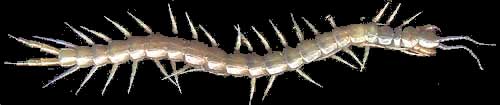
possess one pair of legs (2 legs), while millipede body-segments are equipped with two pairs (4 legs). That makes the critter at the top ofthe page a centipede, right? 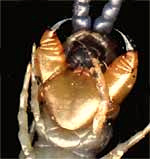 Centipedes are predators, mostly eating other arthropods, while millipedes eat plant material, especially soft, decomposing plant tissue. At the right you see the fangs of the above centipede, so you can imagine that Mother Nature hasn't equipped this critter with such powerful-looking fangs to munch on soggy celery.
- Centipedes, being predators, possess poison glands for incapacitating their prey (large ones can inflict painful though seldom dangerous bites -- a good reason to be able to distinguish millipedes from centipedes). In contrast, a typical millipede defense consists of secreting stinking juice from pores along its sides.
Centipedes are often called "hundred leggers," millipedes are called "thousand leggers," and pill bugs are sometimes called "sow bugs." At the top of this page you see a centipede fairly common in the US Southeast. It's a Scolopendromorpha, Scolopendra viridis. You know that it's a centipede because each body segment has one pair of legs (two legs) while millipede body segments each have two pairs (four legs). The Scolopendromorpha atop this page is about 3 inches long (7.5 cm), but they can grow larger. The larger ones can inflict a painful bite, and also can pinch with their last pair of legs. They dig burrows in which they rest, and females often coil around their eggs or young to protect them.
 The photo at the right shows something most people don't know about centipedes: Some centipede species can produce silk. Mainly they use silk only during mating and capturing prey. However, the fellow at the right didn't seem to be doing either of those things, so maybe we've discovered something here!
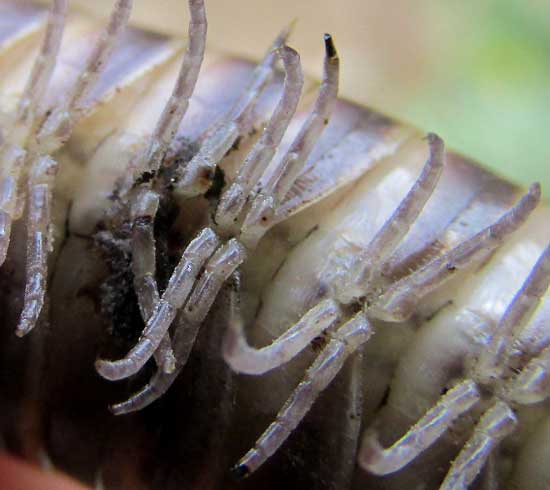
The picture at the left shows a few segments of a Bumblebee millipede, so you can see how two pairs of legs can be squeezed onto a single segment.
MORE INFORMATION:
Some interesting pages with centipede and millipede material can be found on the Web:
- help identifying the 16 recognized orders of millipedes
- introduction to the Myriapoda
- Myriapod section at the wonderful Bugguide.Net
- fossil myriapods
Though thousands of species of both centipedes and millipedes inhabit the earth, there is no good, comprehensive, commonly available field guide for their identification. The Golden Guide Spiders and their Kin may be the best and most commonly avaifilable introduction to the most common pill bugs, centipedes and millipedes, as well as the most conspicuous spiders.