PLANTS | ANIMALS | ECOLOGY | FUNGI | GEOLOGY | GARDENING | TOOLS
MEXICAN PLANTS & ANIMALS HOME

Excerpts from Jim Conrad's
Naturalist Newsletter
from the September 22, 2008 Newsletter issued from Mayan Beach Garden Inn 20 kms north of Mahahual; Caribbean coastal beach and mangroves, ~N18.89°, ~W87.64°, Quintana Roo state, MÉXICO
THREE LOOKS OF THE YUCATAN JAY
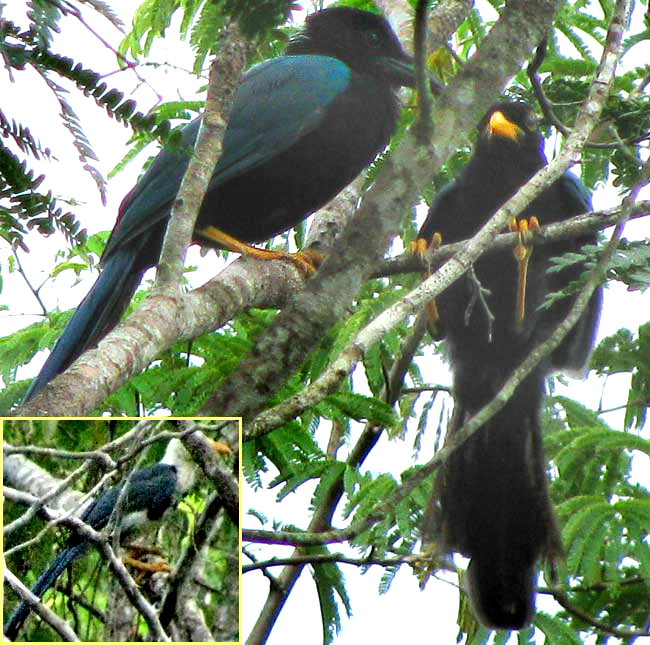
At a certain spot in the scrub near my casita you can nearly always see a flock of eight or so Yucatan Jays, CISSILOPHA YUCATANICUS. You're hiking along, a bird gives a warning call, and into higher branches flush several mostly blue and black birds chattering and scolding CHA-CHA-CHA and rattling CHAHAH-URR-RR just as you might expect noisy, nosey jays of any species to behave. Of course, that's three of them above.
Yucatan Jays have been common and easy to see in most of my homes across the Yucatán. Back at Komchén I wrote, "At dawn, right outside my porch, usually there are a couple of horses grazing, just waiting for me to feed them my banana peelings. There's a white horse and a dark brown one, and the brown one very often has six to twelve Yucatan Jays riding him. Sometimes a jay descends the horse's tail looking for whatever might be suspended in the long hairs. Sometimes a couple of jays sit for a long time just watching the horse's tail-hole. ... Most of the jays riding the brown horse appear to be enjoying the trip. They perch in a line along the horse's spine, looking around, squawking, preening and billing their neighbors."
Despite their commonness and familiar ways, they're endemic -- in the whole world found only in the Yucatán Peninsula and adjacent Belize, northern Guatemala and a little into the northern Isthmus of Tehuantepec. The flock near my casita is composed of birds exhibiting three distinct colorations, as shown in the picture at the top.
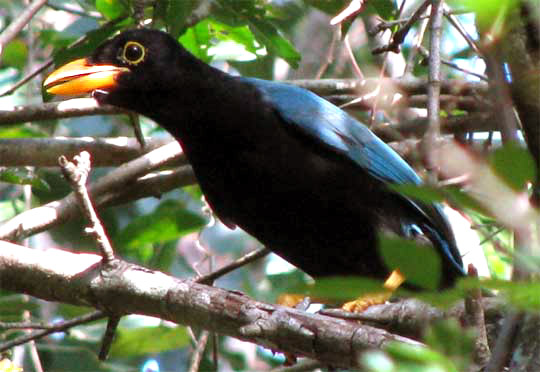
The black-billed bird at the top, left exhibits the typical adult appearance. The yellow-billed bird at the right is an immature bird, the main differences being that his bill is yellow and the ring around his pupil -- his "orbital ring" -- is yellowish, instead of black as with the adult. The inset at the lower left shows another immature Yucatan Jay, but younger than the first one, with yellow beak and white head and lower parts. The yellow beaks of young birds become black by their third winter. Howell in A Guide to The Birds of Mexico and Northern Central America reports the mostly white plumage as seen only from July through September, so I was lucky to capture it.
In sorting out the above color differences I needed to be a bit more discriminating in the use of certain terms than I have been, the terms being "immature," "juvenile" and "juvenal."
Howell defines "immature" as a general term for non- adult birds; "juvenile" birds are those in their first feathered, or "juvenal," plumage, and; "juvenal" is the term used for the first feathered, or non-downy, plumage of a young bird. Therefore, both of the non- adult birds in the picture are immatures," but only the one with a lot of white is a "juvenile."
Yucatan Jays are "cooperative breeders," a term applied to species in which several individuals, usually closely related, help with nest building, incubation, feeding young, etc. "Immature" Yucatan Jays help their parents take care of their even younger siblings, the "juveniles" in their "juvenal" plumage.
It shouldn't be surprising to find any species of jay exhibiting a more-complex-than-normal social structure. Jays belong to the same bird family as crows and magpies, and most birders agree that those are among the most highly evolved and intelligent of all birds.
from the November 28, 2004 Newsletter issued from Reserva Komchén outside Dzemul, northwestern Yucatán, México
YUCATAN JAYS
At dawn, right outside my porch, usually there are a couple of horses grazing, just waiting for me to feed them my banana peelings. There's a white horse and a dark brown one, and the brown one very often has six to twelve Yucatan Jays riding him. Sometimes a jay descends the horse's tail looking for whatever might be suspended in the long hairs. Sometimes a couple of jays sit for a long time just watching the horse's tail-hole. I suspect that any tick climbing onto this horse is quickly devoured by a jay.
Most of the jays riding the brown horse appear to be enjoying the trip. They perch in a line along the horse's spine, looking around, squawking, preening and billing their neighbors.
from the August 21, 2011Newsletter issued from Mayan Beach Garden Inn 20 kms north of Mahahual; Caribbean coastal beach and mangroves, ~N18.89°, ~W87.64°, Quintana Roo state, MÉXICO
MOSTLY WHITE YUCATAN JAYS
Each morning I bike through a raucous, hyperactive flock of Yucatan Jays. You can see some of them in a Hurricane-Dean-killed tree below:
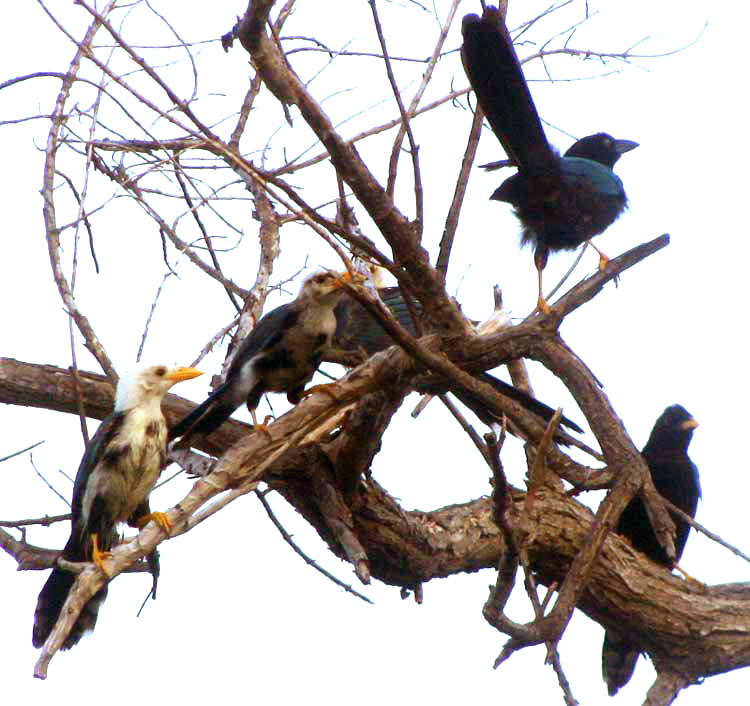
Though Yucatan Jays occur only in the Yucatan Peninsula, northern Belize and Guatemala, the species is common here. What's special about the above picture is that juveniles are present with their yellow beaks and mostly white plumages. Adult Yucatan Jays are completely black and blue, except for their yellow legs. Immature but past-juvenile birds look like the adults, but have yellow beaks and narrow, yellow rings around each their eyes. The eye ring doesn't become black until the third winter. The picture shows, then, three immatures, a juvenile "yearling," and an adult.
It's not surprising to find such a range of ages in a flock of Yucatan Jays. They are profoundly social birds and their flock structures are unusually complex and variable. Sometimes you see one adult bird feeding another, and sometimes food is passed back and forth among several birds before being eaten. In the wild you don't see Yucatan Jays fighting. They're "cooperative breeders," which means that several birds may be involved with a nest, and the helpers may exhibit various ages and sexual status.
All this information and much more is documented in a wonderful paper by RJ Raitt, called "Behavioral Ecology of the Yucatan Jay," which appeared in the December, 1976 edition of The Wilson Bulletin, and which now is freely downloadable in PDF format here
from the October 23, 2011Newsletter issued from Mayan Beach Garden Inn 20 kms north of Mahahual; Caribbean coastal beach and mangroves, ~N18.89°, ~W87.64°, Quintana Roo state, MÉXICO
MOUSE-EATING YUCATAN JAYS
Early one drizzly, foggy morning this week as I approached the end of a road leading to a coastal lagoon I came upon a flock of about ten loudly complaining Yucatan Jays. I thought they were just unhappy to see me until I noticed that at least some of their agitation seemed to arise from one of their members holding something in its beak, as shown below:
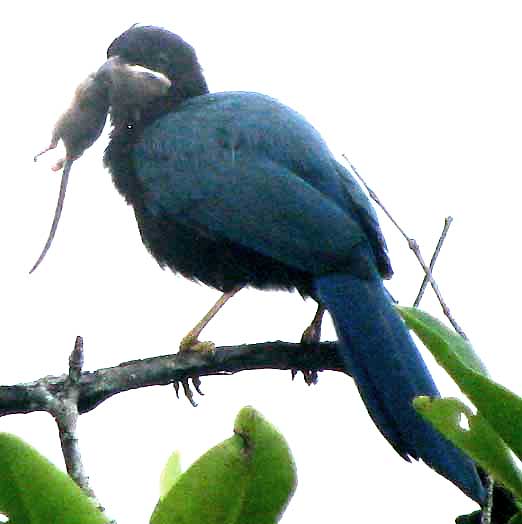
The jay had a dead mouse! Jays belong to the same bird family as crows and ravens, and most species in that family are omnivores, so this wasn't a big surprise. Still, one wonders whether the jay killed the mouse, took it from a predator, or just found it. For fifteen minutes the bird in the picture simply perched in different places with the mouse dangling from his beak, even when a mostly white juvenile bird approached pitifully begging to be fed with flapping wings and feed-me whines. Eventually the whole flock flew into the mangroves, the mouse still dangling.
Omnivory in a species is regarded as indicating relatively high intelligence. In fact, members of the Crow Family display brain-to-body weight ratios equal to that of the great apes and whales, and only slightly lower than humans. When compared to dogs and cats in an experiment testing the ability to find food according to three-dimensional clues, members of the Crow Family proved the most adept.
Issued April 2, 2020 from the forest just west of Tepakán; elev. ~9m (~30 ft), N21.053°, W89.052°; north-central Yucatán state, MÉXICO
FLOCKING DURING HOT AFTERNOON
During early afternoons when it's hottest, Yucatan Jays gather at a certain spot in the big Ramón tree near the windmill. Usually there's 15-20 of them. The picture below shows a loose cluster at a time when the outside-kitchen's shaded thermometer read 104° (40°C), and a nice breeze kept the jays' branches gently swaying, and me cooled off.
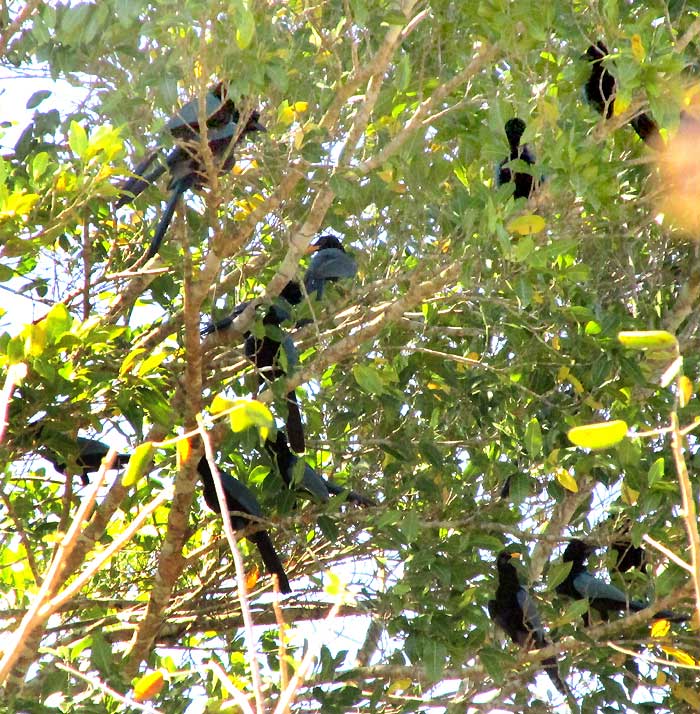
The birds do nothing there, just look around, not moving or saying anything. They're waiting until the Sun sinks low enough for temperatures to start dropping, and then singly and in pairs they'll fly away. I like to see others waiting patiently, for in my life I've learned that waiting has powerful effects, and often is a sign of refinement and depth of understanding. In a way, on these hot afternoons as I sit naked writing or reading, we're all waiting together, and it seems absolutely right to do so, exactly as we're doing it.