PLANTS | ANIMALS | ECOLOGY | FUNGI | GEOLOGY | GARDENING | TOOLS
MEXICAN PLANTS & ANIMALS HOME

Excerpts from Jim Conrad's
Naturalist Newsletter
from the September 1, 2008 Newsletter issued from Sabacché, Yucatán, México
YUCATÁN SPINY LIZARD ON PATROL
One late afternoon I was sitting in the scrub just letting time pass because of the heat, too hot to move, too hot to think, just sit and hope a breeze comes, else just let the sun sink lower and maybe then move on...
Then at the corner of my eye something small came rushing across the forest floor, quick and light, completely disharmonious with the moment's heaviness, the torpor, the timelessness. It was a slender lizard about a foot long, one with very familiar general features, but in small ways a little different from others of the type I've seen. It was one of the "spiny lizards," similar to the North's "fence lizards," clearly a member of the genus Sceloporus.
The genus Sceloporus is huge, not well understood, and with many intergrading forms, so in these Newsletters I'm always tickled to provide details to the future graduate student who'll come along and clarify the Sceloporus situation.
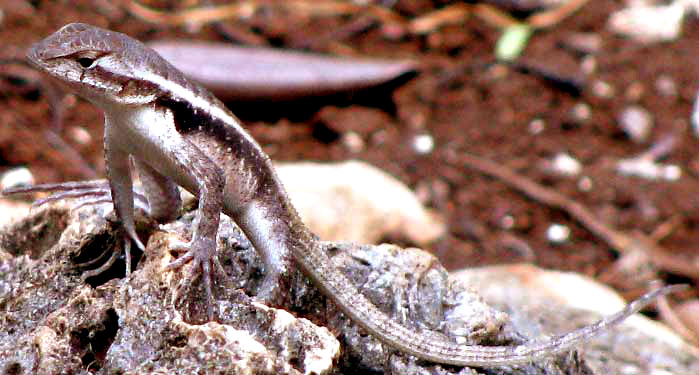
Despite the mind-numbing heat, this little critter atop a limestone rock 15 feet from me couldn't have looked more alert and more at the peak of his form. Looking squarely at me he seemed to recognize my presence, and when he showed no signs of scurrying off I readied my camera, started scooting toward him, and from about ten feet away took the portrait at the top of this page.
He's a Yucatán Spiny Lizard, SCELOPORUS CHRYSOSTICTUS, distributed in the hot lowlands from northern Guatemala and western Belize through the Yucatán Peninsula, being most common here, the northern Yucatán. One feature separating the species from other spiny lizards is the white throat and chest. Most adult members of the genus Sceloporus, at least males in our area, bear a pair of brightly colored belly and throat patches.
The instant I snapped the picture he leaped onto the ground and darted right by me, not three feet away, a pure blur. By the time I'd turned my head and focused on him again he was atop another stone about 20 feet away, again surveying his domain.
Julian Campbell, in Amphibians and Reptiles of Northern Guatemala, the Yucatán, and Belize, says that the species eats insects and arachnids, but also has been known to eat smaller individuals of its own species. He suspects that females may lay multiple clutches of eggs each season, most nests containing two or three eggs. To me this combination of multiple annual nests and sometimes-cannibalism sounds like a fine-tuned mechanism for population control: When times are good, produce several nests; when times are bad, eat the surplus.
from the June 11, 2017 Newsletter issued from Rancho Regensis north of Valladolid, Yucatán, MÉXICO;
elevation ~40m (~130 ft), N~20.876°, W~88.170°
YUCATAN SPINY LIZARD
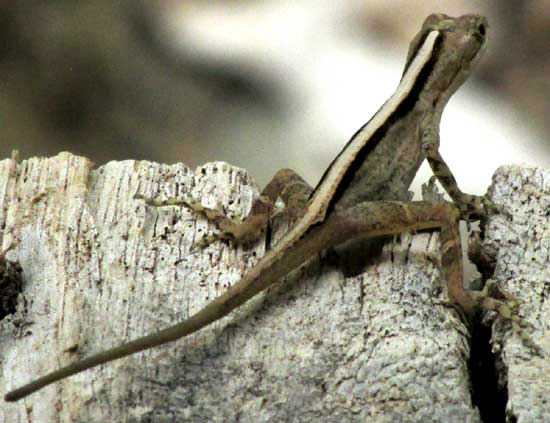
Above, we have only a frontal view. Lately a young Yucatan Spiny Lizard has taken up the habit of visiting the hut porch's wooden floor, where he perches at the floor's edge looking out over the deep pit yawning below. Below, You can see him at the abyss's edge, displaying very nicely the bold black and white lines down his back:
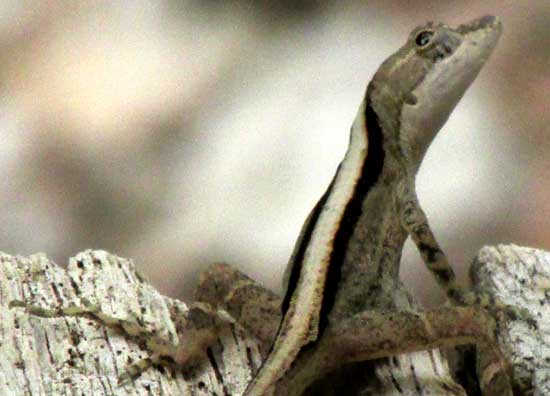
A closer shot showing him looking up at me appears below:
issued on July 17, 2019 from near the forest just west of Tepakán; elev. ~9m (~30 ft), N21.053°, W89.052°; north-central Yucatán state, MÉXICO
FEMALE YUCATAN SPINY LIZARD
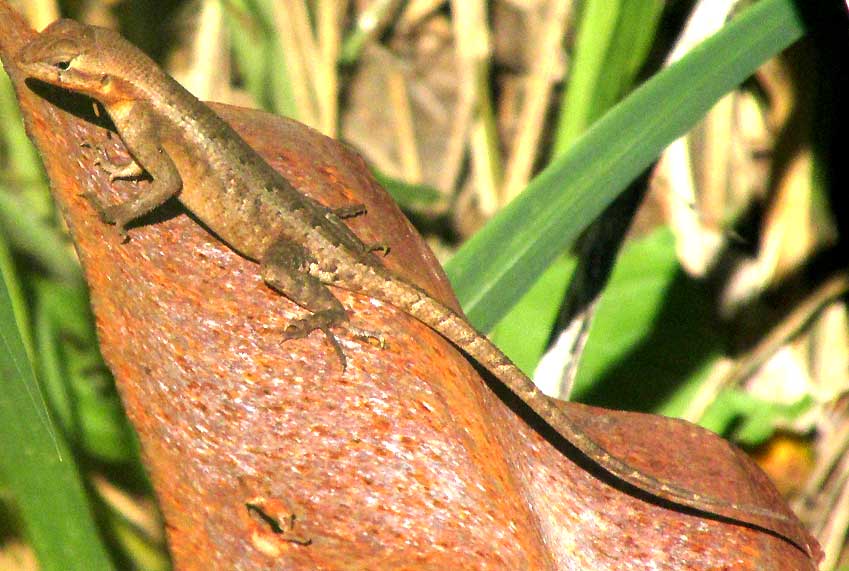
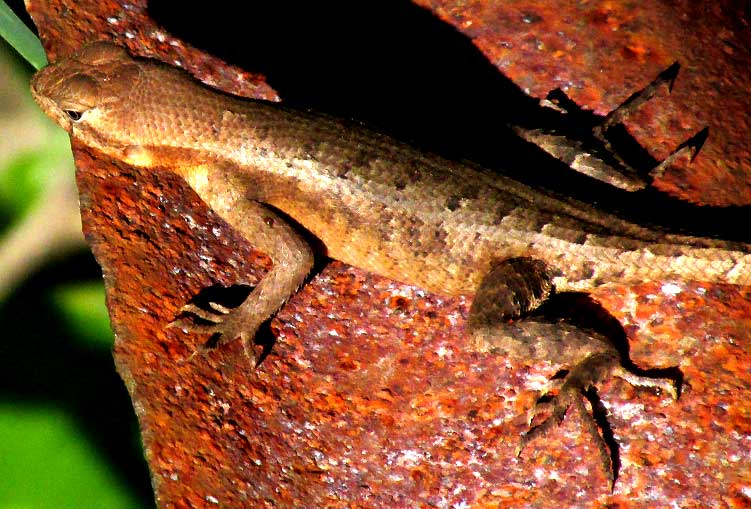
Above, individuals display striking white lines along their tops, the lines bordered below by black. Campbell, in Amphibians and Reptiles of Northern Guatemala, the Yucatán, and Belize, describes such streaks for male individuals. Keeping in mind that "dorsum" means above part and "dorsolateral" means upper side, for females, he writes that they "... often lack pale dorsolateral lines, although a vague indication of these may be present in some individuals, and have a pale to medium brown or grayish dorsum with dark brown dorsolateral markings... " That appears to describe the individual shown below, basking in morning sunlight on the corrugated tin sheets framing my garden to keep the Black Iguanas out:
A shot from above better showing the back pattern appears below:
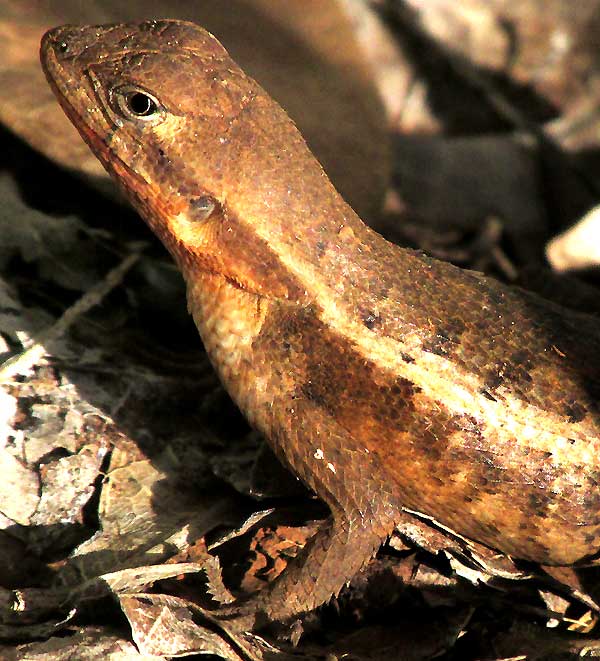
The front of the body is shown closer up below:
issued May 18, 2020 from the forest just west of Tepakán; elev. ~9m (~30 ft), N21.053°, W89.052°; north-central Yucatán state, MÉXICO
ANOTHER COLOR PATTERN
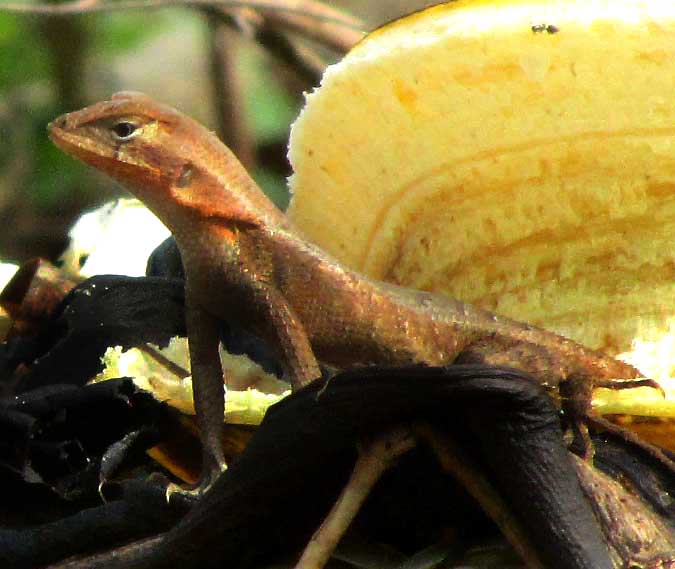
At the beginning of the rainy season the female shown below turned up on a banana peeling atop my compost heap, displaying a different pattern.