PLANTS | ANIMALS | ECOLOGY | FUNGI | GEOLOGY | GARDENING | TOOLS
MEXICAN PLANTS & ANIMALS HOME

Excerpts from Jim Conrad's
Naturalist Newsletter
from the April 17, 2011 Newsletter issued from Hacienda Chichen Resort beside Chichén Itzá Ruins, central Yucatán, MÉXICO; limestone bedrock, elevation ~39m (~128ft), ~N20.676°, ~W88.569°
YELLOW WARBLER IN A GUMBO-LIMBO
Atop a dry-season leafless Gumbo-Limbo tree the unmistakable silhouette of a slender-beaked, busily foraging wood-warbler caught my eye. It's spring migration time, so it's exactly the time for this. You can see the bird eyeing some Gumbo-Limbo fruit pods below:
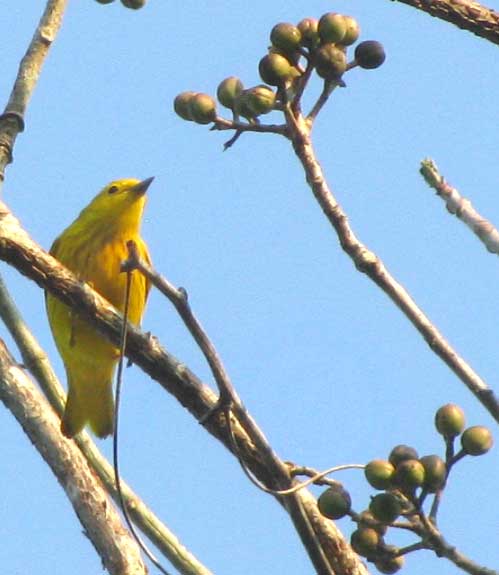
This is a male Yellow Warbler, DENDROICA PETECHIA, in full courtship plumage, with those thin, rusty streaks running down the yellow breast making identification easy. Up North I associate Yellow Warblers with willow thickets in swamps and along streams, so this one looks a little out of place in a Gumbo-Limbo. However, that's the way it is with migrants, their overwintering grounds usually being very different from their summer breeding ones.
Here in the Yucatán Yellow Warblers are only winter visitors, so the bird in the picture probably is leaving the area and won't be back until August or so. I'm guessing that he'll soon fly over the Gulf of Mexico onto the US Gulf Coast. However, some overwintering Yellow Warblers migrate into summer homes in Mexico's Western Sierra Madre highlands, so it's conceivable he'll go there instead. The species winters south to Peru and Brazil, so this may not be a bird who's overwintered in the Yucatán, but rather one "just passing through" from South or Central America.
Why would a Yellow Warbler be foraging in a leafless Gumbo-Limbo tree? The tree, Bursera simaruba, is very resinous and I've seen insects attracted to the resin. I'm betting the bird was going after those insects.
from the October 16, 2011 Newsletter issued from Mayan Beach Garden Inn 20 kms north of Mahahual; Caribbean coastal beach and mangroves, ~N18.89°, ~W87.64°, Quintana Roo state, MÉXICO
YELLOW WARBLER IN THE YUCATÁN
The Yellow Warblers I'm seeing here lack the streaking. They're just very nondescript, nervously flitting, yellowish little birds void of all striking field marks, like what you can see below:
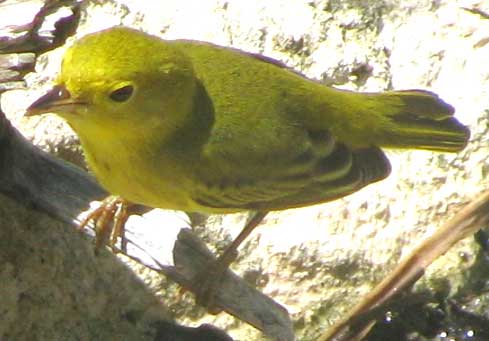
Actually, if you look closely you can see slight remnants of streaking on that bird's chest. That bird was one of a pair of similar-looking ones met working along the edge of a mangrove swamp the other day.
This summer I've commonly seen (but couldn't photograph) spectacularly different-looking Mangrove Warblers, which look like typical Yellow Warblers except that the entire heads of adult males look as if they've been dipped in rust-colored paint. Depending on your expert, Mangrove Warblers constitute one of 35 different Yellow Warbler subspecies, or else they form a distinct species.
Typical Yellow Warblers are present in our area only during the Northern winter, but Mangrove Warblers are permanent residents here along the coast.
So, does the picture show an immature or female typical Yellow Warbler just arrived from up North, or an immature or female Mangrove Warbler? I'm not expert enough to know. Maybe someone out there can say.
from the February 15, 2015 Newsletter issued from Río Lagartos, on the Yucatan Peninsula's northern coast (~N21.60°, ~W88.16°), Yucatán state, MÉXICO
MANGROVE WARBLER
In the mangroves along the estuary's borders often we see Mangrove Warblers such as the one on a Black Mangrove stem shown below:
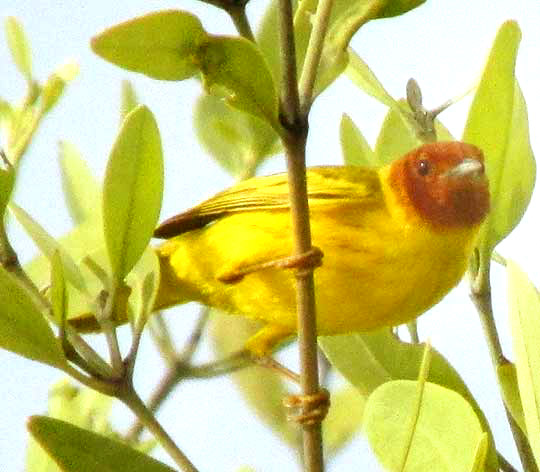
With a chestnut-colored head on a yellow body, this bird is easy to identify. True to its name, mainly it's found in mangrove swamps, though I've seen them in thorn forest a few miles inland.
The Mangrove Warbler is one of those birds that give taxonomists fits, because it doesn't fit neatly into human ideas of what a species should be. Some authorities list Mangrove Warblers as a distinct species but nowadays most consider them as mere geographic forms of the widespread and common Yellow Warbler. And even the Yellow Warbler's taxonomy has been debatable. Most of my life the species has been placed in the big genus Dendroica, but now most experts say it belongs in Setophaga, along with redstarts.
The Yellow Warbler is tremendously variable over its distribution. It nests throughout most of North America and winters from about here south into northern South America. Current thinking is that about 35 Yellow Warbler subspecies cluster into three main groupings. One of those three groupings, embracing about twelve of the 35 subspecies, is referred to as the Mangrove Warbler, or erithachorides group. At this writing, the technical name of our Mangrove Warbler of the Yucatan is SETOPHAGA PETECHIA, ssp. BRYANTI.
Other than that and the fact that they display such outlandishly chestnut-colored heads, our Mangrove Warblers behave like regular warblers, hanging around in trees, especially trees beside bodies of water, and they like nothing better than to gulp down juicy caterpillars.