PLANTS | ANIMALS | ECOLOGY | FUNGI | GEOLOGY | GARDENING | TOOLS
MEXICAN PLANTS & ANIMALS HOME

Excerpts from Jim Conrad's
Naturalist Newsletter
from the October 6, 2008 Newsletter issued from Sabacché, Yucatán, MÉXICO
ANONA-EATING WOODPECKER
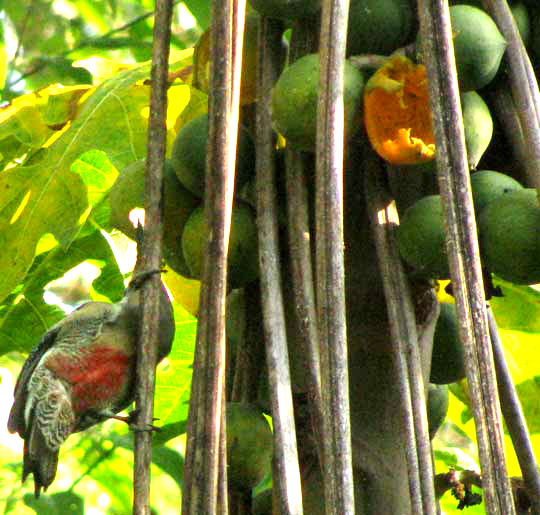
The anona tree outside my casita door still is bearing sweet fruit, and the neighborhood Golden-fronted Woodpecker, CENTURUS AURIFRONS, has been taking more than his share. You can see him pecking a fruit below:
This isn't the first time a Golden-fronted Woodpecker has revealed his sweet-tooth to me. During my winter, 2005 stay at San Juan Hacienda a bit north of here (see below) this bird pecked holes in immature coconuts and caused much damage in orange orchards.
Birders in the eastern US might see little difference between our Golden-fronted Woodpecker and the Red- bellied Woodpecker so common up there. Golden-fronted Woodpeckers, distributed from the southwestern US to El Salvador and Honduras, exhibit various geographical variations in Mexico. Our Yucatan subspecies dubius is distinguished from other subspecies by the very narrow barring on its back and its reddish belly at certain times of the year, the other subspecies sometimes showing yellow bellies. If you compare the above picture with the US's Red-bellied you'll see that the back of ours is darker overall because the black bars across the back are much narrower, more numerous and closer together.
from the November 23, 2005 Newsletter written at Hacienda San Juan Lizarraga one kilometer east of Telchac Pueblo, Yucatán, MÉXICO
and issued from Hotel Reef Yucatan 13 kms to the north
FRUIT-PECKING GOLDEN-FRONTED WOODPECKERS
The other day the gardeners decided to take a break from their sweaty machete swinging and drink the juice from some of our green coconuts. As Roberto retrieved coconuts from a tree Franciso came and invited me to join them. The coconuts were macheted open with little more than an expert flick of a wrist. The cool, sweet juice sure was good and chatting in the palms' shade was delightful. Francisco decided to have a second serving but when he sliced off the coconut's top he found the cavity inside hardly developed and with little juice. The cavity's inner surface was deformed with warts.
"Carpentero," he hissed contemptuously, which meant "Woodpecker." "The carpentero comes and pecks one hole in the young coconut, drinks a little, then flies away. And when he wants more, instead of returning to the coconut he's already ruined, he goes to a new one and ruins it."
The woodpecker in question was our most common woodpecker species, always to be seen, the Golden- fronted Woodpecker, distributed from Texas and Arizona through Mexico to Nicaragua. Birders in the eastern US would look at this species and see hardly any difference between it and their own Red-bellied Woodpecker. The differences are there, however, if you look for them.
This wasn't the first time I'd hard complaints about Golden-fronted Woodpeckers. Both Don Gildardo and the owner of the citrus orchard on San Juan's western side, when they first saw me wandering around birding, volunteered their opinions about this woodpecker who destroys so many of their oranges.
"They peck a hole, drink what they want, then later do the same thing to another orange, not the one they've already ruined!"
The holes let in insects and disease organisms.
The other day I saw a large, red shirt flying from a giant bamboo stem rising from inside an orange tree. I didn't have to ask what it was for, and I could see for myself that it wasn't doing any good.
from the January 22, 2012 Newsletter issued from Hacienda Chichen Resort beside Chichén Itzá Ruins, central Yucatán, MÉXICO; limestone bedrock, elevation ~39m (~128ft), ~N20.676°, ~W88.569°
HUNGRY BIRDS
Last Monday morning, everything seemed hungry, and I'm not sure why. Maybe it was because it was such a perfect, moist, warm, springy morning (despite all the dry-season-falling leaves) that many organisms, including myself, just felt like gorging on everything.
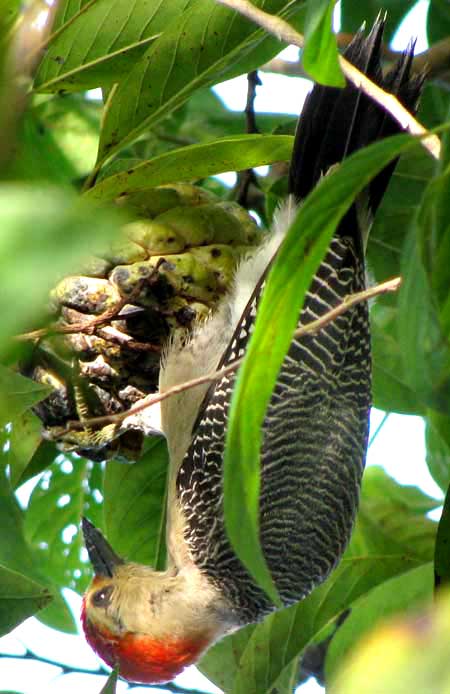
For instance, during my morning walk a Golden-fronted Woodpecker with his seasonally spectacularly red belly flew into a Wild Papaya and gave a maturing fruit the eye before stabbing into its orange flesh, as seen below: