PLANTS | ANIMALS | ECOLOGY | FUNGI | GEOLOGY | GARDENING | TOOLS
MEXICAN PLANTS & ANIMALS HOME

Excerpts from Jim Conrad's
Naturalist Newsletter
from the March 20, 2016 Newsletter issued from Hacienda Chichen Resort beside Chichén Itzá Ruins, central Yucatán, MÉXICO; limestone bedrock, elevation ~39m (~128ft), ~N20.676°, ~W88.569°
BLACK WITCH MOTH
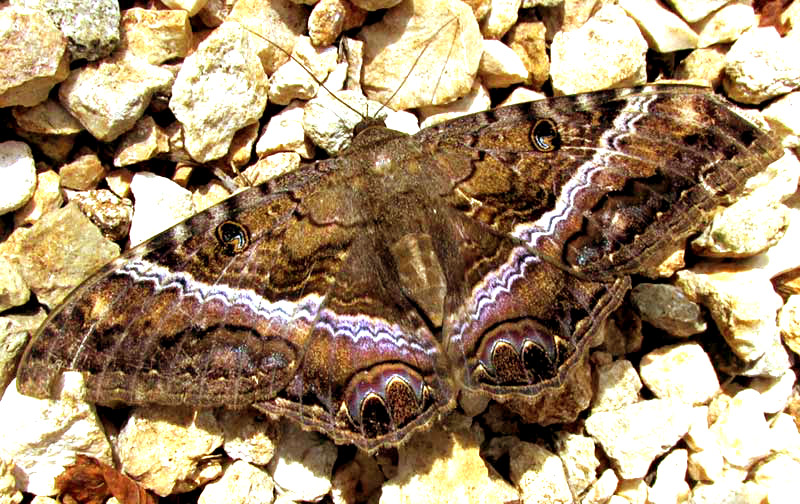
The hut in which I live was first visited by a Black Witch Moth back in 2010, resulting in our page shown in the next section, below. That visitor had been faded and tattered, so this week when I came upon a much fresher looking one -- on the sidewalk beside the Hacienda's restaurant -- I got some pictures. A top view of the six-inch-broad moth (15cm) appears below:
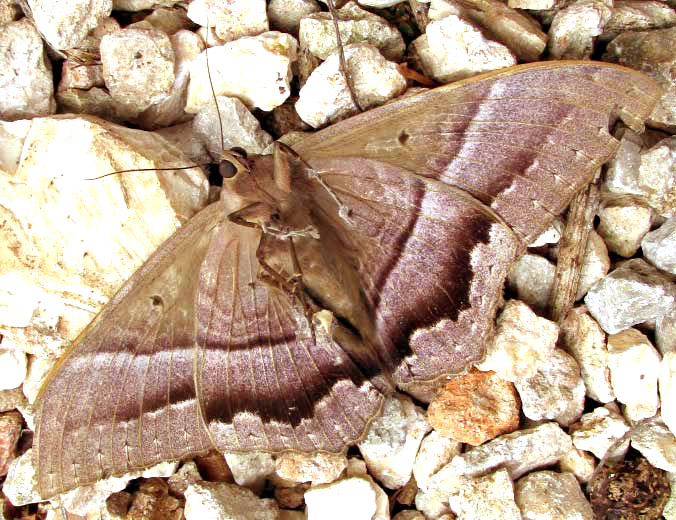
The underside is shown below:
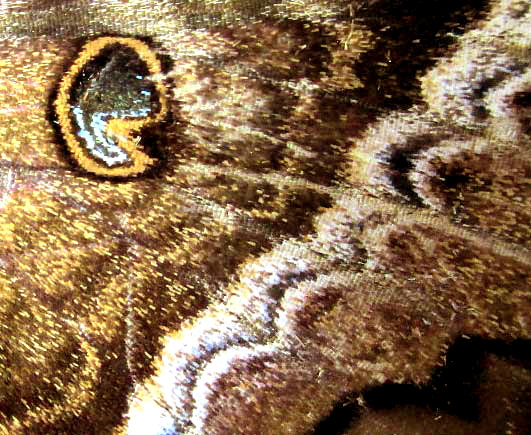
And an artsy close-up of part of a wing is shown below:
These pictures were possible because the moth was incapacitated, almost dead. Its legs were bound in cobwebs so maybe the moth had become entangled in a web on the restaurant's ceiling, became exhausted trying to get away, and had been removed during the daily restaurant cleaning. Among the Maya, Black Witch Moths are famous for seeking shelter in people's huts and outbuildings.
The Maya concept that Black Witch Moths are "house borrowers" was another reason I wanted to take a second look at the moth. On the 2010 Black Witch Moth page I comment on a strong belief held by many rural and small-town people throughout Central America and mainland Mexico (as opposed to here in the Yucatan) that it's a bad omen when a Black Witch Moth enters your house. When they enter, someone may be about to die.
However, a year or so ago an anthropologist friend wrote saying that during her decades of work among the Yucatan's Maya she'd never heard anyone express the bad-luck/ pending death belief about the Black Witch Moth. Since then I've been asking around and now I see that it's true: Elsewhere people may believe that Black Witch Moths are harbingers of death, but not the Maya here in the Yucatan.
I asked my Maya friend Paulino what Black Witch Moths are called in Maya and he gave the name of Ma-ha-nah, more or less, which he translated into Spanish as Presta-casa, which I interpret as meaning "House-borrower."
I'll bet there's a good story of why the Maya have a different set of beliefs about Black Witch Moths. In fact, here in the Yucatan I'm continually finding ways that Yucatan culture differs from the rest of Mexico, including the use of the Spanish language. For instance, throughout most of mainland Mexico a turkey is a guajalote, but here in the Yucatan it's a pavo.
from the June 20, 2010 Newsletter issued from Hacienda Chichen Resort beside Chichén Itzá Ruins, central Yucatán, MÉXICO; limestone bedrock, elevation ~39m (~128ft), ~N20.676°, ~W88.569°
BLACK WITCH MOTH
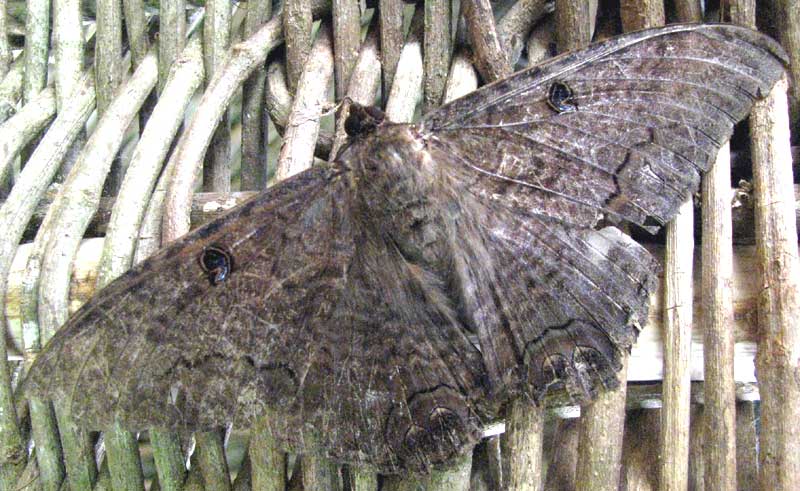
Six-inch-across (15 cm), dark moths have begun spending their days in my hut, their big wings flush with the ceiling's thatch, or maybe they'll be on my pole walls or the vine door, or even outside beneath the thatch overhang. You can see one on the vine door above.
I sent volunteer insect identifier Bea in Ontario a picture and it wasn't long before a message came back telling me that I was in for a heap of trouble. What we have here is the Black Witch Moth, ASCALAPHA ODORATA, a species familiar to country folks from Brazil through Central America, Mexico and the Caribbean, and sporadically deep into the US. And any hut-dwelling country person in that vast range will tell you: Having a Black Witch in your hut is not good news. If someone in your hut is sick and a Black Witch enters, the sick person will die. In Mexico Black Witches commonly are called Mariposas de la Muerte, or Butterflies of Death. In Maya a Black Witch is Mahá-nahí, which roughly translates to a less menacing "House Borrower."
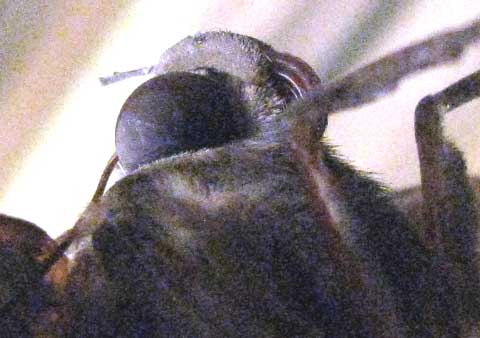
Above a close-up of a Black Witch's head shows a bulbous, black, many-windowed compound eye and a brownish, coiled proboscis. Many large, showy moths live so briefly that they possess no mouthparts -- they only live long enough to mate and lay eggs. But you can see from our moth's frayed wing margins that Black Witches live awhile. The proboscis enables the adult to eat soft, mushy or rotting fruit, sugary tree sap and the like. Caterpillars feed on the leaves of trees and shrubs in the abundant Bean Family.
Of course my Maya friends assure me that the bit about the hut's occupant dying is purely a superstition. What bothers me is the way they tell me -- a little too gaily, a smile a little too forced, a voice a little too encouraging, the way you talk to someone whose doctor has given them only days to live.