PLANTS | ANIMALS | ECOLOGY | FUNGI | GEOLOGY | GARDENING | TOOLS
MEXICAN PLANTS & ANIMALS HOME

Excerpts from Jim Conrad's
Naturalist Newsletter
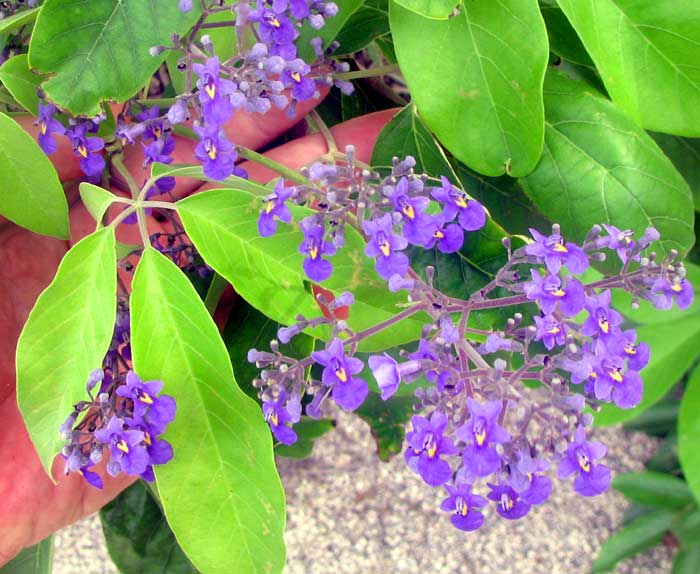
from the August 7, 2011 Newsletter issued from Mayan Beach Garden Inn 20 kms north of Mahahual; Caribbean coastal beach and mangroves, ~N18.89°, ~W87.64°, Quintana Roo state, MÉXICO
VITEX IN BLOOM
When I arrived three months ago already a certain small tree along the sand road bore a few flowers, but I've been waiting to photograph until the flowering reached more of a peak. Now that's happening, as shown above.
At the left in that picture notice the tree's "palmately compound" leaves -- leaflets arising from a single spot atop the petiole, like fingers from the palm of a hand. When you see such leaves associated with purple, bilaterally symmetrical flowers, you should think the genus Vitex is a big genus of about 250 mostly tropical and subtropical species. About 18 Vitex species have been brought into cultivation, mainly because they're such pretty plants.
Our species is VITEX GAUMERI, occurring from southern Mexico south to Costa Rica. Its main English name appears to be Fiddlewood, which is a name shared with several related and unrelated trees. Sometimes Vitex gaumeri is called Walking Lady; in Maya it's Yax-nik. Vitex is a genus in the Verbena Family, the Verbenaceae.
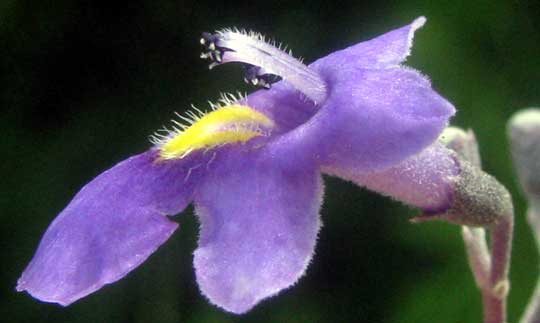
Below you can see Vitex gaumeri's flower, beautifully adapted for pollination -- the yellow "nectar guide" leading from the pollinator's "landing pad" beneath stamens whose anthers will daub pollen onto the pollinator's back as it enters the corolla's throat:
The IUCN's "Red List" classifies Vitex gaumeri as "endangered," probably because of tremendous habitat destruction throughout the lowland area the plant lives in, and because of overharvesting of the tree for its exceptionally fine wood.
from the September 3, 2017 Newsletter issued from Rancho Regensis north of Valladolid, Yucatán, MÉXICO;
elevation ~40m (~130 ft), N~20.876°, W~88.170°
FIDDLEWOOD FRUITING
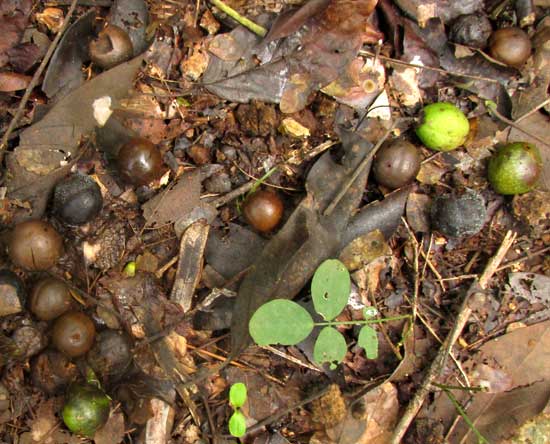
Here and there in the rainy-season-lush forest the ground is littered with spherical, green-turning-brown fruits very similar to the Muscadine grapes currently dangling from wild vines in the US southeastern states. Below, you can see a section of the forest floor here just as I found it -- the most recently fallen fruits green while older ones are brown:
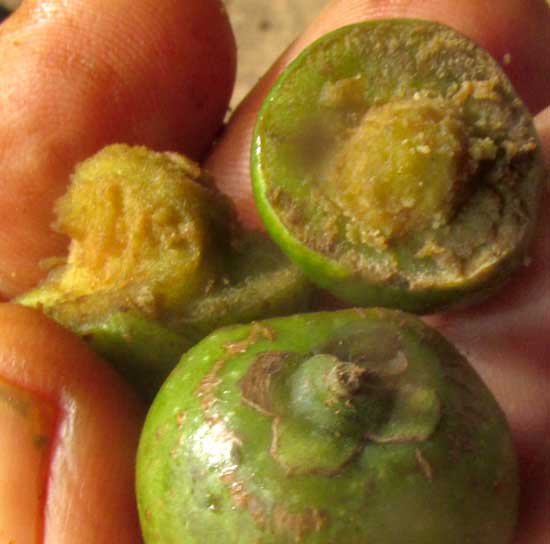
Cutting across these grapelike fruits, you find a fair amount of surprisingly hard "flesh" surrounding bony seeds looking enough like grape seeds, as you can see below:
However, searching for a grapevine in the forest canopy above the fallen fruits, you'll not find one. Instead, you'll see Muscadine-like fruits dangling from tree limbs, as shown below:
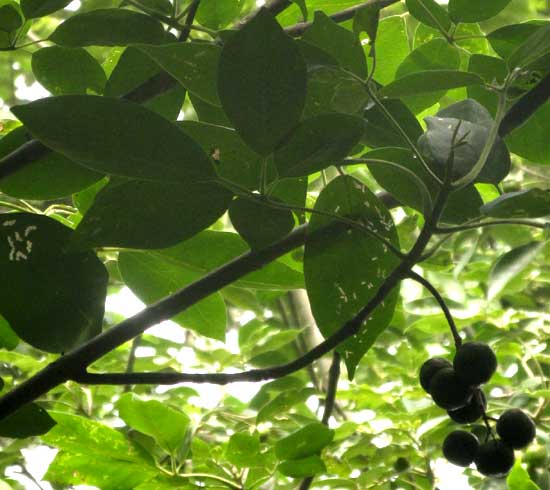
In that picture, notice that the leaves arise opposite one another along the stems, and that they are "digitately compound" -- single leaves composed of five or so leaflets all joined at their basses like digits on a hand.
Relatively few tree species produce digitately compound leaves, so I should have recognized the species immediately. However at first I just couldn't think of any that might produce Muscadine-like fruits. To convince myself that I really was seeing such fruits and leaves produced by a tree, and not a vine growing into the tree, I had to follow the fruit cluster's branch back along its forkings, to the trunk, But it definitely was a tree, even one with a monumental trunk, as witnessed below:
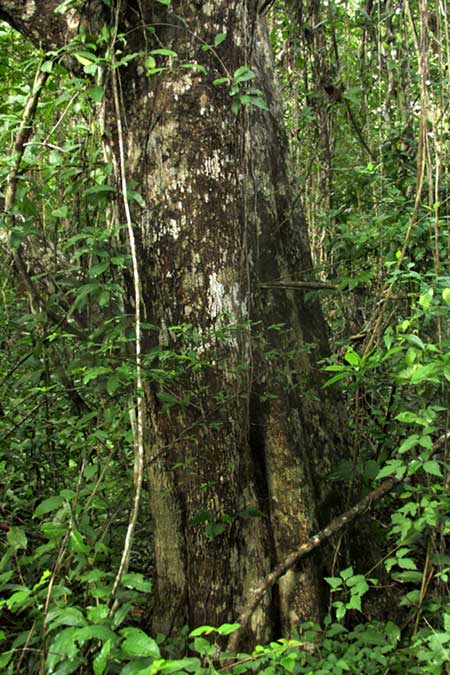
Finally it occurred to me what this was: It's the wonderful Vitex gaumeri. I was slow to connect the grapelike fruits with Fiddlewood because the species belongs to the Verbena Family, the Verbenaceae. Up North we're used to thinking of the Verbena Family as producing herbs like verbenas and lantanas, not big trees. I'd forgotten how in the tropics the family lets itself go, producing not only big, beautiful trees as well as herbs, but also woody vines like glorybowers and Queens Wreaths.
As I made the above pictures, a very noisy flock of White-fronted Parrots was busy high in the tree's top. Judging from numerous fruits on the ground bearing holes in their skin, the parrots' powerful beaks were a match for the fruits' very tough flesh.