PLANTS | ANIMALS | ECOLOGY | FUNGI | GEOLOGY | GARDENING | TOOLS
MEXICAN PLANTS & ANIMALS HOME

Excerpts from Jim Conrad's
Naturalist Newsletter
from the May 9, 2010 Newsletter issued from Hacienda Chichen Resort beside Chichén Itzá Ruins, central Yucatán, MÉXICO; limestone bedrock, elevation ~39m (~128ft), ~N20.676°, ~W88.569°
A FLOOD OF YELLOW-GREEN VIREOS
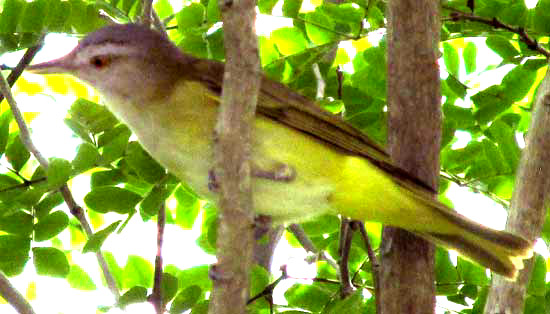
While the callings of Clay-colored Robins have been dominating each day's early and late bird-choruses, there's been another bird species calling, just as numerous, just as persistently singing, but less noticeable because the birds are smaller and their songs softer and simpler. They're Yellow-green Vireos, VIREO FLAVOVIRIDIS, and you can see one with his wings held out and his mouth agape because of the heavy heat in the picture.
Yellow-green Vireos are among the few migratory species who arrive to nest in the Yucatan at this time of year from the south. This fall they'll return south. The species breeds during the "summer" from southern Texas to Panama, and winters in western Amazonia in South America.
Yellow-green Vireos look, sound and behave very much like the Red-eyed Vireos that breed up North, even having red eyes. You can think of a Red-eyed Vireo as employing black mascara to highlight its white eyebrow, while the Yellow-green Vireo has the same facial pattern, just without the mascara. Also, Yellow-greens are yellow along their sides and on their undertail coverts, while Red-eyeds are whitish.
The Yellow-green's song strikes me as an even mingling of the Red-eyed's monotonous, high-pitched phrases and the House Sparrow's slightly tremulous chirping.
Like in Northern Red-eyed counterpart, Yellow-green Vireos suddenly arrive in a vast migratory wave already lustily singing and filling treetops with activity. Usually they stay too high up for me to get good photos of them. The above picture presented itself only because the bird shown was chasing another bird who'd tried to escape by flying lower than usual.
The North's Red-eyed Vireos pass through here only during migration. Howell says that Red-eyeds are mostly silent during migration.
from the June 4, 2017 Newsletter issued from Rancho Regensis north of Valladolid, Yucatán, MÉXICO;
elevation ~40m (~130 ft), N~20.876°, W~88.170°
VIREOS SINGING
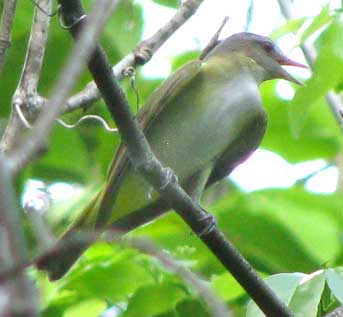
Yellow-green Vireos are common here during the summer rainy season, but it's hard to get good pictures of them because, like Red-eyes up North, they stick to upper tree levels and usually move among the shadows, easily heard but hard to see. This week one came closer than usual and I was able to photograph him from a different angle than the photo on our page shows. Despite the slight blurriness, the new photo better shows the bird's facial pattern and greenish-yellow underparts, seen below: