PLANTS | ANIMALS | ECOLOGY | FUNGI | GEOLOGY | GARDENING | TOOLS
MEXICAN PLANTS & ANIMALS HOME

Excerpts from Jim Conrad's
Naturalist Newsletter
from the December 25, 2011 Newsletter issued from Hacienda Chichen Resort beside Chichén Itzá Ruins, central Yucatán, MÉXICO
TUZA
Jogging the entry road at dawn, bright moonlight revealed something hamster-size and unmoving at the road's edge. A toe-nudge found it heavy and soft. It could have been an oversized, run-over rat, but it was exactly beside a plot where they'd cut the forest back to plant Henequen, and soil between the Henequen plants was honeycombed with tunnels and much occupied with crumbly mounds of red dirt, the work of mole-like critters known locally as Tuzas. Maybe this was a dead Tuza. I've wanted to see a Tuza, which are very seldom seen because they're subterranean. I jogged back to the hut carrying the unknown animal by its short tail. When the sun was up, I got to see what's shown below:
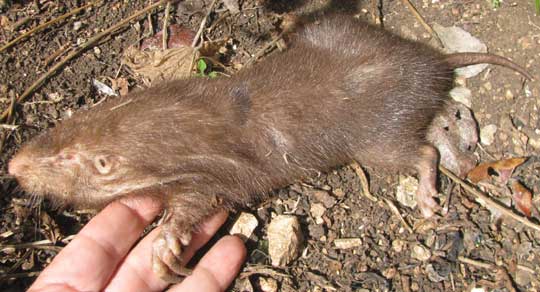
That's what my friends had been telling me a Tuza looks like. Still, I didn't yet know what the animal would be called in English and Latin. Lots of tunneling, hamster-size mammals are similar to almost identical. However, when I flipped the body over and saw the head's bottom, I knew what a Tuza was. You can see that below:
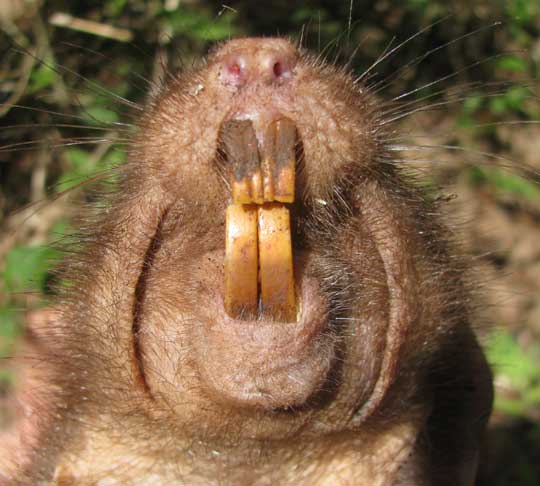
Tuzas are pocket-gophers. Those slits beneath the cheeks are openings to pouches into which the rodent who is foraging plant material outside its tunnel stuffs herbage. Later, protected inside its tunnel, it transfers the clipped stems and leaves from the pouch into its mouth.
We've seen a pocket-gopher before, back in highland Chiapas in 2008, when friends brought me a live one from whose pouches green, compacted balls of clipped- off leaves had tumbled when captured. You can see how similar the Chiapas species was to our Yucatán one at www.backyardnature.net/chiapas/gopher.htm.
Chiapas's species was a high-elevation specialist, probably Pappogeomys bulleri, but our current lowland one appears to be ORTHOGEOMYS HISPIDUS YUCATANENSIS. The yucatenensis is the subspecies name, and that subspecies is endemic to the Yucatán. The broader species is distributed through southern lowland Mexico, Belize, Guatemala, to northwestern Honduras. Its English name is usually given as Hispid Pocket Gopher.
Tuzas are famous among Maya farmers for their ability to move into a field and kill plants by eating roots and tunneling. The Maya seldom suffer the Tuzas' presence for long, however, for they know how to drop poisoned grain down their holes. I suspect that that's exactly what had happened to our Tuza.
The jogging road's newly cleared Henequen field was a perfect place for Tuzas, for roots of trees and bushes killed and removed for the Henequen now must be decaying, soft and mushy. For someone used to eating tough roots crammed wih bitter chemicals that dissuade root-eaters, those rotting roots with their breaking-down alkaloids must seem like delicacies.
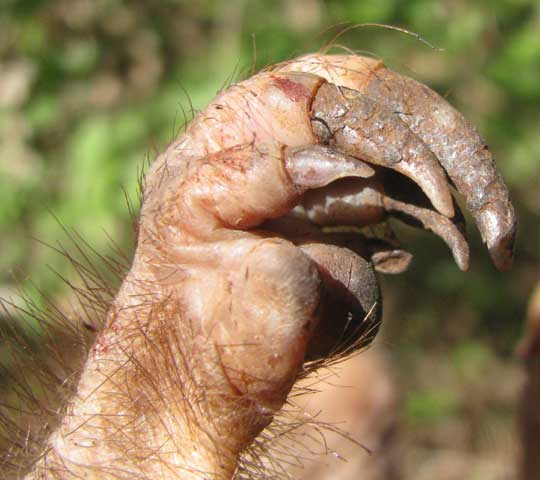
I left our Tuza in a spot where I could watch him decompose over the days, for upon death an animal becomes an ecosystem in itself, and beholding the succession of organisms who come to do their jobs is fascinating and inspiring. In fact, I became somewhat attached to the disappearing creature, before some animal carried him away on the third night. Before he was gone, however, I took a picture of his front paw, which was elegantly adapted for tunneling in earth, and poignantly evocative of a kinship I strongly feel between Tuza and me. That picture is below:
from the February 14, 2016 Newsletter issued from Hacienda Chichen Resort beside Chichén Itzá Ruins, central Yucatán, MÉXICO
TUZA WORK
Tuza tunnels lie just under the ground's surface all around the hut. I'm amazed how often I dig into them when I'm planting something. Here and there Tuzas throw up mounds of loose dirt from their tunneling, and since the dirt is nice and crumbly I scoop it up and use it for potting soil. Maybe three months ago a Tuza mound appeared next to the hut's door, and it's supplied several buckets of fine soil.
This week the heliconia plants around whose bases the Tuza dirt has been left next to the hut's door began leaning over and turning brown. When I tugged on one, it easily came out of the ground, for all its roots and bottom parts had been nibbled off by Tuzas. Below, you can see two rootless heliconias and another one leaning over with curling leaves:
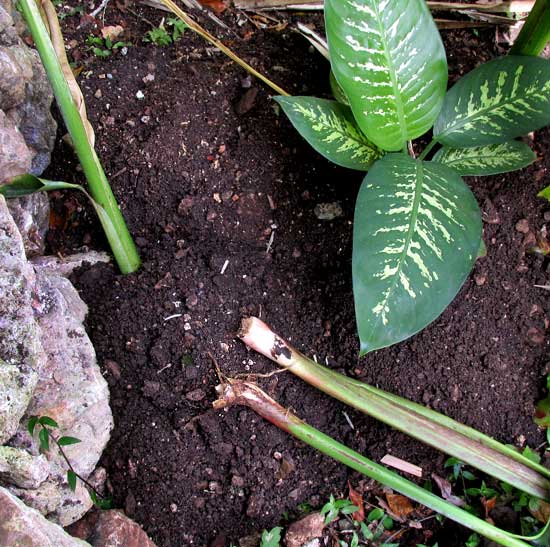
An interesting feature of that picture is that the glossy-leafed plant at the upper right, a Dieffenbachia, appears to be untouched. Probably that's because Dieffenbachias are famous for the powerful toxic chemicals in their sap. Sometimes they're called "dumb cane" because if you take a bite of it your mouth becomes paralyzed so you can't speak, becoming dumb, as in "deaf and dumb." It looks like the Dieffenbachia's chemicals have done their job here, and that Tuzas know which roots to avoid.
from the December6, 2015 Newsletter issued from Hacienda Chichen Resort beside Chichén Itzá Ruins, central Yucatán, MÉXICO
TUZA TRAP
On a visit to Hacienda Chichen's organic garden I found my friends Paulino and Pedro busy working at something that at first I couldn't figure out. In the picture below, see if you can:
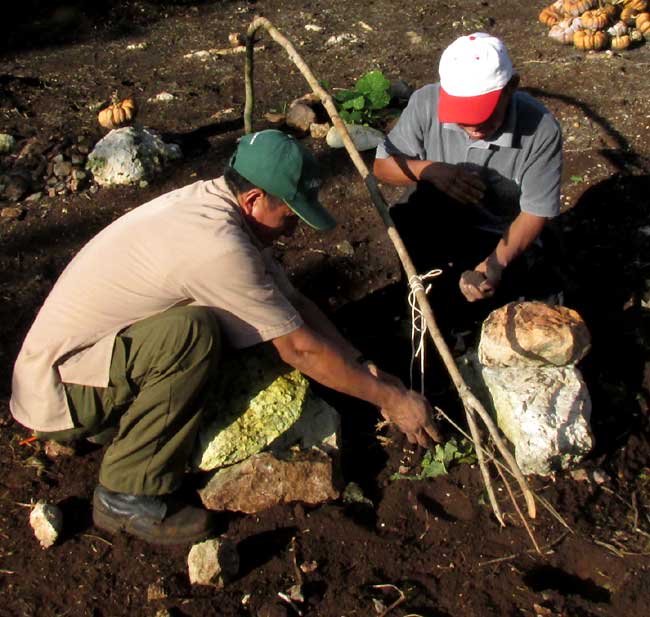
They were carefully spreading large Hoja Santa leaves atop a hole in the ground large enough to put your fist in. A similar hole is at the picture's bottom, right corner. Atop the leaves they then arranged several parallel sticks so that they covered the hole's mouth. Then a light coverning of loose, granular soil was spread atop the whole thing, hiding the sticks and leaves. That's when the above picture was taken.
After taking all this in I began noticing that a tree sapling was bent over so that its top passed over the hole, and that from the sapling's trunk two white strings passed through the soil, sticks and leaves. One of the strings was very taut, the other loose.
Before I could analyze the situation, Paulino explained that they were building a Tuza trap, Tuzas being a kind of pocket gopher common in the Yucatan. Here's how the trap works:
First, you have to know that Tuzas dig extensive networks of horizontal, subterranean tunnels, with vertical exit and entry holes here and there. The two strings pass through the leaves, sticks and dirt, and down the center of a vertical Tuza hole. In the picture, the bent-over sapling is held down by the taut string, which is held in place by a stake that has been driven into the ground at the bottom and in the center of the hole.
The loosely hanging string has a wire noose at its end. The noose's opening has been pressed into the tunnel's walls at the bottom of the vertical shaft so that the Tuza navigating his horizontal tunnel has to pass through the noose. However, half a finger's length beyond the noose the taut string attached to the stake driven into the tunnel floor bars the Tuza's passage -- so really only the Tuza's head passes through the noose.
So, there the Tuza is with the noose surreptitiously around his neck, and the knowledge that he can easily gnaw through such rootlike obstacles as that taut string barring his way, so he starts gnawing. When the string breaks, the bent-over sapling held in place by the taut string instantly jerks upright with great force. However, the sapling rises only a little, because now the previously loose string with the wire noose at its end comes into play. The noose in a flash closes hard around the Tusa, and yanks him upward with great force.
But, the noose can't go far, because its string passes between two parallel, close-together poles shallowly buried in the ground and crossing the top of the Tuza's tunnel, just beneath the roof of leaves, sticks and dirt. And those poles don't give way because their ends are anchored in place by the large limestone rocks shown in the picture on both sides of the hole. The jerked-up Tuza's body, therefore, slams into the barrier created by the two buried poles, and is kept there with all the force of the sapling, which hasn't by any means returned to its natural position. The wire noose pulled so hard around the Tuza's body closes so narrowly that the Tuza can't breathe, and dies.
I like Tuzas, but can sympathize with my friends' position, for they have worked hard to establish a small banana plantation at the garden, and the Tuzas are beginning to enter the area and disturb the banana plants' roots. Actually, Paulino and Pedro are taking a special organic-garden approach to dealing with their Tuzas, for the Maya certainly know how to wipe out a population simply and easily by dropping poisoned corn grains down their holes.
I have Tuzas around the hut, too, but for me they provide a valuable service, as you can see below:
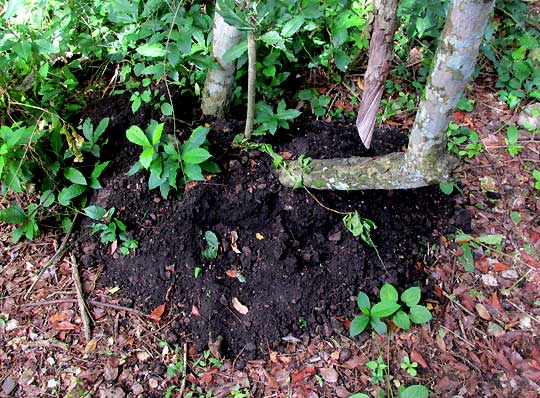
That picture shows two or three bushels of black, organic-matter-rich, nice and crumbly soil perfect to use as potting soil, mounded around the base of a Spanish Plum tree. And that soil has been left there by Tuzas. The depressions on the mound's near side are where I've removed potting soil.
Of course, Tuzas also do Nature a service by loosening up the soil and keeping it from becoming so compacted that rainwater can't soak in well. Their tunnels provide air ducts that conduct air underground into areas away from their holes. And soil air is as important as soil moisture, for most soil organisms need oxygen as much as we do.
from the March 5, 2017 Newsletter issued from Rancho Regensis north of Valladolid, Yucatán, MÉXICO;
elevation ~40m (~130 ft), N~20.876°, W~88.170°
POCKET GOPHERS TOPPLE BANANA TREE
One morning this week in the garden I found a Banana tree in the pitiful condition shown below:
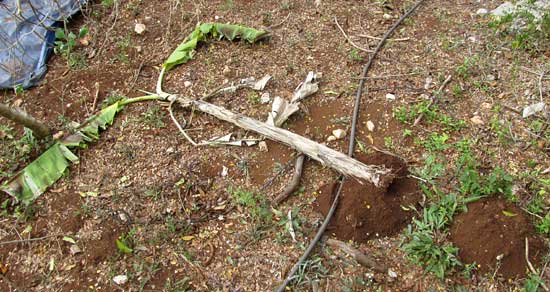
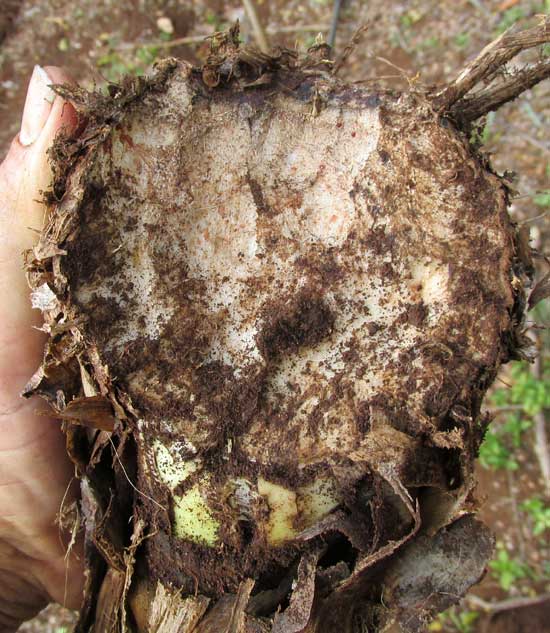
The fresh mounds of earth next to the fallen tree are typical of Tuza activity. The bottom of the Banana stalk clearly show where a Tuza came up from below, gnawing roots until not enough roots were left to hold the plant upright, as seen below:
The Tuzas still haven't discovered my carrot patch, and I'm enjoying those carrots enormously, but know it's only a matter of time before they all succumb to the Tuzas.