PLANTS | ANIMALS | ECOLOGY | FUNGI | GEOLOGY | GARDENING | TOOLS
MEXICAN PLANTS & ANIMALS HOME

Excerpts from Jim Conrad's
Naturalist Newsletter
from the June 21, 2018 Newsletter issued from Rancho Regenesis in the woods ±4kms west of Ek Balam Ruins; elevation ~40m (~130 ft), N~20.876°, W~88.170°, central Yucatán, MÉXICO
MEXICAN TREEFROGS CALLING
Several days ago some kind of weather system drifted over us providing four days and nights of heavy overcast with occasional showers, cooler weather and some nice breezes. It felt good to us humans and it must have been an exciting time for the rancho's frogs and toads, for they called very robustly.
Mostly they were Gulf Coast Toads calling with lusty, sustained trills, but there was a different call, too, one that reminded me of sharp honks emitted by those horns with rubber balls on their backs, which you squeeze to toot. Clowns in circuses use them, as do folks on bicycles riding around in city streets selling things. Except that these honks were amazingly loud, somewhat gruff ones, no-nonsense honks. When I went to see who was making them I found among the dozens of toads two or three smaller frogs who when they honked briefly inflated double-pouched bladders below their mouths, as shown below:
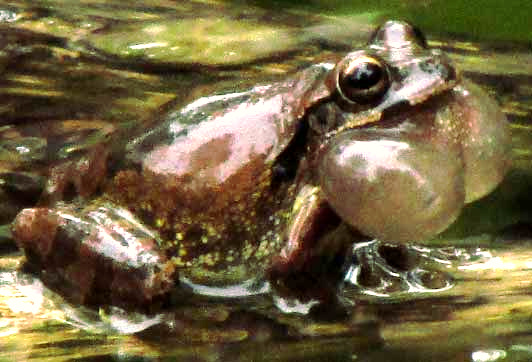
Technically such bladders are described as "paired, subgular, greatly distensible vocal sacs."
I was disappointed that the loud little frog was so drably colored, but soon another frog started honking the same way, and when I found him neatly camouflaged on some rocks his appearance was very different, as you can see below:
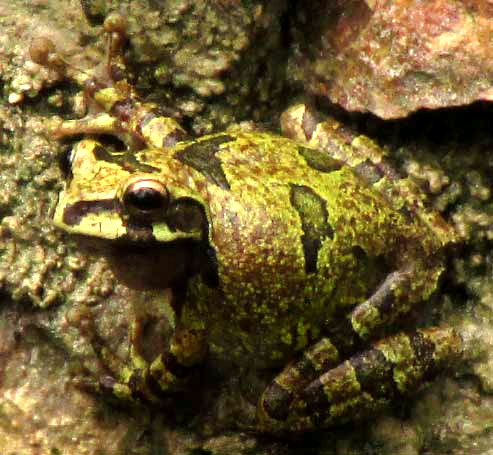
In that picture, notice at the image's top, left the round pads, or "finger discs," at the toe tips, which help the frog stick to vertical surfaces, and which are typical of treefrogs. We've seen this treefrog before, at Chichén Itzá {next entry}, and our pictures of that one show a frog as different looking from these as these are from one another.
This is the Mexican or Baudin's Treefrog, SMILISCA BAUDINII. Jonathan Campbell in his Amphibians and Reptiles of Northern Guatemala, the Yucatán, and Belize characterizes it as a widespread and common species, and writes that its "loud, raucous call is one of the most frequently heard sounds in the evenings after or during rain showers." Occupying a wide variety of habitats the species is distributed from extreme southern Texas south through Mexico and Central America to Costa Rica. Campbell also notes that the species is capable of "considerable metachrosis; a pale green specimen collected at night in the rain may become almost completely brown by the following morning."
With such variation in appearance, how can the species be distinguished from others, who also may show variation? Campbell points to some field marks that remain fairly distinct in all variations. First, between the eye and tip of the nose there's a dark line, or "dark canthal stripe," as he calls it. Second, there's a spot between the back of the eye and the lip below it, which can be whitish, ash gray or lime green. In our first, darkly drab frog the spot was ash gray, but in the second it was lime green.
from the January 22, 2006 Newsletter written at Hacienda San Juan Lizárraga one kilometer east of Telchac Pueblo, Yucatán, MÉXICO
BAUDIN'S TREEFROG
According to my herp fieldguide we have three treefrog species here. Farther south and east where rainfall is greater, the forest more luxuriant and there's a higher species diversity, there are others. Our most commonly encountered treefrog species here is the Mexican, or Baudin's, Treefrog, SMILISCA BAUDINII.
My first encounter with this treefrog was about a month ago when one appeared on an arching, shaded date-palm petiole about a yard off the ground, crouching there in full view, day and night, for several sunny, very dry days. He was pale green and stood out against the palm's dark green foliage. I don't think I've ever seen a treefrog perch so conspicuously in one place.
My latest encounter was one morning this week when I flushed the commode in a bathroom with a door that's kept open. This one, pale brown with dark brown banding and spotting, had been hiding up under the seat's rim and he almost got flushed into unknown territory. At first it was hard to believe that this dark-banded frog was the same species as the pale green one I'd seen earlier.
The herp book says that sometimes after rains this frog emerges in incredible numbers. There's one report of an outbreak of the species "so numerous on the trees as to bend down the branches."
from the December 7, 2018 Newsletter issued from Rancho Regenesis in the woods ±4kms west of Ek Balam Ruins; elevation ~40m (~130 ft), N~20.876°, W~88.170°, central Yucatán, MÉXICO
MEXICAN TREEFROGS OF A DIFFERENT COLOR
This week Genesis volunteer Daniel Leyva photographed a phase of Mexican Treefrog at Genesis so different from what I've seen so far, that at first I didn't recognize it. Daniel's picture is seen below:
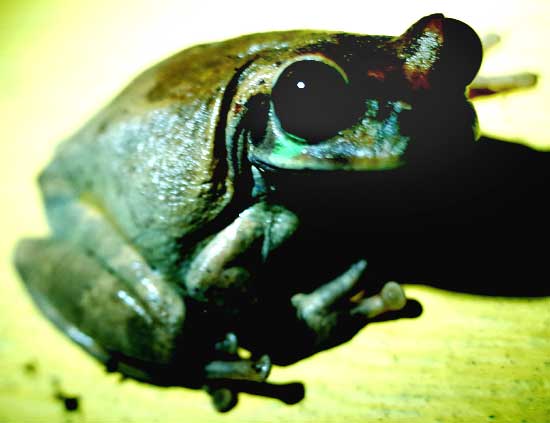
The frog, perched on a leaf, is lit by a flashlight, so it's hard to judge what it might look like in daylight. Still, it seems mostly greenish and there's a bright, bluish spot connecting the eye with the upper lip. One of the frogs on our web page displays a slightly bluish spot there, but nothing so outstanding.
It's surprising how variable this frog is. We've seen a brownish one matching the murky brown pond-water it was calling from. A green-and-dark-gray one matched splotches the gray limestone rocks with patches of greenish algae it perched on. One in a tank with a white interior was light gray. And now we have this green one on a green leaf.
issued August 16, 2019 from near the forest just west of Tepakán; elev. ~9m (~30 ft), N21.053°, W89.052°; north-central Yucatán state, MÉXICO
MEXICAN TREEFROG IN A GUTTER
Early each night, even when no afternoon storm has brought a rain, my sleep is disrupted by a certain Mexicn Treefrog who has discovered a wonderful way to amplify his wonk-wonk-wonk call many times over. He's taken up residence in a gutter running along one of the hut's roof edges. You can see him during the day, all balled up to expose the least possible skin surface area to water evaporation, on the gutter's floor below:
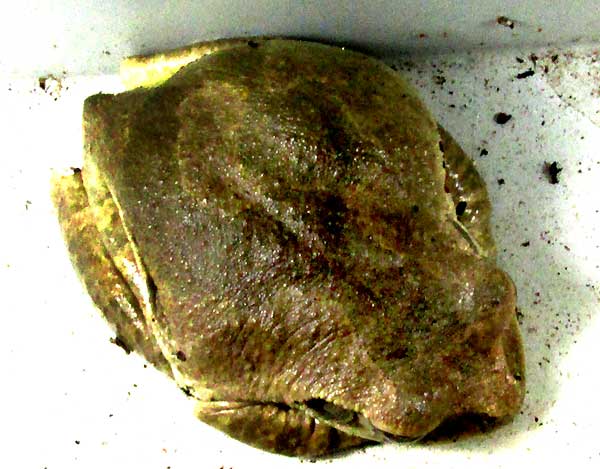
In the gutter, he lives where another gutter of a different style and size overlaps his section of the lower gutter, so that his hiding place has a gutter bottom below him, and a gutter ceiling above. Both gutters are made of thin aluminum sheeting. Below, you can see a front view of our frog hunkered down, the bottom gutter floor receding into the distance:
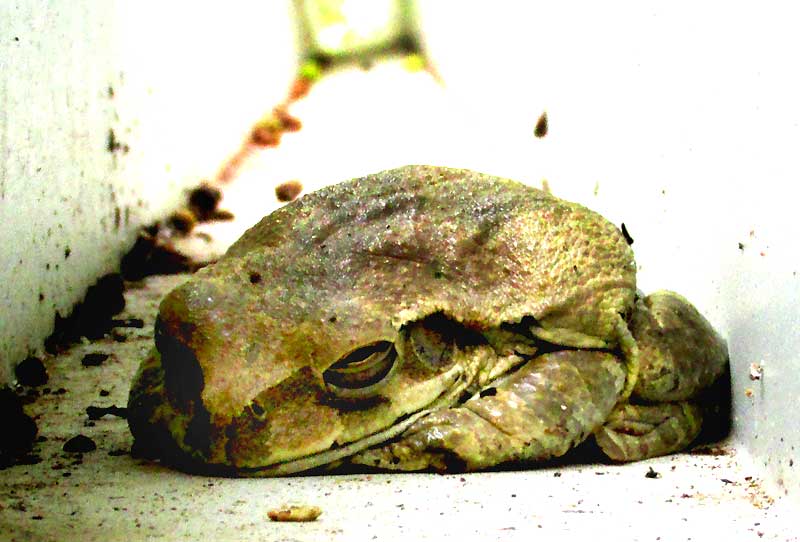
Now, when this frog croaks, his call reverberates between the two thin aluminum sheets. Reverberates and acquires a tinny quality making the croaks a little ghostly. Somehow the gutters form a kind of sounding board that amplifies the call, and when the amplified call issues through the opening between the rock wall and the aluminum-sheeting roof -- which itself may amplify and resonate with the gutters -- the croaks bounce down to where I'm lying, sounding something like hoarse, tinny barks of a medium-sized dog standing right beside where I'm trying to sleep.
End of story.
issued September 10, 2019 from near the forest just west of Tepakán; elev. ~9m (~30 ft), N21.053°, W89.052°; north-central Yucatán state, MÉXICO
METACHROSIS ON A SHIRT
"Metachrosis" is the fancy word for "the ability to change color." Above we see Mexican Treefrogs of various colors, and we've noted that this species is "capable of considerable metachrosis," as an expert says. Here's a yellow one on a yellow shirt:
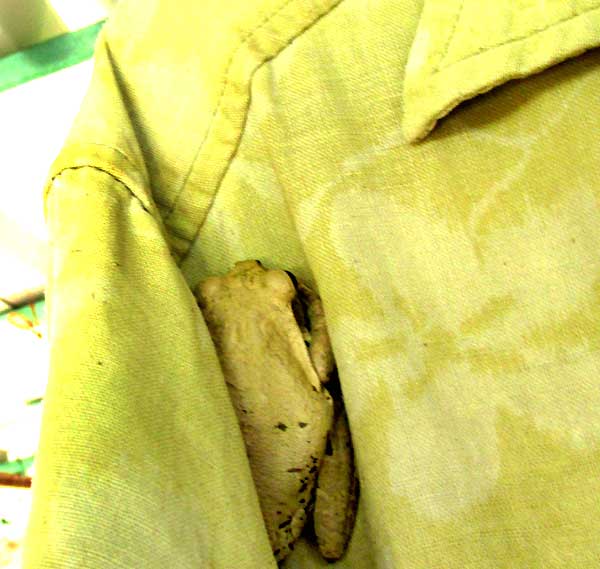
I suspect that this is the same individual I've seen quite brown spending the day in a deeply shaded gutter (above).