PLANTS | ANIMALS | ECOLOGY | FUNGI | GEOLOGY | GARDENING | TOOLS
MEXICAN PLANTS & ANIMALS HOME

Excerpts from Jim Conrad's
Naturalist Newsletter
from the November 6, 2011 Newsletter issued from Hacienda Chichen Resort beside Chichén Itzá Ruins; limestone bedrock; elevation ~39m (~128ft), N20.675°, W88.569°; central Yucatán state, MÉXICO
TEN-FT-TALL COTTON
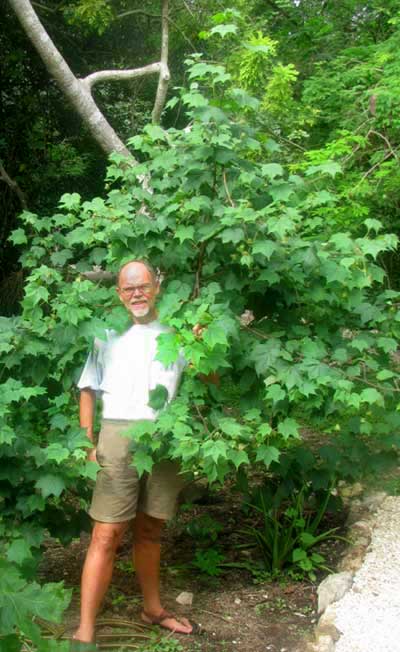
Above you can see me standing beside a Tree Cotton plant. You might recall that in this year's February 6th Newsletter (see next entry) we profiled a cotton plant found in Pisté producing beige, not white, cotton. That mature plant struck me as non-woody, was three or four feet tall, and its leaves were three-lobed, so I thought it was Upland Cotton of the kind much planted in the US Deep South.
However, I carried seeds home with me, they germinated and I planted the seedlings right before I left the Hacienda six months ago. This woody, ten-ft-tall plant with mostly five-lobed leaves is what grew from those seedlings! In our area we have two closely related cotton plants -- both capable of producing woody shrubs as in our picture. I think the one in the picture is Gossypium hirsutum, based on the loosely arranged stamens seen in the next picture; stamens of the other species, Gossypium barbadense, are more compactly held inside the blossom.
It happens that our Tree Cotton is flowering now and a flower is shown below:
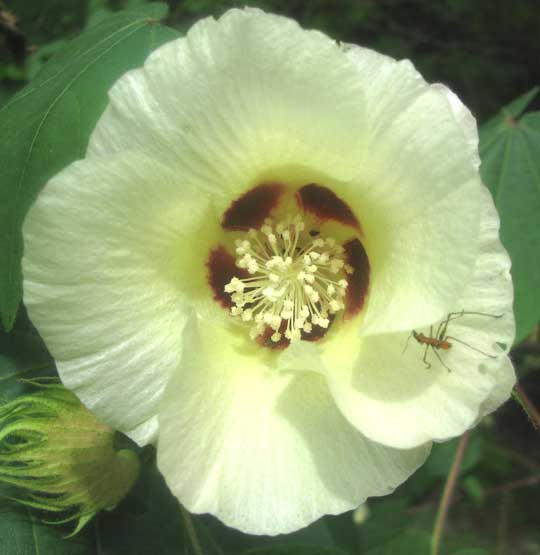
Flowers emerge as yellow but after pollination turn rose-purplish. Having many stamens in the blossom's center arising from a cylindrical "staminal tube" surrounding the style is very suggestive of a hibiscus flower. That's to be expected since both cotton and hibiscus are members of the huge Hibiscus Family, the Malvaceae. A notable feature characteristic of cotton flowers is shown in the blossom side-view below:
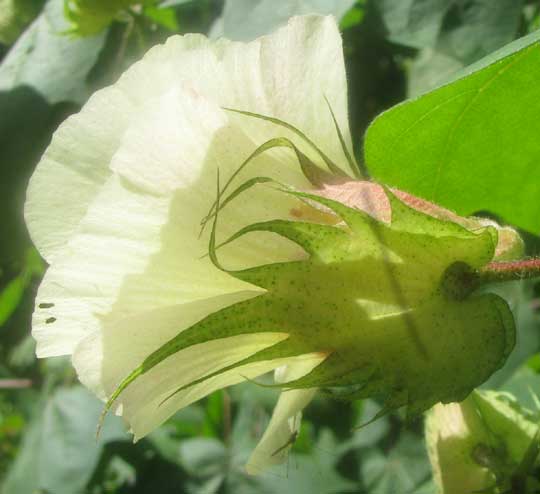
Cotton flowers have calyx lobes, or sepals, similar to those of many other flower kinds, but that's not what you're seeing at the base of that flower's yellowish corolla. The pale green, purple-tinged thing deeply fringed at its top (left side in photo) is a bract, which is a modified leaf. Cotton flowers are subtended by three or more large bracts that obscure the calyx lobes and the entire bottom of the corolla. The flower bracts on our Tree Cotton bear many dark glands. I'm guessing that those glands repel insects that otherwise would travel beyond the bracts and eat the flower parts, which of course the plant doesn't want.
from the February 6, 2011 Newsletter issued from Hacienda Chichen Resort beside Chichén Itzá Ruins, central Yucatán, MÉXICO; limestone bedrock, elevation ~39m (~128ft), ~N20.676°, ~W88.569°
BEIGE COTTON
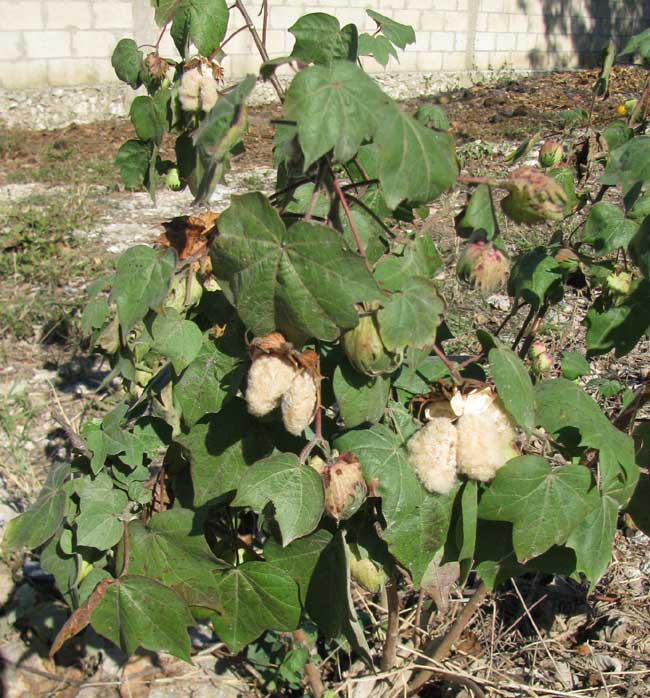
In an abandoned lot at the edge of Pisté I saw a leg-tall cotton plant with opening bolls releasing wads of fluffy cotton. Back in Mississippi we had lots of that at a certain time of year, but this was unlike any plant I've ever seen up there. The plant appears above. A close-up showing what was special about it is shown below:
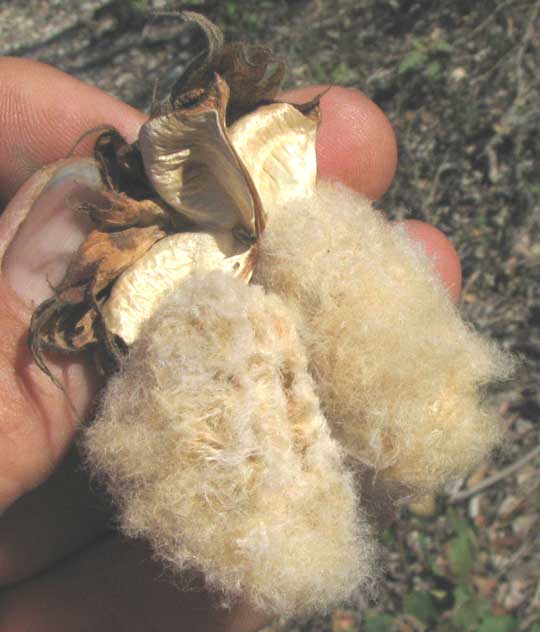
What's unusual is that the cotton fibers aren't pure white the way cotton up North is. It's light brown, or beige, so here was something to figure out.
Cotton plants belong to the genus Gossypium in the Hibiscus Family. Several Gossypium species naturally occur in both Eurasia and the Americas. Our Pisté plant is a real cotton, GOSSYPIUM HIRSUTUM; Happily, my questions about beige Mexican cotton were more than answered by a wonderful, illustrated article by James Vreeland entitled "The Revival of Colored Cotton," in a 1999 issue of Scientific American.
Pictures in that article show handsome, multihued textiles displaying a rich variety of natural cotton-fiber shades, including dark chocolate brown. Vreeland writes, "It appears that these colors were intentionally differentiated and bred by ancient Peruvian fisherfolk, who made nets and lines from the darker shades because they were less visible to fish."
So, I figure that our Pisté plant is nothing less than a relict of ancient cotton populations, harkening back to a time before humans began thinking that all cotton needed to be white.
By the way, Fray Diego de Landa, in his 1566 Relación de las Cosas de Yucatán often mentions how the Maya, both before and after the Spaniards' arrival, slept under cotton blankets and in war wore cotton jackets as body armor. In his Chapter 49 he writes that two kinds of cotton were planted: an annual dying after its first year and a small tree that produced cotton for five or six years.
from the November 20, 2011 Newsletter issued from Hacienda Chichen Resort beside Chichén Itzá Ruins; limestone bedrock; elevation ~39m (~128ft), N20.675°, W88.569°; central Yucatán state, MÉXICO
TWO FLOWER COLORS ON ONE BRANCH
My Tree Cotton is becoming an attraction, especially among the Maya employees who want seeds later so they can grow what their ancestors once grew. Foreign visitors also get a kick seeing how cotton can stand ten feet tall, plus do the marvelous thing shown below:
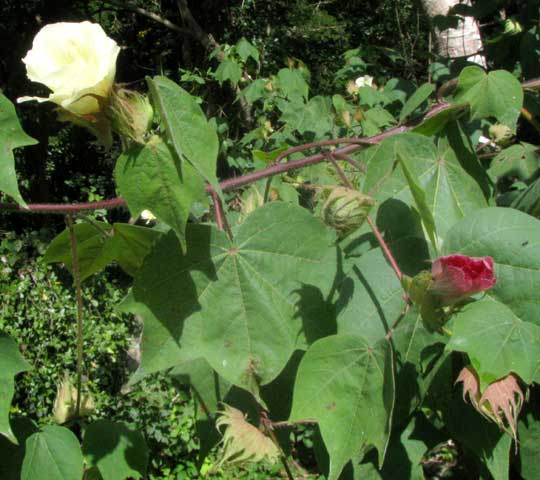
There you see a pale yellow flower and a rose-purple one arising near one another on the same branch.
Corollas emerging from their buds are pale yellow and they stay yellow as the blossoms remain receptive to pollinators. Once pollinated, flowers turn rose- purple, plus they close. By turning rose-purple, the flowers become darker and less attractive to pollinators, thus helping pollinators do their work more efficiently by not continuing to attract them to flowers already pollinated. Closing the blossom accomplishes the same thing.
Once a blossom has been rosy for a day or two it falls off in one piece, sometimes with an audible plop heard as I sit readying beside the bushes.
from the December 4, 2011 Newsletter issued from Hacienda Chichen Resort beside Chichén Itzá Ruins; limestone bedrock; elevation ~39m (~128ft), N20.675°, W88.569°; central Yucatán state, MÉXICO
COTTON BOLLS FORMING
When Tree Cotton's hibiscus-like corollas fall off, ovaries are left behind to mature into fruits, which in the case of cotton are splitting-open capsules referred to as bolls. Nowadays many ovaries on our Tree Cotton are on their ways to becoming bolls. You can see one enlarging ovary snugly nested in its shallowly five-toothed, black-dotted calyx, which in turn is held within three deeply toothed bracts, below:
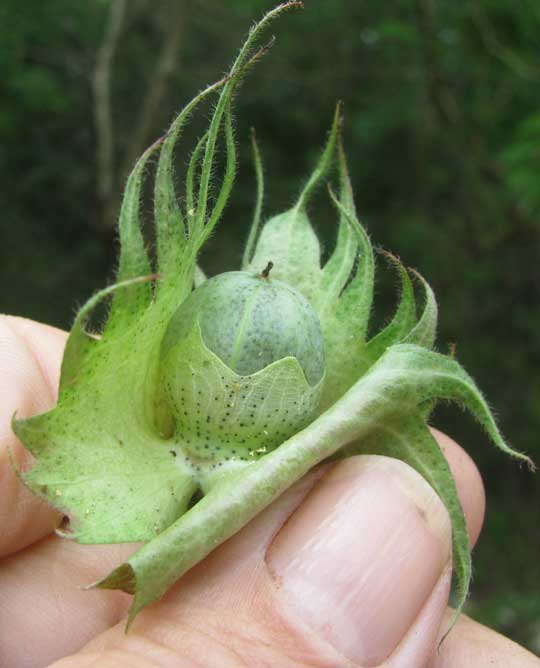
The black dots are glands. I'm assuming that they issue some kind of chemical that repels potentially damaging insects.
When you cut longitudinally across a developing ovary, white pulp turning into cotton fiber is seen, as shown below:
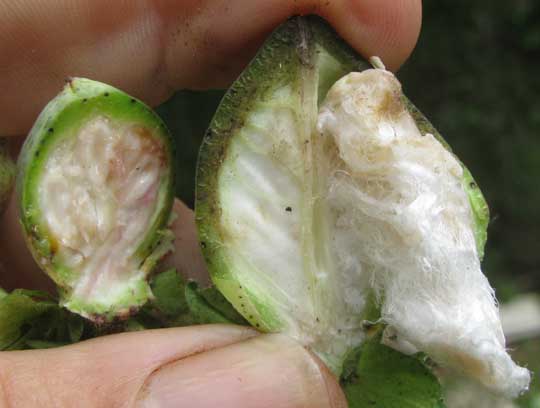
At the left in that picture four or so shiny, white, elliptical seeds are enmeshed in white pulp in which no fiber is discernable, but in the larger, more mature ovary at the right I could tease the white matrix into wet, sticky, partially formed fibers. The ovaries have to mature a good bit more before they become bolls splitting open to release soft, dry cotton.
from the January 8, 2012 Newsletter issued from Hacienda Chichen Resort beside Chichén Itzá Ruins; limestone bedrock; elevation ~39m (~128ft), N20.675°, W88.569°; central Yucatán state, MÉXICO
COTTON BOLLS OPENING
Each day the Tree Cotton trees look a little scruffier as leaves dry and curl up, and eventually fall off for the dry season, and each day more bolls open to release fluffy wads of beige-colored cotton, as shown below:
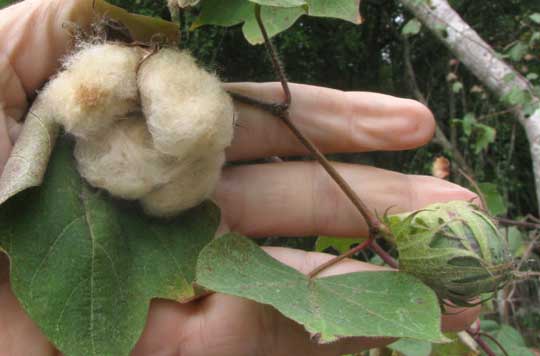
At the lower right in that picture there's an immature, green fruit, or boll, mostly enclosed in the flower's three, large, deeply incised bracts. Most bolls produce four clumps of cotton, each clump produced in an ovary's cell, or carpel, though some bolls produce only three or as many as five. Each clump contains five or less often four seeds, rarely six. Thus each boll produces on the average 4x5=20 seeds, which are the size of grape seeds, hard and dark, and difficult to separate from the cotton.
The trees bear hundreds of bolls so everyone dropping by the hut nowadays is encouraged to carry seeds home and plant them.
from the March 4, 2006 Newsletter issued from Hacienda San Juan just east of Telchac Pueblo, Yucatán, MÉXICO
TREE COTTON
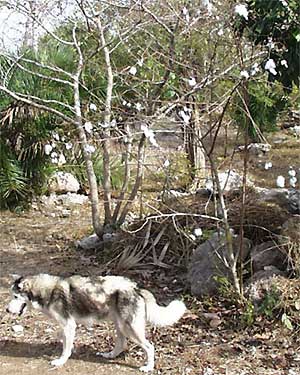
Cotton plants belong to the genus GOSSYPIUM of the Hibiscus Family. Over 20 Gossypium species exist, and there are many cultivated varieties. Cotton grown in the US is herbaceous and about knee high. Here we have a cotton species that grows as a woody, perennial bush -- Tree Cotton, a real cotton of the genus GOSSYPIUM.
The plant is about eight feet tall and currently is in its leafless, dry-season condition. However, new three-lobed leaves are just emerging from certain buds as the bolls are bursting with cotton. That's it below, with the blue-eyed dog beneath it still wandering around looking for a home.
from the November 16, 2014 Newsletter issued from Río Lagartos, on the Yucatan Peninsula's northern coast (~N21.60°, ~W88.16°), Yucatán state, MÉXICO
UPLAND OR SEA-ISLAND COTTON?
The following is a little technical but I'm including it because the presence of wild cotton here on the Yucatan's northern coast is important, and the exact identity of the various cottons can be hard to determine.
The wild Upland Cotton, Gossypium hirsutum, we've documented in the last two Newsletters as growing among the dunes here on the Yucatan's northern coast raised some questions with me. For, both Upland and Sea-Island Cotton (the latter being Gossypium barbadense, of South American origin) are listed as growing in the Ría Lagartos Biosphere Reserve. These two species are very closely related, very similar, and are known to hybridize. Therefore, I've been double-checking my identifications.
Even features of well defined plants of each species overlap a great deal, though a practiced eye usually can tell them apart. Here's a review of certain differences between the two species as detailed in PA Fryxell's 1992 treatment of the Hibiscus Family in the Flora de Veracruz:
| G. BARBADENSE | G. HIRSUTUM | |
| leaves | 3-7 lobed | 3-5 lobed |
| leaf middle lobe | oval to lance-shaped | oval to triangular |
| leaf middle lobe | > 1.5 x longer than wide | < 1.5 x longer than wide |
| capsular fruits | 3 cells | 3-5 cells |
| capsular fruits | narrowly ovoid | ovoid |
| bracts | 5-17 teeth | 3-19 teeth |
| bract sinuses | rounded/ U-shaped | more or less V-shaped |
LH Bailey's 1949 Manual of Cultivated Plants further distinguishes them by saying that G. barbadense's anthers are "compactly arranged on uniformly short filaments" while anthers of G. hirsutum are "loosely arranged on filaments of varying lengths." If you're at a loss as to what's "compact" and what's "loose" in anther terms, pictures on the Internet can help develop an eye for this feature.
First take a look at the yellow, "compact" cluster of anthers in a public-domain picture of a G. barbadense flower made available by CT Johansson of Sweden, shown below:
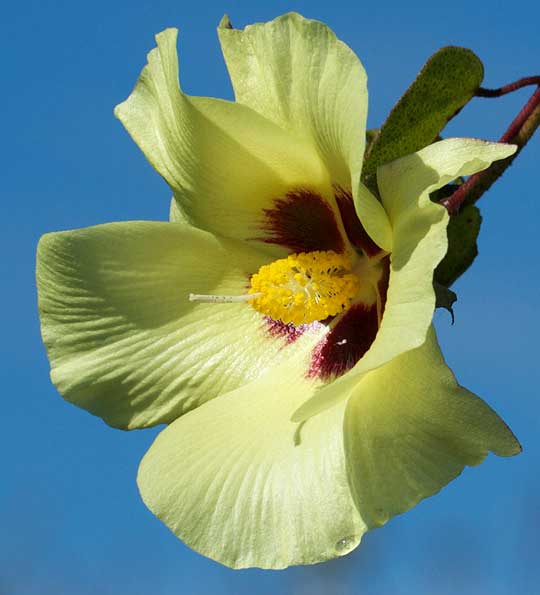
Compare those anthers with the ones in our own G. hirsutum flower from local northern Yucatán dunes shown toward the top of the page.
To me this matter of compact and loose filaments seems to be the most dependable for distinguishing the two species. Using that feature, I find that maybe all the cotton plants I've seen so far in the Yucatan -- wild and planted next to Maya huts, both low herbs and woody, small trees -- have been Upland Cotton, Gossypium hirsutum.