PLANTS | ANIMALS | ECOLOGY | FUNGI | GEOLOGY | GARDENING | TOOLS
MEXICAN PLANTS & ANIMALS HOME

Excerpts from Jim Conrad's
Naturalist Newsletter
from the January 17, 2010 Newsletter issued from Hacienda Chichen Resort beside Chichén Itzá Ruins; limestone bedrock; elevation ~39m (~128ft), N20.675°, W88.569°; central Yucatán state, MÉXICO
TI PLANT
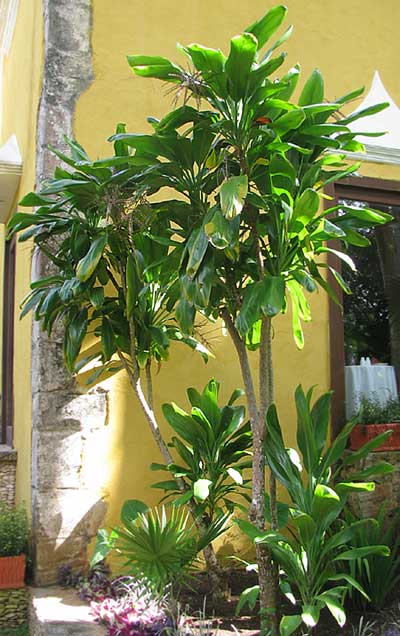
At a back corner of Hacienda Chichen's main building, right outside a Dining Room window, a 12-ft-tall, several-stemmed evergreen is growing, shown below:
I've been hoping that this plant would flower because I couldn't figure out what it was. This week it's begun producing pea-size flowers in open, basketball-size panicles, two blossoms of which you can see below:
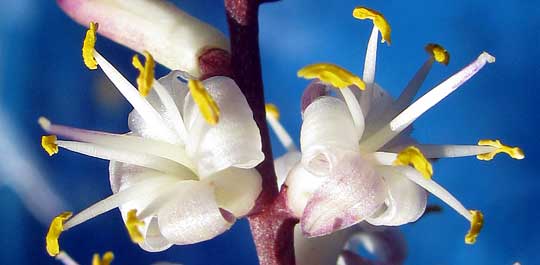
At first I thought that the plant might be some kind of palm, but these are not palm flowers. They're liliaceous. The plant is a member of the Lily Family. It's the Ti Plant, sometimes also called Palm Lily, Good Luck Plant and even Cabbage Palm. It's CORDYLINE FRUTICOSA.
Admittedly, Ti Plants look like some of the smaller palms with undivided fronds, so what's the difference between a palm flower and a flower in the Lily Family? The main difference is a technical one. If you cut across a Palm-Family flower's ovary you'll see that it's divided into three chambers or cells, each cell containing a single ovule (the future seed). Two of the three ovules will abort, leading to a fruit with a single seed (like a coconut). When the ovary of a flower from our Ti Plant was cut across, I couldn't make out how many cells it had, but it was easy to see that the ovary held numerous ovules, not three or less, and that by itself disqualified the Palm Family. Sometimes horticulturists refer to Ti Plants as a Dracaena, but technically that's something else, also different from the Ti Plant because its ovaries bear numerous ovules.
The Ti Plant is native to tropical southeastern Asia, Papua New Guinea, Melanesia, northeastern Australia, the Indian Ocean, and parts of Polynesia. Long ago it was introduced into Hawaii and New Zealand and now is well established there. It has been introduced into many tropical lands not only because it's a handsome plant but also because it's very useful. It arises from starchy rhizomes that are sweet when the plant is mature, so they're eaten, plus the plant's leaves once were used to thatch the roofs of houses, and to wrap around stored food. In fact, I read that the Hawaiian hula skirt, instead of being made from palm fronds as I had thought, is made from about 50 Ti leaves, as is the Tongan dance dress, the sisi. Wikipedia says that Ti Plant tubers somehow provided a glossy covering on surfboards in Hawaii in the early 1900s.
Many cultures regard the Ti Plant as capable of warding off evil and negative energies. One webpage reports the flowers as used "for auric protection, repelling negative or invasive energies... Beneficial for those who display uncharacteristic behaviour."
If you do a Google image-search on the Ti Plant you'll see pictures of many plants looking only vaguely like the one in the picture. You'll see spotted and striped forms with colors ranging from raspberry-red to white, yellow and bronze-green, and most Ti Plants are smaller than ours. That's because many cultivars of the Ti Plant have been created. Up North you often see them in pots and floral displays, especially because their leaves hold up better than most when someone neglects to water the plant.
This is a wonderful plant. Too bad it's frost intolerant.