PLANTS | ANIMALS | ECOLOGY | FUNGI | GEOLOGY | GARDENING | TOOLS
MEXICAN PLANTS & ANIMALS HOME

Excerpts from Jim Conrad's
Naturalist Newsletter
from the February 25, 2006 Newsletter written at Hacienda San Juan Lizárraga one kilometer east of Telchac Pueblo, Yucatán, MÉXICO and issued from Hotel Reef Yucatan 13 kms to the north
TAMARIND TEA
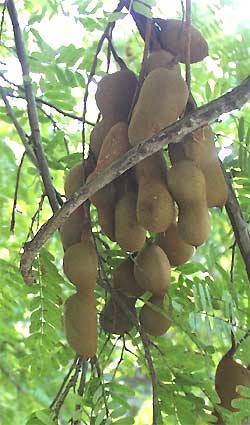
For months I've been eyeing the Tamarind trees' abundant, dangling legumes, wondering when they would ripen so I could make tamarind tea. The time has come. We now have more tamarind fruits than we can deal with. Above you can see some of them. Notice the leaves' feathery texture. They provide a very pleasant shade.
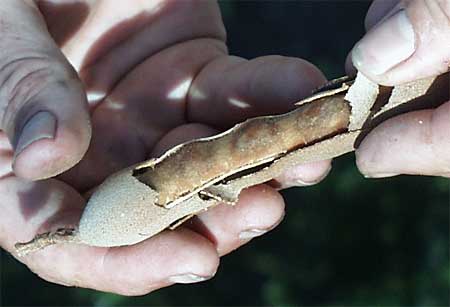
The legumes are like large snapbeans, but brown and very plump. Their brown skin is hard and brittle like thin plastic. You know the legumes are mature when you can squeeze them with your fingers and the skin shatters revealing a honey-colored, gummy mass inside which are embedded several very hard, dark-chestnut-colored seeds the size and shape of baby lima beans. Below you can see such a legume on which the brittle shell has been shattered.
Whenever I'm conducting a tour of the hacienda we stop beneath a Tamarind tree. Sharper visitors often remark that the Tamarind's feathery, doubly compound leaves remind them of the Mimosas or Albizias back home, or of the acacias they've seen during travels in other lands. It's true that Tamarinds are closely related to those trees, all being members of the Bean Family. In the Tamarind's dense shade we pull off a few Tamarind legumes, pick away the brown rind, and snack on the honey-colored, gummy pulp. It's pleasantly sour with a slight taste of raw snapbeans.
Local people here also snack on Tamarind fruits right from the tree but mainly they make a lemonade-like cold drink. They crush fruits in the bottom of a large pitcher, pour in water, let it sit overnight or at least two or three hours until the pulp softens and can be smushed, and then the hard parts are strained out. What's left is an acidy, somewhat murky looking, honey-colored liquid which, when sweetened and kept cold, really hits the spot on a hot afternoon.
Tamarinds are very commonly planted in towns and haciendas here, as well as all through the world's tropics. They're grown for both their fruits and the tree's pretty form and shade. The species is thought to be originally from Africa and maybe southern Asia. Its Latin name is TAMARINDUS INDICA. "Indica" means "from India," and "tamarindus" is from the Arabic "tamar-Hindi" meaning "date-fruit from India."
From the August 18, 2008 Newsletter written in Sabacché and issued from a ciber in nearby Tecoh, Yucatán, MÉXICO
TAMARINDS FLOWERING
Despite Tamarinds being native to the Old World tropics, in Sabacché big Tamarind trees are among the favorite shade trees. During the winter dry season I'll bet men in the shady loafing area shown above spend endless hours standing around chewing the acidy fruit-pulp.
Nowadays in Sabacché's Tamarind trees you can find a few fruits already as long as five inches and covered with a brittle, brown shells, but mostly here in the rainy season the Tamarinds are flowering. I'd never looked closely at a Tamarind flower, so when I saw the blossoms here I knew I was going to have some fun, seeing what new things Tamarind flowers might do.
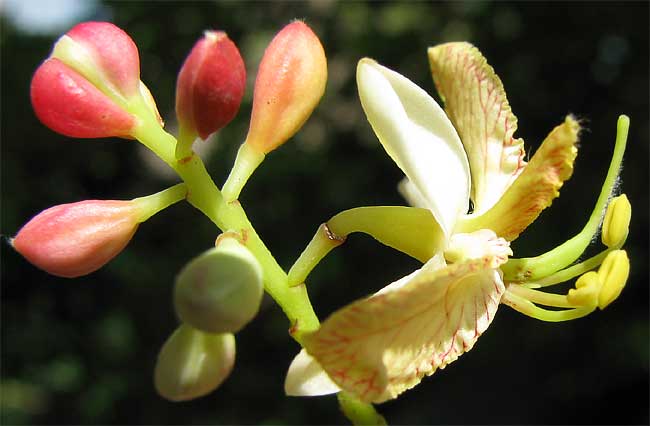
I wasn't disappointed, either. Tamarinds, TAMARINDUS INDICA, belonging to that subgroup of the enormous Bean Family which produces "papilionaceous" or butterfly-like flowers, produce flowers unlike any other papilionaceous blossoms I've ever seen. There's an inch-broad blossom in a few-flowered raceme shown above.
Notice that the open flower on the right appears to have petals of two colors and textures -- one pure white and waxy textured, the other pale yellow with pink veins and papery with frilly margins. The pure white, waxy ones are actually petal-like sepals, or elongate lobes of the calyx tube. Only the papery, yellowish, pink-veined items are petals.
But, this flower appears to bear only three petals, while any decent papilionaceous Bean-Family flower ought to have five. It's true, the Tamarind flower's lower two petals are reduced to bristles hidden at the stamen tube's base.
Orthodox papilionaceous Bean-Family flowers should have ten stamens, too, but in the photo we see only three. They're the matchstick-like things at the bottom, right of the flower in the picture. The oval, yellow things are the anthers, which will split open to release pollen, and the greenish stems they're attached to are the filaments. Anthers and filaments together are regarded as stamens.
If your memory needs to be jolted about what normal papilionaceous Bean-Family flowers are all about, go to www.backyardnature.net/fl_beans.htm.