PLANTS | ANIMALS | ECOLOGY | FUNGI | GEOLOGY | GARDENING | TOOLS
MEXICAN PLANTS & ANIMALS HOME

Excerpts from Jim Conrad's
Naturalist Newsletter
from the April 12, 2019 Newsletter with notes from a camping trip into the Petén district of northern GUATEMALA
SAWGRASS AROUND THE LAKE
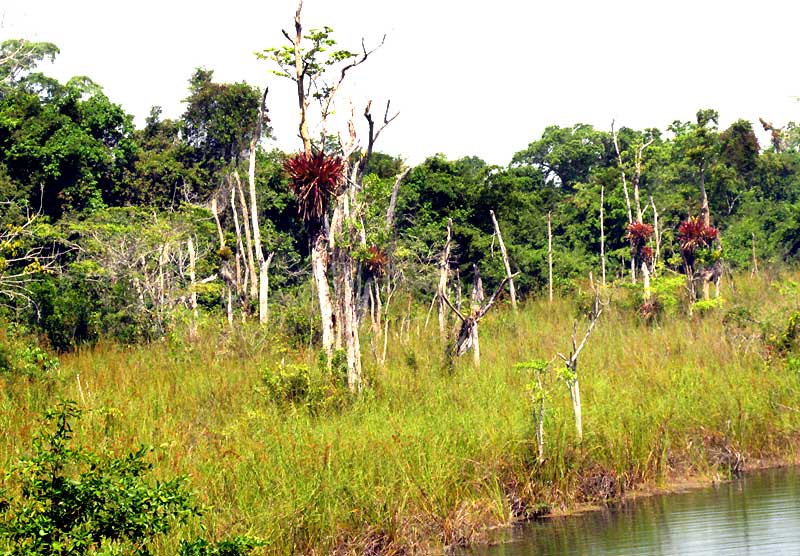
On March 28 during last month's camping trip into northern Guatemala's Petén district, when I checked into the hillside campground in El Rosario National Park on the west side of the town of Sayaxché, I enjoyed a striking view of a more or less circular lake below the campground, and the country beyond.
The lake was very shallow and the water almost transparent. Fish easily could be seen swimming along the bottom. One of the lake's most striking features was that all around, except right below the campground, it was framed with a broad, impenetrably dense fringe of tall grasses or grasslike plants. Above, you can see one side of the lake.
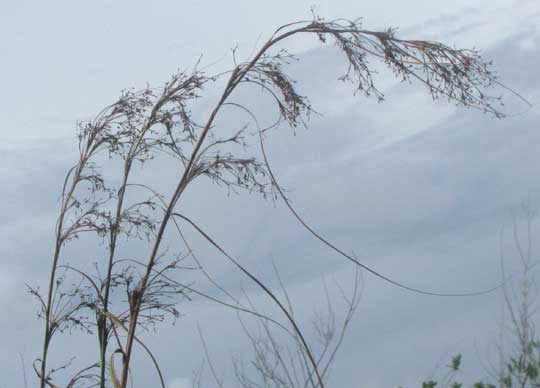
I've seen tall, dense stands of such a grasslike plant fringing bodies of water in tropical and subtropical situations -- such as in the Florida Everglades, where it's the most abundant flowering plant. It's Sawgrass, CLADIUM JAMAICENSE. Until now I've never had a chance to take a close look at a plant with mature flowers, so here was my chance, because a small cluster of flowering, 10-ft-tall (3m) Sawgrass plants grew at the lake's very edge just below the campground. You can see it below:
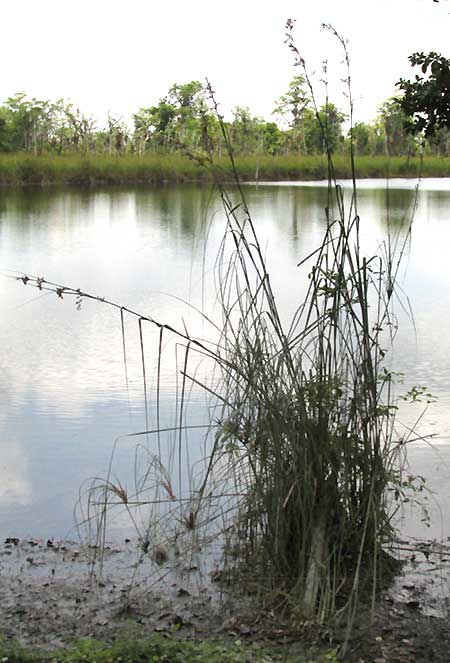
Something to notice in that picture is that, at the plant's base, two horizontal canes shoot out bearing small tufts of leaves, which can root and form new large plants. A close-up of those tufted potential new Sawgrass plants is shown below:
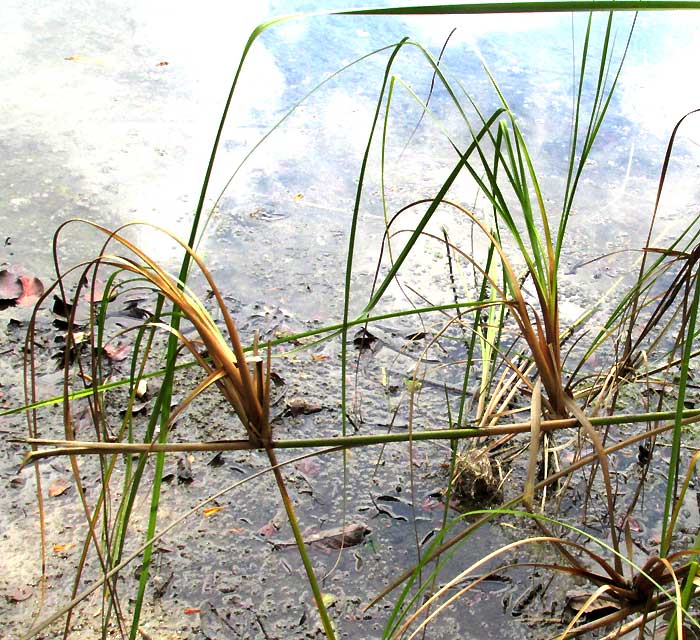
You can imagine that many close-together large plants all issuing such horizontal canes from which new plants arise might create an impenetrable tangle, and of course that's one thing Sawgrass is famous for, along with its blade margins bearing sharp, cutting "teeth."
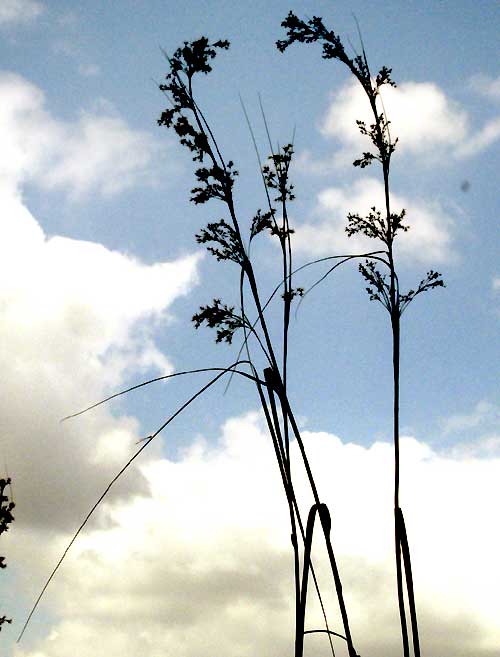
The plants' large flowering heads consist of stacked, ±flat-topped clusters of spikelets, each cluster subtended by a slender bract, as shown below:
A single multi-branched spikelet cluster appears below:
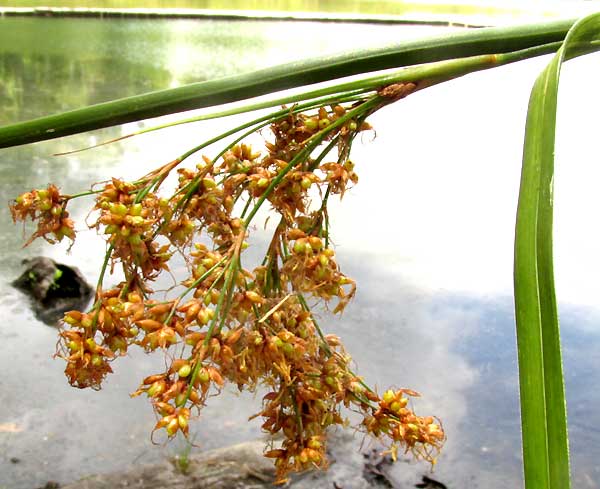
And individual spikelets show some of their unique features below:
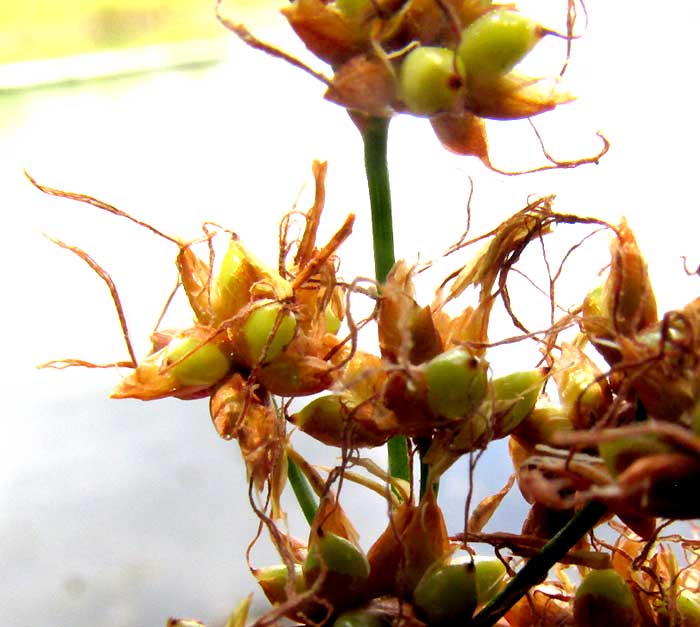
Here you don't see typical grass anatomy, because Sawgrasses aren't grasses. They belong to the Sedge Family, the Cyperaceae. In the above picture you can see that the achene-type fruits are egg-shaped, or ovoid, tipped with a sharp point, from which two or three stigmas arise, the stigmas being where pollen is received. Below each achene a brownish, papery scale arises. The scales and stigmas give the clusters an unkempt look, but Nature doesn't always find neatness adaptive and therefore desirable.
Many birds nest and feed in Sawgrass thickets, and various reptiles and amphibians find food and shelter there. The plant's seeds are abundant and nutritious. And when hurricanes comes the plants protect the shoreline from wave erosion.
from the August 7, 2011 Newsletter issued from Mayan Beach Garden Inn 20 kms north of Mahahual; Caribbean coastal beach and mangroves, ~N18.89°, ~W87.64°, Quintana Roo state, MÉXICO
SAWGRASS
The road between Mahahual and Sian Ka'an Biosphere Reserve skirts several little ponds with grassy margins. Some of those "grasses" are spectacular, and some aren't even grasses. For example, you can see a small part of a single clump about ten feet high (3m) and as wide as about three large refrigerators below.
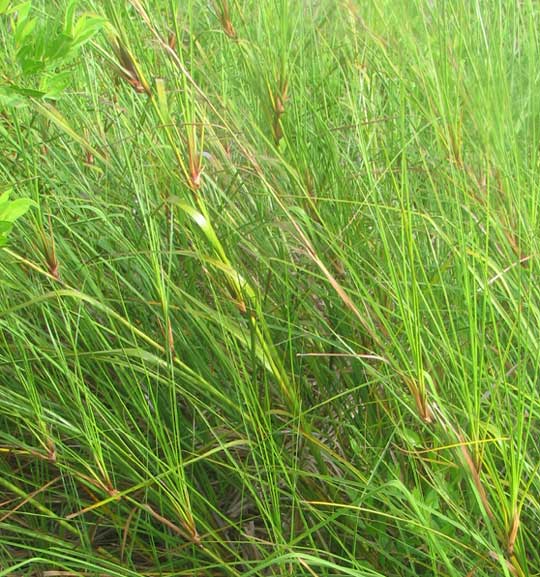
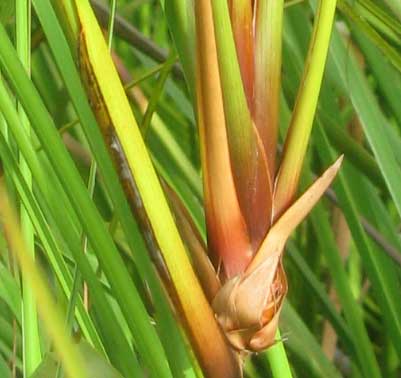
Besides its robust vigor, something catching my eye about this plant -- in the picture most easily seen in the bottom, left corner -- was how its leaning stems sprouted leafy plantlets for future vegetative reproduction. A close-up of a plantlet's knobby base is shown below:
The plants were a little past their flowering peak, but old inflorescences were still present, as seen below:
Despite its outward appearance, this plant was not a grass -- not a member of the Grass Family, the Poaceae. Instead of its stems being round in cross-section, like those of grasses, they were triangular. Also, its flowers were not arranged in spikelets and florets the way grass flowers are. Our giant's tiny, messy-looking flowers are shown below:
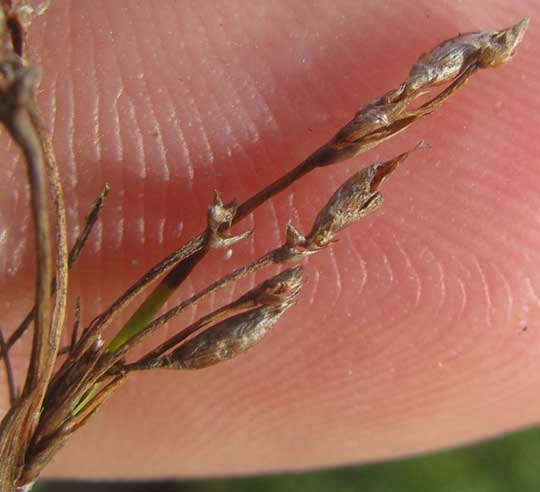
This is a member of the Sedge Family, the Cyperaceae. That's a big family of about 5,500 species in 109 or so genera, centered mostly in tropical Asia and South America. To give you an idea of how the Sedge Family compares with the Grass Family, in my Flora of McLean County, Kentucky, done for my Master's thesis I listed 55 grass species, but only 33 members of the Sedge Family -- of which 22 were sedges, or members of the genus Carex.
The plant we're dealing with here, however, isn't a Carex or any genus found back in Kentucky. It's CLADIUM JAMAICENSE, known as Sawgrass, even though it's not a grass. Sawgrass is famous as being the dominant flowering plant in the Florida Everglades. When you see hovercraft skimming across the Everglades' "River of Grass, that "grass" is the Sedge-Family member Cladium jamaicense. You can see the tiny, sharp blade teeth behind the name "sawgrass" below:
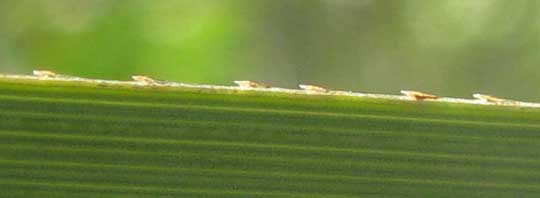
If a Sawgrass blade cuts at your hot, sweaty arm just right, a rather neat little bleeding cut results.
Sawgrass is such a robust, fast-growing plant that researchers are looking into its potential for producing ethanol fuel.
Many birds nest and feed in Sawgrass clumps, and various reptiles and amphibians find food and shelter there. The plant's seeds are abundant and nutritious. In the Everglades, Alligators use higher ground within Sawgrass stands for nesting sites.
Sawgrass is native from the Southern US through the West Indies, Mexico, and Central America into tropical South America. In this local area Sawgrass only spottily occurs, mostly at the bases of elevated roads crossing wetlands.
It's worth noting that not only have we seen that the dominant palm in our mangrove swamps is the Paurotis, Acoelorrhaphe wrightii, which is the characteristic palm of Florida's Everglades, but also our Sawgrass is the Everglades' most abundant flowering plant.