PLANTS | ANIMALS | ECOLOGY | FUNGI | GEOLOGY | GARDENING | TOOLS
MEXICAN PLANTS & ANIMALS HOME

Excerpts from Jim Conrad's
Naturalist Newsletter
from the August 21, 2011 Newsletter issued from Mayan Beach Garden Inn 20 kms north of Mahahual; Caribbean coastal beach and mangroves, ~N18.89°, ~W87.64°, Quintana Roo state, MÉXICO
BROADLEAF SARGASSO
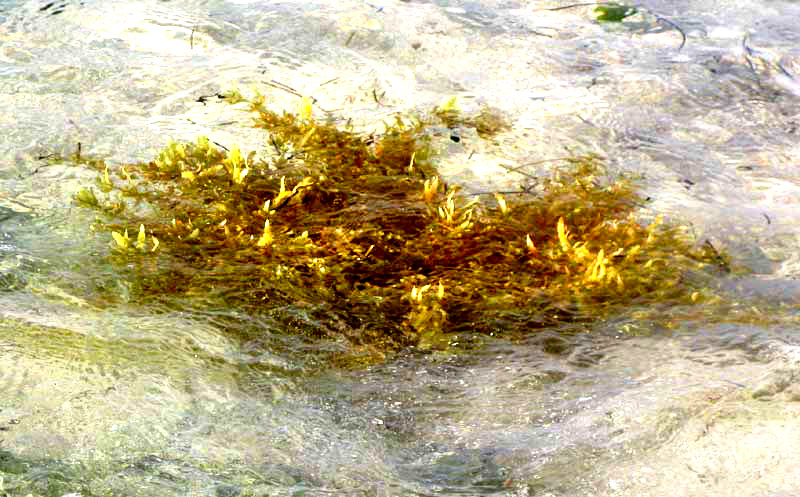
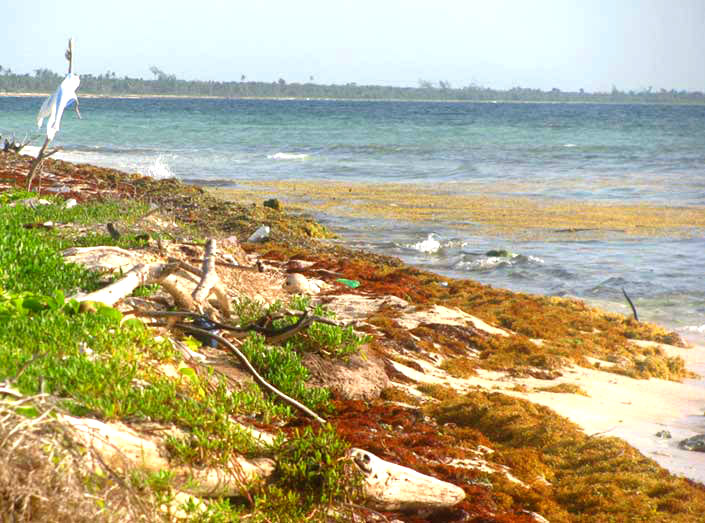
Each day seaweed of various kinds floats up on the beach, providing our garden crew an unending job of keeping the swimming beach clean. You can see what a typical, free-floating bunch looks like as it approaches the beach before stranding above. You can see it accumulating on an a beach below:
A close-up showing this seaweed's golden color, pea-sized air bladders, and leaves with toothed margins is below:
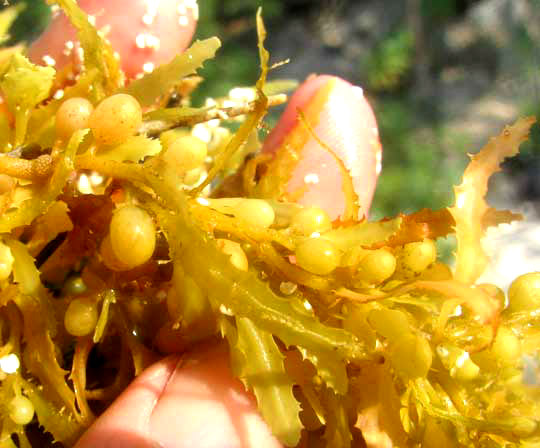
The color, the bladders and toothed leaves all distinguish this as the brown alga known as Sargasso, genus Sargassum. Numerous Sargasso species are distributed throughout the world's temperate and tropical oceans, but in this part of the world the two main freely floating ones are Sargassum natans and S. fluitans. I read that the bladders of S. natans each bear a needle-like spine, which is lacking on S. fluitans. Since our bladders bear no spines, what's floating onto our beaches is Sargassum fluitans, sometimes known as Broadleaf Sargasso.
Sargasso is famous because of the Sargasso Sea, a vast pool in the central North Atlantic choked with floating forests of Sargasso, which harbor incredibly diverse concentrations of living floating organisms.
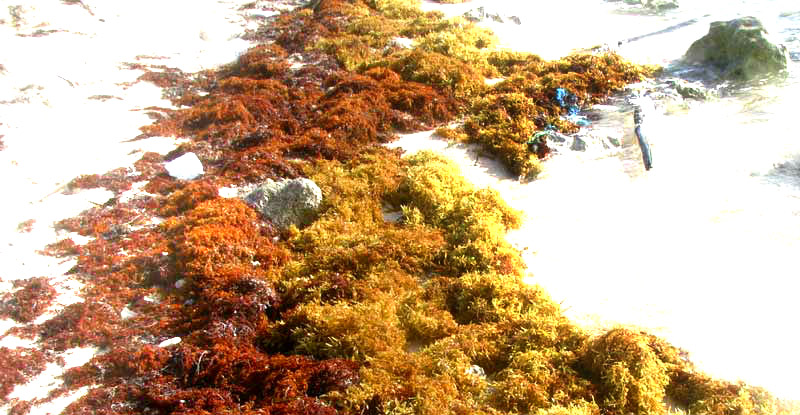
When you see the sheer quantity of Sargasso biomass that washes ashore, dries out, and eventually merges with the mineral beach, it's easy to believe that what accumulates must be important to beach ecology. You can see how fresh Sargasso next to the water first is golden, then darkens with age, and finally shrivels as it dries out, and vanishes into the sand below
On the Internet I find an occasional mention of Sargasso being used as mulch. We do that, too, mixing it with wet kitchen scraps once rain has washed off some of the salt. Wet kitchen scraps tend to clump and messily rot without the Sargasso's bulk mixed in. The Sargasso enables air to circulate better and, like a sponge, holds moisture needed for the decomposition process.
Also a study shows that goats fed Sargasso gained weight as fast as if the were eating a regular goat diet, so it seems to me that Sargasso is nutritive. Though I find no studies on the matter, I suspect that "Sargasso drifting ashore" is an example of nutrient and energy transfer from the open sea to the beach ecosystem. Solar energy captured in open water ends up fueling springtails on the beach, and sandpipers who eat the springtails.