PLANTS | ANIMALS | ECOLOGY | FUNGI | GEOLOGY | GARDENING | TOOLS
MEXICAN PLANTS & ANIMALS HOME

Excerpts from Jim Conrad's
Naturalist Newsletter
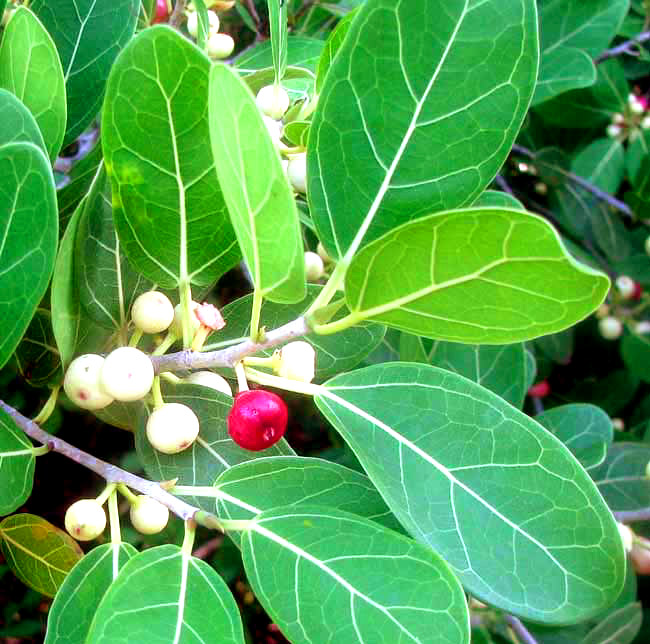
from the September 18, 2011 Newsletter issued from Mayan Beach Garden Inn 20 kms north of Mahahual; Caribbean coastal beach and mangroves, ~N18.89°, ~W87.64°, Quintana Roo state, MÉXICO
RED FIGS
One of several native fig species found here is heavy with pea-sized figs nowadays, as shown above. That tree was about 15 feet tall (4.5m) and was distinguished from other fig species in the area by its figs arising in pairs at leaf petiole bases (not singly) on longish stalks, or peduncles, and the figs were greenish-cream when immature, but dark red when ripe. The hairless leaves were three-veined from the base instead of having a single midrib. Fig taxonomy is a mess, maybe with certain species called one thing in Mexico and something else elsewhere, but provisionally I'll park our current species under the name of FICUS OVALIS NOTE: In 2016 more information is available on the Internet and I see that this is FICUS CRASSINERVIA, occurring from Mexico to Panama.
The ripe figs are tasty, though often containing little worms. Eating the figs is almost like eating cherries without pits. A split-open one is shown below:
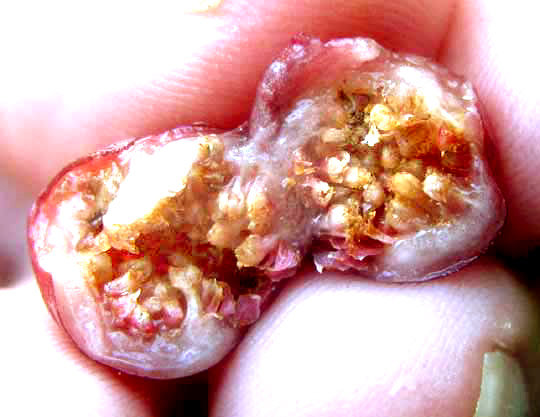
If you find a tree bearing figlike fruits but you're unsure whether they're really figs, break open the fruit. Figs have hollow centers and a soft, grainy texture. Also, check the stems. Fig trees, like other members of the Fig Family -- as well as sycamores and magnolias -- have "stipular rings," as shown below:
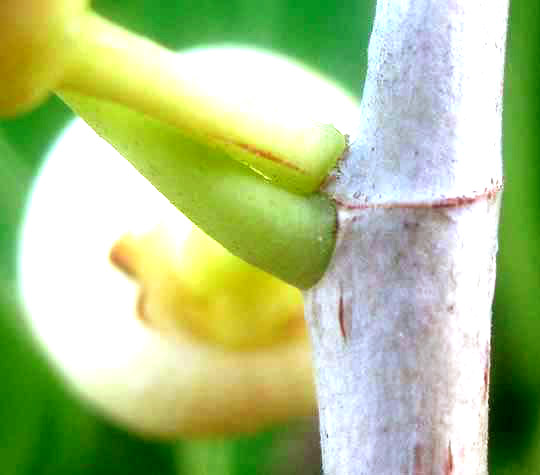
In that picture the ring is seen encircling the gray stem. It's a scar left from a stipule, which earlier encircled the stem. Stipules are modified leaves whose prime tasks are to protect young, delicate tissue by overlying them. Most stipules, once the delicate tissue they protect toughens up, fall away, leaving a scar. Most stipules are small and earlike, but fig tree stipules and their scars are unusually prominent.