PLANTS | ANIMALS | ECOLOGY | FUNGI | GEOLOGY | GARDENING | TOOLS
MEXICAN PLANTS & ANIMALS HOME

Excerpts from Jim Conrad's
Naturalist Newsletter
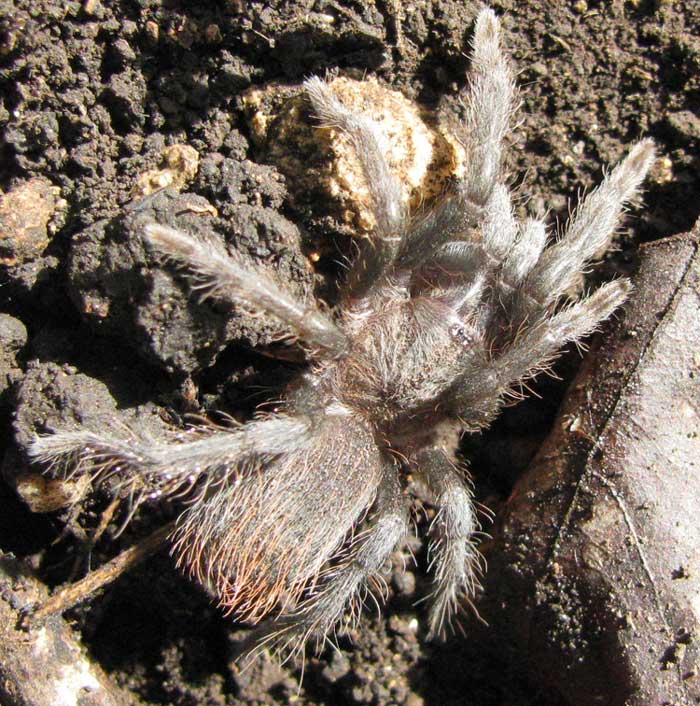
from the February 13, 2011 Newsletter issued from Hacienda Chichen Resort beside Chichén Itzá Ruins, central Yucatán, MÉXICO; limestone bedrock, elevation ~39m (~128ft), ~N20.676°, ~W88.569°
YUCATAN RED-RUMPED TARANTULA
Next to the hut, digging up a bed for flowers, beneath a large rock I found the tarantula shown above. Lots of tarantulas are encountered here and it's not a big deal since everyone knows they won't bother you. I simply relocated her to a nearby pile of rocks and continued digging the bed.
The best way I know to identify a tarantula is to upload a picture to the free-access Arachnoboards.Com site where they even have a special "thread" just for posting tarantula pictures needing to be identified. The forum is at http://www.arachnoboards.com/ab/.
Having done that, before long someone left a message suggesting that what's in the picture might be the endemic BRACHYPELMA EPICUREANUM*, native just to the Yucatán, and first introduced to science with a collection made right here at the ruins of Chichén Itzá. However, there's a very similar and closely related species, Brachypelma vagans, it also might be.
These names led to a map displaying the distributions of Mexico's ten Brachypelma tarantulas, accessible here.
That map indicates that here only B. epicureanum occurs. However, I don't trust the map completely. For one thing, it shows no tarantulas at all in Querétaro, but we've already found B. vagans there, profiled at www.backyardnature.net/q/redrump.htm.
Also, my growing impression is that at the Hacienda we have at least two tarantula species, with the "big, black one" being B. vagans, and there's a "smaller, paler one" which now I'm guessing is B. epicureanum. But, maybe I'm just seeing adult and juvenile forms of the same thing. I've been in contact with an expert and he doesn't know. He says that the information I'm gathering here is important new data for this part of the world.
And that's something I like to hear.
from the March 13, 2011 Newsletter issued from Hacienda Chichen Resort beside Chichén Itzá Ruins, central Yucatán, MÉXICO; limestone bedrock, elevation ~39m (~128ft), ~N20.676°, ~W88.569°
YUCATÁN RED-RUMPED TARANTULA UPDATE
This week Daniel of the garden crew brought me a tarantula he'd found beneath sod being removed from Hacienda Chichen's lawn. You may remember the small, pale tarantula we had last month, which an expert up North thought might be the endemic Brachypelma epicureanum. Daniel's tarantula this week was larger than the one before, and blacker. It's shown below:
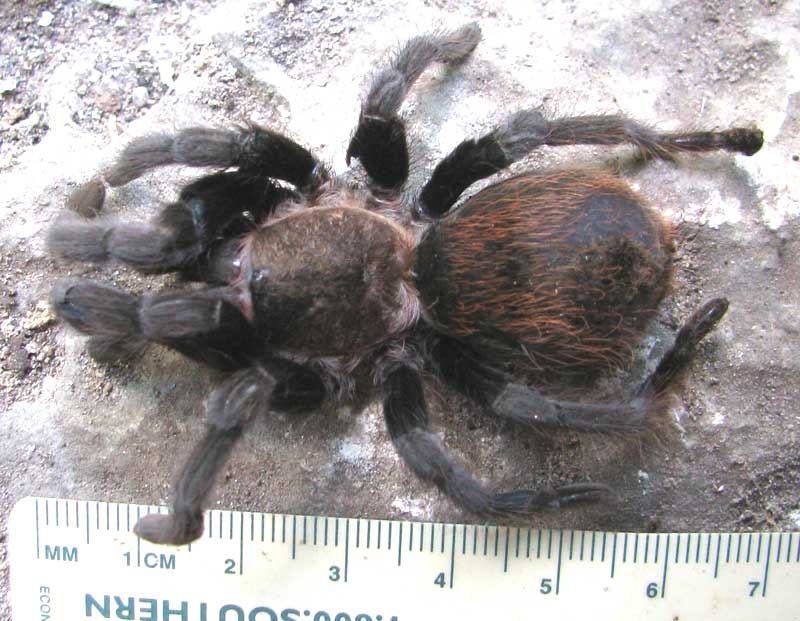
The ruler sizes it as about 7cm long, which is 2-¾ inches long. This is smaller than most similar-looking tarantulas in mainland Mexico, supporting the notion that it might be the endemic B. epicureanum.
Whatever it is, I'm tickled to be able to help the experts by posting my pictures and stories like this.
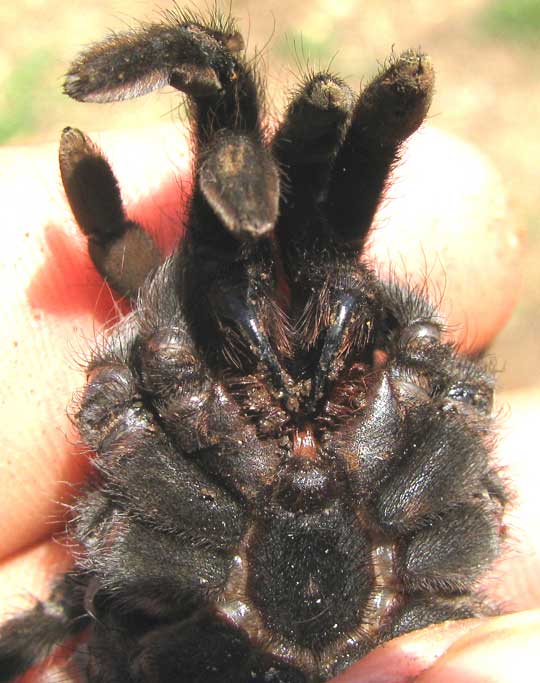
While I had this tarantula I flipped him over and shot his mouth area, where you can clearly see two black, shiny fangs in the center of the picture. That photo is below:
from the January 9, 2005 Newsletter issued from near Dzemul in northwestern Yucatán, MÉXICO
SPOT, THE TARANTULA
In dawn's dim light each morning I can barely make out a dark spot in or around my sink. The spot changes location from day to day so it's always interesting to see where Spot has moved during the night. When I return from jogging there's enough light go see that Spot is a black, very hairy tarantula.
Spot is a male and I don't expect him to stay around my sink for long. I know he's a male because he has very large, bulbous "pedipalps" -- leglike structures arising from his head area. There's a page on "sexing tarantulas" at http://www.tarantulas.com/sexing.html.
The reason I don't expect Spot to hang around long is that mature male tarantulas are absolutely obsessed with finding females, who generally spend their time secure in their burrows. In fact, males search for females with such fervor that they literally wear themselves out. Females may live 30 years or more, depending on the species, while males, even under the best of conditions, seldom last over a year and a half. In nature their lifespan may be measured in only weeks or days. Spot has been looking a little ragged lately so I expect his imminent demise.
Over 50 tarantula species are found in the southwestern and south-central US, and surely many more than that here in Mexico. I don't know what species Spot is, but I can tell you that he's smallish for a tarntula, foot-to-foot only about as wide as the top of a coffee cup, and very hairy. Because of those hairs I don't handle him. Usually people have more trouble with irritating tarantula hairs than with bites. The bites, which are hard to provoke, are not at all dangerous.
A National Geographic page about tarantulas, for kids, is at https://kids.nationalgeographic.com/animals/invertebrates/facts/tarantula.
from the February 13, 2005 Newsletter issued from near Dzemul in northwestern Yucatán, MÉXICO
ARMY ANTS & TARANTULA
Approaching Komchén's main living area on Monday morning I found a bit of commotion. A dark smudge of army ants was swarming across the shop's walkway into the bushes before the library. Ana María and Lino were on hand and I heard Ana María exclaim "Pobrecita" ("Poor little thing...") as she rushed to the ant-smudge front and scooped something into her bare hands.
She'd saved a mature tarantula somewhat larger than the top of a coffee cup. It was a black one with long, stiff, red-orange hairs mantling her abdomen. The creature had been chased from her nest by the ants and at that point 20-30 ants were still on her, tearing at her body. Ana María carried her to a quiet spot, put her down, and set about squirting water on the ants, trying to redirect them away from where guests were sleeping.
The tarantula remained where Ana María placed her for at least 20 minutes, moving not at all as the ants continued trying to dismantle her. However, the ants couldn't get past the creature's stiff, sharp hairs. The ants did manage to cut two small bunches of hairs from her, fashion them into rough balls, and begin moving the hair-balls through the grass.
However, now those ants had been separated from the main ant swarm and were receiving no chemical instructions from their peers, so they really had no idea where to go with their booty. Eventually they just wandered off individually, directionless. As the tarantula found herself more and more free of ants she began twitching her legs, clearly getting ready to move on. Sad for her, even if she could find her nest again, her babies had surely been cut to pieces and carried off by the ants.
So, that morning, both army ants and tarantula had had their lives drastically rearranged. Ana María had interviened on behalf of the tarantula, but I had just stood there watching, feeling equally allied to ants and tarantula.
One other thing -- as the army ants continued advancing through the herbage, some Hooded Warblers and Ovenbirds overwintering here from North America appearead to be having some fun. They fed on many small insects abandoning their hiding places as they tried to escape the ant hoards.