PLANTS | ANIMALS | ECOLOGY | FUNGI | GEOLOGY | GARDENING | TOOLS
MEXICAN PLANTS & ANIMALS HOME

Excerpts from Jim Conrad's
Naturalist Newsletter
from the February 8, 2019 Newsletter issued from Rancho Regensis north of Valladolid, Yucatán, MÉXICO;
elevation ~40m (~130 ft), N~20.876°, W~88.170°
TROPICAL MISTLETOE FIGURED OUT
Above we've looked at the commonly occurring, red-flowered mistletoe sometimes called Tropical Mistletoe. However, when those images were taken not much literature was available about the four genera and ten mistletoe species listed for the Yucatan Peninsula, and I could identify our plants only to genus level. During the last ten years CICY, the Centro de Investigación Científica de Yucatán in Mérida has published a lot about the Yucatan, much of it freely available online, so this week when a Tropical Mistletoe turned up flowering atop a Crepe-Myrtle tree beside the garden, I decided to see if new literature was available to help me identify our plants to species level.
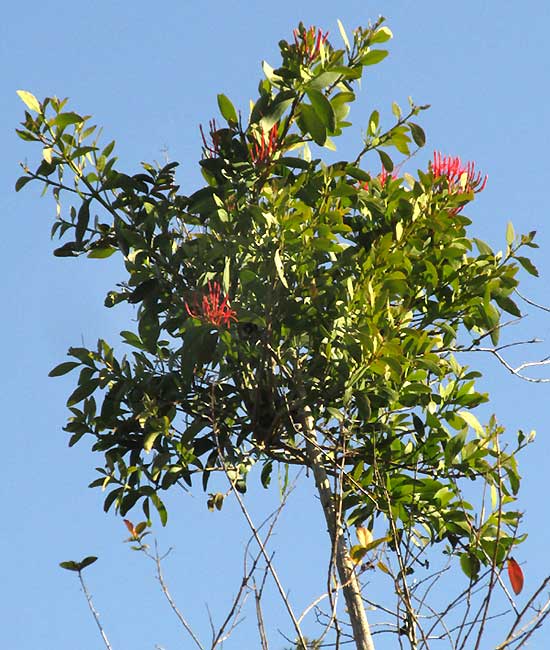
The mistletoe atop its dry-season-leafless Crepe-Myrtle is shown below:
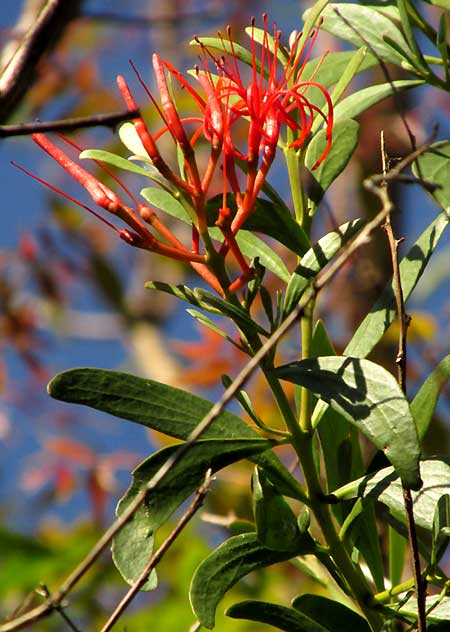
The mistletoe's handsome flowers at branch tips, and leaves with rounded tips, are shown below:
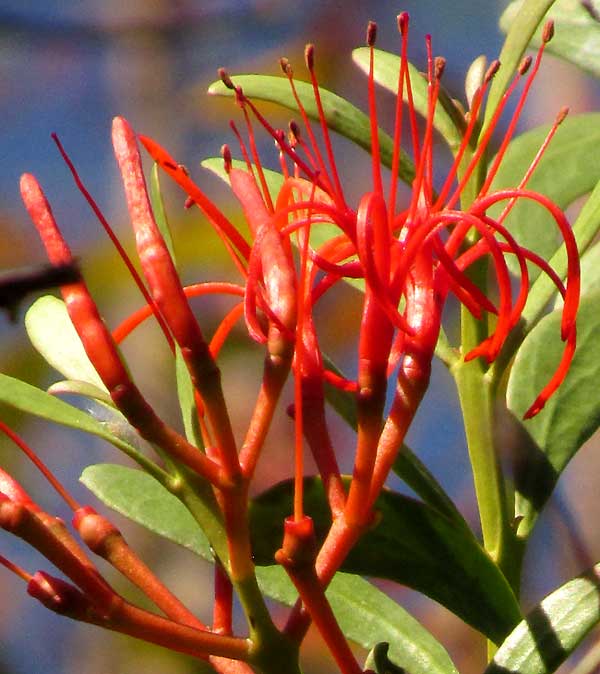
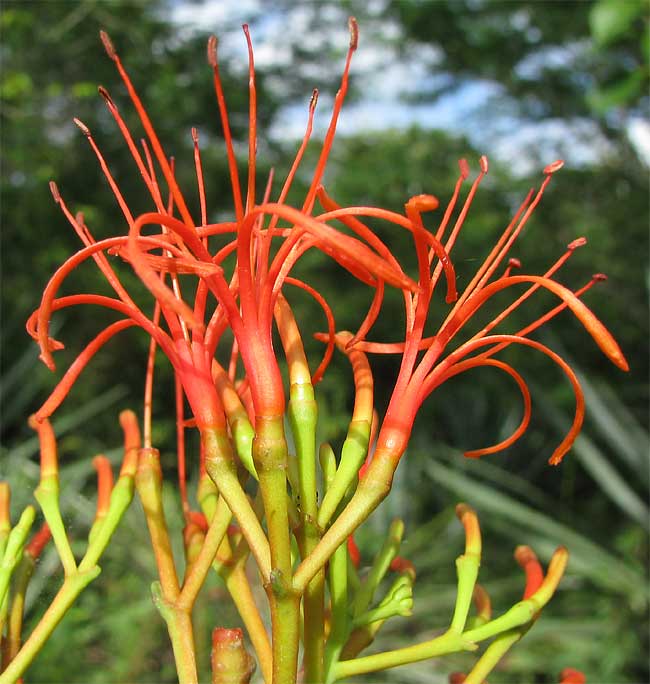
A close-up of the flowers with their greatly projecting stamens appears below:
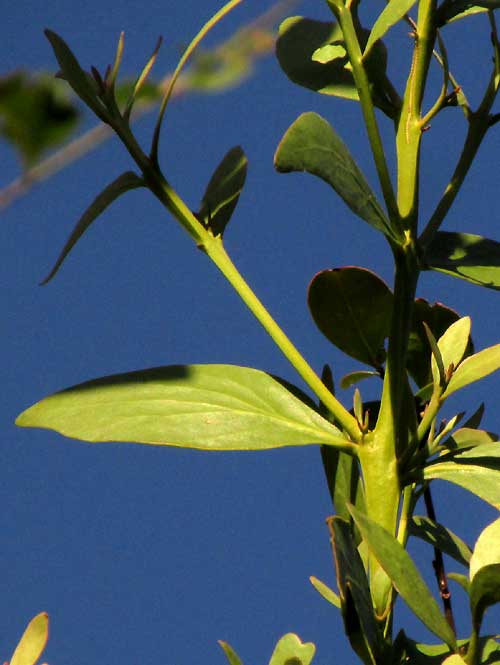
A close-up showing the stems enlarging below leaf-producing nodes, and bearing squared corners, is shown below:
And, lo and behold, last year CICY published a paper by Tun and Martínez-Ambriz entitled Psittacanthus mayanus y la familia Loranthaceae en Yucatán, which included an identification key for all the Yucatan's mistletoes. In less than a minute of using that key I knew our Tropical Mistletoe's species.
It's PSITTACANTHUS MAYANUS, endemic to just southern Mexico and parts of Belize and Guatemala. Based on that species name, I'll begin thinking of our plants as "Mayan Tropical Mistletoes."
Otherwise, little is known about the species, other than what is true of other mistletoes as well, which is that they are only partly parasitic on trees, being able to manufacture their own food because of the chlorophyll in their leaves. Normally they don't seriously damage a tree, but do provide great service to wildlife such as hummingbirds and flying squirrels.
from the October 30, 2006 Newsletter issued from Genesis Retreat in Ek Balam, Yucatán, MÉXICO
TROPICAL MISTLETOE FLOWERING
Below you can see some flowers of a Psittacanthus growing in the scrub, on a Bean Family tree, near Sabacché, about half an hour southeast of Mérida:
from the December 11, 2011 Newsletter issued from Hacienda Chichen Resort beside Chichén Itzá Ruins; limestone bedrock; elevation ~39m (~128ft), N20.675°, W88.569°; central Yucatán state, MÉXICO
TROPICAL MISTLETOE FRUITING
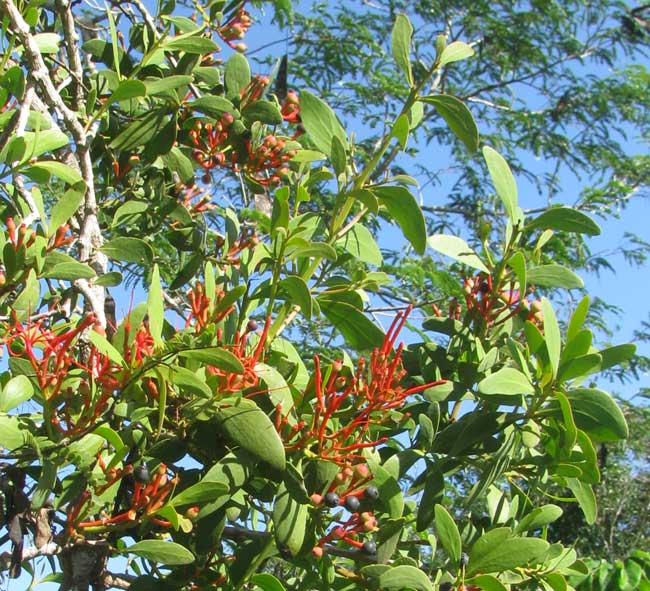
Below is some Tropical Mistletoe, genus PSITTACANTHUS, with its large, brightly red flowers, seen ten feet up:
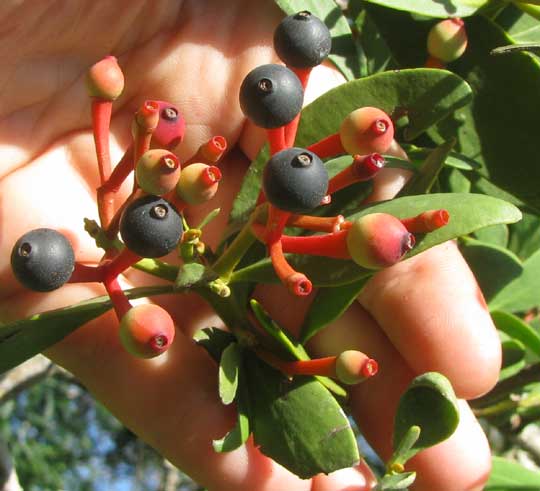
You can see that this mistletoe's fruits are much larger, and black instead of the North's white, below:
issued on January 20, 2020 from Tepakán Yucatán, MÉXICO
TROPICAL MISTLETOE SEED
Below is a fruit with its single seed squeezed out:
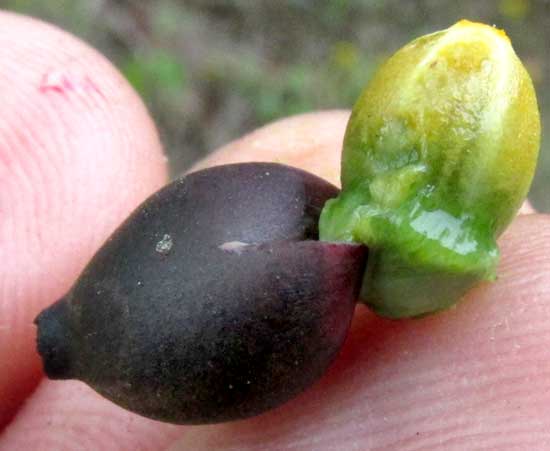
Several bird species have been seen feeding on the fruits, including Social Flycatchers and Great Kiskadees.